Verification of Nortons Theorem Manufacturer,Supplier and Exporter in India
Product Code : EL-VONT-1129
Jlab Export is a leading Verification of Nortons Theorem Manufacturer,and suppliers in India
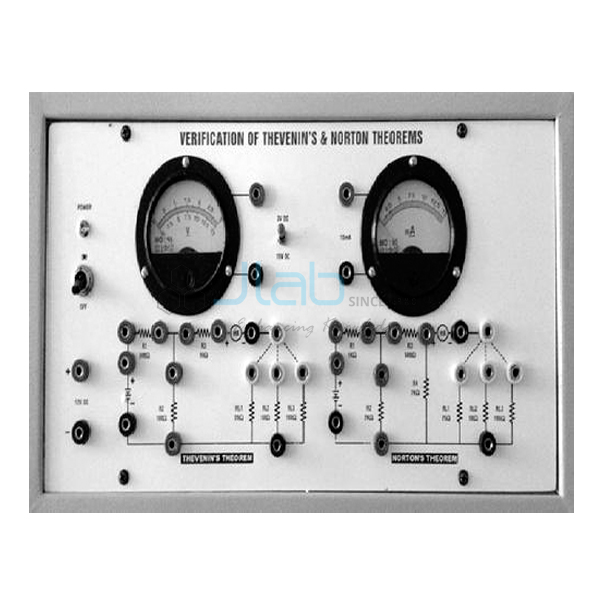
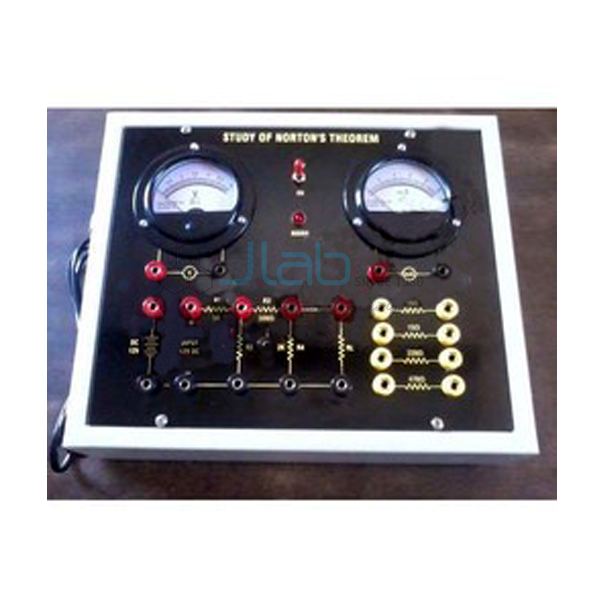
Verification of Nortons Theorem (code EL-VONT-1129) is a trainer for proving Norton’s theorem: that a linear network feeding a load can be replaced by one current source in parallel with one resistance. It has a fixed 12 V DC supply, two moving-coil meters, a circuit diagram printed on the front panel and 4 mm sockets for every connection. It is made by Jain Laboratory Instruments Pvt Ltd (JLab) at its works in Ambala, India.
Specifications
| Parameter | Detail |
|---|---|
| Experiment | Verification of Norton’s theorem |
| DC power supply | One fixed-output DC supply, 12 V at 250 mA |
| Meters | Two moving-coil meters (ranges not stated in the listing) |
| Circuit diagram | Printed on the front panel |
| Connections | Supply, meters and resistances brought out at 4 mm sockets |
| Quality check | Each trainer is visually inspected before dispatch |
| Pack quantity | Each (sold individually) |
| Minimum order quantity | 10 units |
| Dispatch time | Usually 7–10 working days |
| Product code | EL-VONT-1129 |
| Manufacturer | Jain Laboratory Instruments Pvt Ltd (JLab) — OEM |
| Country of origin | India (made in Ambala, Haryana) |
How Does It Compare with Other JLab Network Theorem Trainers?
| Trainer | Theorem | DC supply (as listed) | Meters and connections (as listed) |
|---|---|---|---|
| This trainer (EL-VONT-1129) | Norton’s | 12 V at 250 mA | Two moving-coil meters; 4 mm sockets |
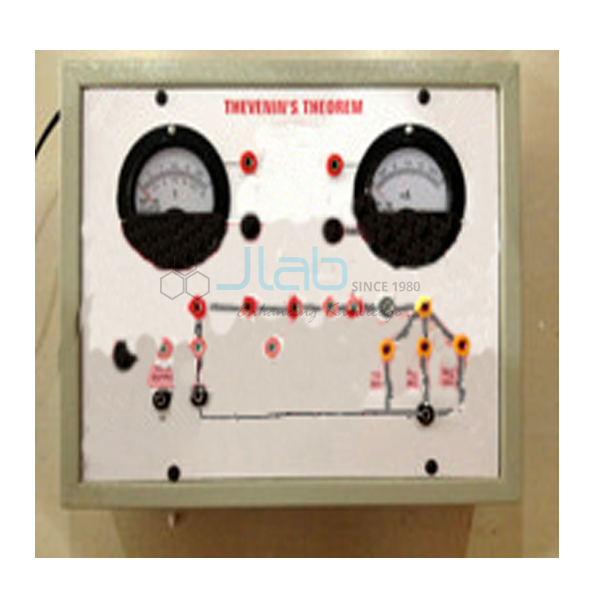
| Verification of Thevenins Theorem | Thevenin’s | 12 V at 250 mA | Two moving-coil meters; 4 mm sockets |
| Verification of Network Theorems | Superposition, Norton’s, Thevenin’s, maximum power transfer | Three fixed outputs, 12 V and 5 V at 100 mA | Four moving-coil meters; terminals |
| Verification of Maximum Power Transfer Theorem in DC Circuits | Maximum power transfer | 12 V at 300 mA | Two moving-coil meters; potentiometer; terminals |
The Norton’s and Thevenin’s trainers are listed with the same supply, meters and sockets, so they can be ordered as a pair to run the two equivalents side by side. Choose the four-theorem panel instead if one unit has to cover several experiments.
What Is the Norton’s Theorem Trainer Used For?
Norton’s theorem is part of network analysis in basic electrical engineering, polytechnic diploma and B.Sc. physics and electronics courses, and of ITI/TVET electrical practicals. On this trainer students first read the current in the load resistor with the 12 V supply on. They then remove the load and connect the ammeter straight across the load sockets to read the short-circuit (Norton) current, and find the Norton resistance — the resistance seen from the load sockets with the supply replaced by a short circuit — by measurement or from the resistor values. The load current predicted by the current-divider rule, Norton current × Norton resistance ÷ (Norton resistance + load resistance), should match the first reading.
Before shorting the load sockets through the ammeter, check that the expected current is within the meter’s range, and switch the supply off whenever the circuit is rewired.
What to Specify When Ordering
- Quantity — minimum 10 trainers; add the matching Thevenin’s trainer if you want both equivalents.
- Patch cords for the 4 mm sockets and a multimeter, if they should come with the order.
- Mains voltage and plug type at the destination, which the listing does not state.
Frequently Asked Questions
What does Norton’s theorem state?
Any linear two-terminal network of sources and resistors can be replaced, as seen by a load, by a current source equal to the short-circuit current at those terminals in parallel with the resistance seen from them when the sources are replaced by their internal resistance.
What supply and meters does this trainer have?
One fixed-output DC supply of 12 V at 250 mA and two moving-coil meters, with the supply, meters and resistances brought out at 4 mm sockets. Meter ranges and resistor values are not given in the listing; ask JLab for them.
How are Norton’s and Thevenin’s theorems related?
They describe the same network two ways. The Norton resistance equals the Thevenin resistance, and the Norton current equals the Thevenin voltage divided by that resistance, so either equivalent can be converted into the other.
How many trainers do I have to order, and how soon are they dispatched?
At least 10 units, sold individually. They are visually inspected and usually dispatched within 7–10 working days; for exports, add transit time to your country.
What details help JLab quote for an export order?
Quantity, destination country and port or city, delivery terms such as FOB or CIF, mains voltage, any packing or labelling instructions and the tender reference, if there is one.
Who makes the Norton’s theorem trainer?
It is made by Jain Laboratory Instruments Pvt Ltd (JLab) at its works in Ambala, Haryana, India, which quotes for it directly.
OEM Manufacturer
JLab is the trading name of Jain Laboratory Instruments Pvt Ltd, an Indian manufacturer of electrical and electronics training equipment for colleges and technical institutes, incorporated in 2017 with its base on Hargolal Road, Ambala, Haryana. Its network theorem trainers are made at JLab’s own works rather than sourced from traders, so institutions, dealers and importers deal with the manufacturer directly, each trainer is visually inspected before dispatch, and repeat orders and spare parts come from the same source. JLab exports worldwide and ships to every region; examples include Benin in West Africa, Cambodia in Southeast Asia, Ethiopia in East Africa, Papua New Guinea in Oceania and Ukraine in Eastern Europe. For tender-based purchases, see the JLab lab tenders page.
Related Trainers and Instruments
- Verification of Nortons and Thevenins Theorems — one listing for both equivalents.
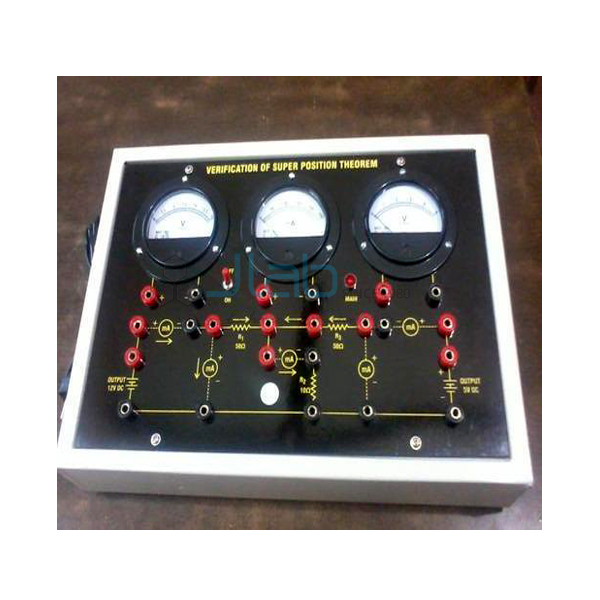
- Verification of Superposition Theorem — two regulated supplies and three meters for the superposition experiment.
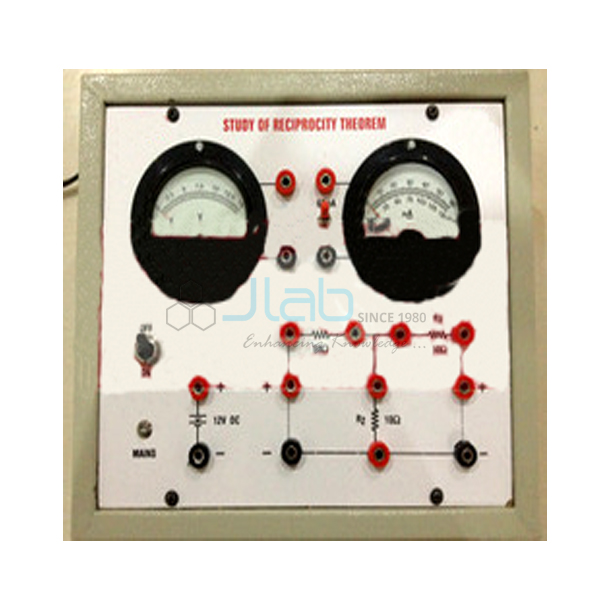
- Verification of Reciprocity Theorem — another single-theorem trainer with two moving-coil meters.
- Digital Multimeter — measures resistance and DC voltage and current, useful for checking the Norton resistance and resistor values.
More in the Verification of Network Theorem range and the Scientific Instrument range.
Request a Quote
Quotes come direct from the manufacturer. Press Add To Cart on this page or write through the contact page with the quantity (minimum 10 units), whether you also need the Thevenin’s trainer, patch cords or a multimeter, your mains voltage and the delivery destination.
Last updated: 9 October 2026