Verification of Thevenins Theorem Manufacturer,Supplier and Exporter in India
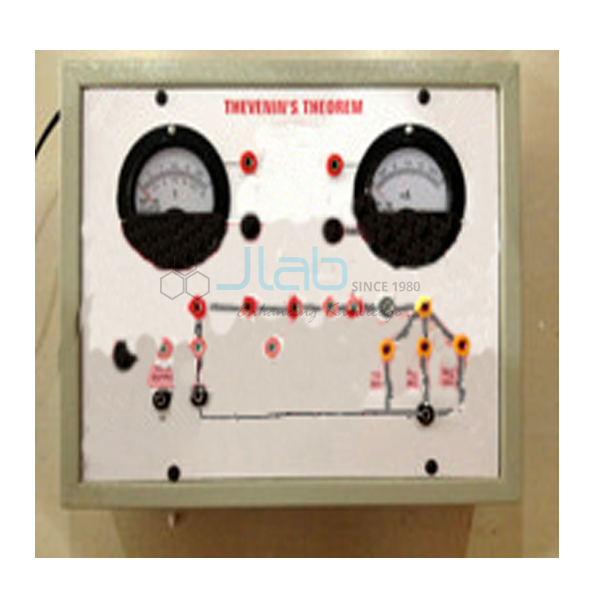
Product Code : EL-VONT-1130
Jlab Export is a leading Verification of Thevenins Theorem Manufacturer,and suppliers in India
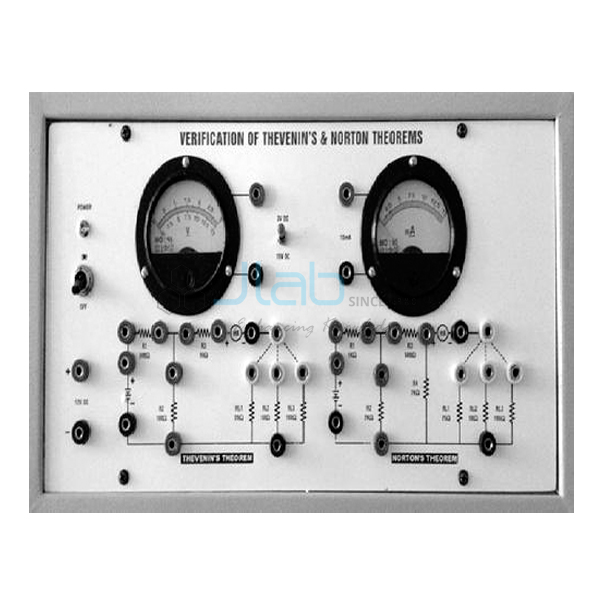
Verification of Thevenins Theorem (code EL-VONT-1130) is a trainer for reducing a resistor network to one voltage source in series with one resistance and confirming that the load current is unchanged. It has a fixed 12 V DC supply and two moving-coil meters, with connections at 4 mm sockets on a printed front-panel diagram. It is made by Jain Laboratory Instruments Pvt Ltd (JLab) at its works in Ambala, India.
Specifications
| Parameter | Detail |
|---|---|
| Experiment | Verification of Thevenin’s theorem |
| DC power supply | One fixed-output DC supply, 12 V at 250 mA |
| Meters | Two moving-coil meters (ranges not listed) |
| Circuit diagram | Printed on the front panel |
| Connections | Supply, meters and resistances brought out at 4 mm sockets |
| Details to confirm | Resistor values, patch cords and mains input are not given in the listing |
| Quality check | Each trainer is visually inspected before dispatch |
| Pack quantity | Each (sold individually) |
| Minimum order quantity | 10 units |
| Dispatch time | Usually 7–10 working days |
| Product code | EL-VONT-1130 |
| Manufacturer | Jain Laboratory Instruments Pvt Ltd (JLab) — OEM |
| Country of origin | India (made in Ambala, Haryana) |
How Does It Compare with Other JLab Network Theorem Trainers?
| Trainer | What it verifies | Listed supply | Listed meters |
|---|---|---|---|
| This trainer (EL-VONT-1130) | Thevenin’s theorem | One fixed output, 12 V at 250 mA | Two moving-coil meters, 4 mm sockets |
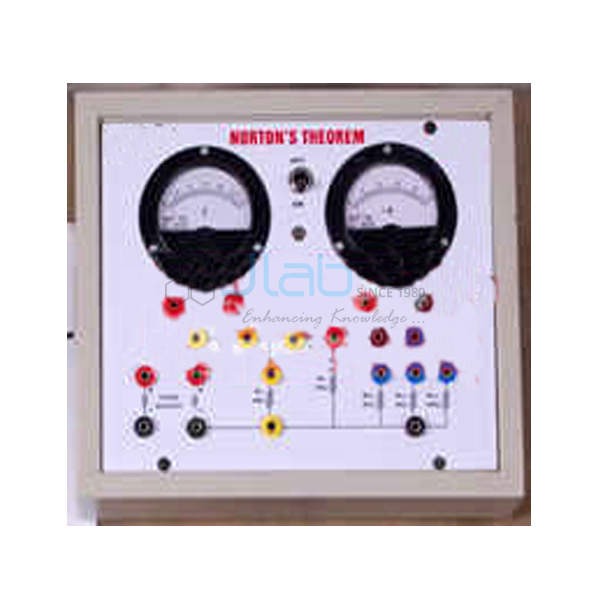
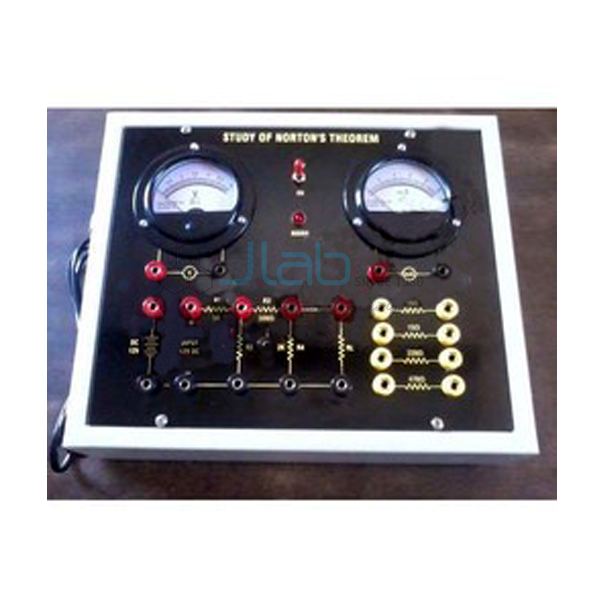
| Verification of Nortons Theorem | Norton’s theorem | One fixed output, 12 V at 250 mA | Two moving-coil meters, 4 mm sockets |
| Verification of Superposition Theorem | Superposition theorem | Two fixed regulated outputs, 12 V and 5 V at 500 mA | Three moving-coil meters |
| Network Theorems (Electronics Lab range) | Superposition, Thevenin’s, Norton’s, maximum power transfer | Fixed regulated 12 V and 5 V DC | Dual-range moving-coil voltmeter and ammeter |
This trainer and the Norton’s trainer share the same listed hardware and differ in the theorem printed on the panel. Take this one where Thevenin’s theorem is taught first, or both to show that the two equivalents give the same load current.
What Is the Thevenin’s Theorem Trainer Used For?
Thevenin’s theorem is a core part of network analysis in basic electrical engineering, polytechnic diploma and B.Sc. physics and electronics courses and in ITI/TVET electrical practicals. It is especially useful when one resistor in a circuit is the load that keeps changing: once the rest of the network is reduced to its Thevenin equivalent, the current for each new load is a one-line calculation instead of a full re-analysis.
A typical run on this trainer: measure the load current with the 12 V supply on; remove the load and read the open-circuit voltage across the load sockets (the Thevenin voltage); replace the supply with a short circuit and find the resistance seen from the load sockets (the Thevenin resistance), with a multimeter or from the resistor values; then calculate Thevenin voltage ÷ (Thevenin resistance + load resistance) and compare it with the measured current. Switch off before every change of connections.
What to Specify When Ordering
- How many trainers — the minimum order is 10.
- Whether to add the matching Norton’s trainer or other network theorem trainers.
- Patch cords for the 4 mm sockets, a multimeter, and the mains voltage at site.
Frequently Asked Questions
What does Thevenin’s theorem state?
A linear two-terminal network of sources and resistors behaves, as far as a load is concerned, like a single voltage source equal to the open-circuit voltage at those terminals in series with the resistance seen from them when every source is replaced by its internal resistance.
How is the Thevenin voltage measured?
Remove the load and read the voltage across the open load sockets. A moving-coil voltmeter draws a little current itself, so a higher-resistance voltmeter gives a reading closer to the true open-circuit value.
Which supply and meters are built in?
One fixed-output DC supply of 12 V at 250 mA and two moving-coil meters, wired to 4 mm sockets with the resistances. The listing does not give meter ranges or resistor values; JLab can confirm them with the quote.
How is this different from the Norton’s theorem trainer?
The listed hardware is the same; the difference is the theorem verified. Thevenin’s equivalent uses a voltage source in series with a resistance, Norton’s a current source in parallel with the same resistance.
Who manufactures this trainer?
Jain Laboratory Instruments Pvt Ltd (JLab) makes it at its works in Ambala, Haryana, India, and quotes for it as the manufacturer.
OEM Manufacturer
JLab is the trading name of Jain Laboratory Instruments Pvt Ltd, an electrical and electronics lab trainer manufacturer in India that was incorporated in 2017 and operates from Hargolal Road, Ambala, Haryana. The Thevenin’s theorem trainer is produced at JLab’s own works instead of being bought in, which lets engineering colleges, polytechnics, ITIs, dealers and importers order factory-direct; each piece is visually inspected before dispatch, and repeat orders and spares are handled by the manufacturer. JLab exports worldwide, shipping to buyers in every region — for example Ireland in Western Europe, Vietnam in Southeast Asia, Georgia in Eastern Europe, Libya in North Africa and Peru in South America. Tender details are on the JLab lab tenders page.
Related Items
- Verification of Nortons and Thevenins Theorems — covers Thevenin’s and Norton’s theorems together.
- Verification of Maximum Power Transfer Theorem in DC Circuits — the load-matching experiment that builds on the Thevenin resistance.
- Verification of Network Theorems — four theorems, including Thevenin’s, on one panel.
- Digital Multimeter — for measuring the Thevenin resistance and checking resistor values.
See the full Verification of Network Theorem range or the Scientific Instrument range.
Request a Quote
Quotes come direct from the manufacturer. Use Add To Cart on this page, or send the quantity (minimum 10 units), any companion trainers, patch cords or meters, the mains voltage, the destination and, for exports, your preferred delivery terms and tender reference through the contact page.
Last updated: 9 October 2026