Verification of Maximum Power Transfer Theorem in DC Circuits Manufacturer,Supplier and Exporter in India
Product Code : EL-VONT-1133
Jlab Export is a leading Verification of Maximum Power Transfer Theorem in DC Circuits Manufacturer,and suppliers in India
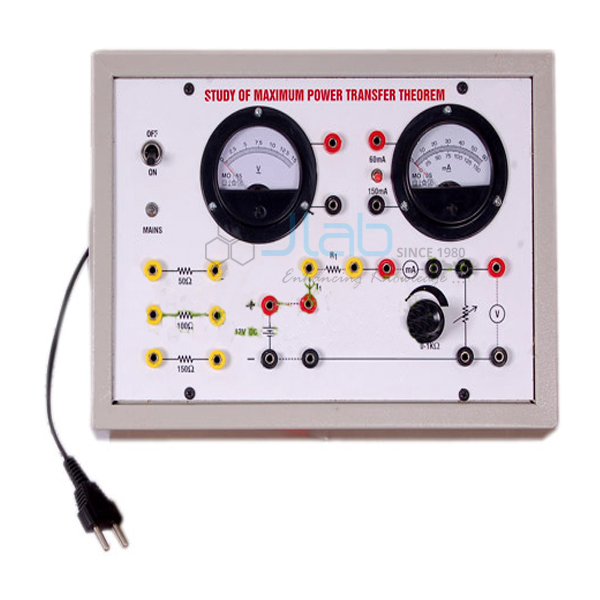
Verification of Maximum Power Transfer Theorem in DC Circuits (code EL-VONT-1133) is a trainer for finding the load resistance at which a DC source network delivers the most power. It combines a fixed 12 V DC supply at 300 mA, two moving-coil meters, a potentiometer and resistances, all brought out on terminals beside a printed circuit diagram. It is made by Jain Laboratory Instruments Pvt Ltd (JLab) at its works in Ambala, India.
Get a quote: use the Add To Cart enquiry button below, or send your quantity and destination through the contact page.
Specifications
| Parameter | Detail |
|---|---|
| Experiment | Verification of the maximum power transfer theorem in DC circuits |
| DC power supply | One fixed-output DC supply, 12 V at 300 mA |
| Meters | Two moving-coil meters (ranges not stated in the listing) |
| Components on terminals | Supply, meters, potentiometer and resistances |
| Circuit diagram | Printed on the front panel |
| Not stated in the listing | Potentiometer and resistor values, connecting leads, mains input — ask JLab |
| Quality check | Each trainer is visually inspected before dispatch |
| Pack quantity | Each (sold individually) |
| Minimum order quantity | 10 units |
| Dispatch time | Usually 7–10 working days |
| Product code | EL-VONT-1133 |
| Manufacturer | Jain Laboratory Instruments Pvt Ltd (JLab) — OEM |
| Country of origin | India (made in Ambala, Haryana) |
How Does It Compare with Other JLab Network Theorem Trainers?
| Trainer | Theorems | Listed supply | Listed meters and parts |
|---|---|---|---|
| This trainer (EL-VONT-1133) | Maximum power transfer (DC) | 12 V at 300 mA | Two moving-coil meters; potentiometer |
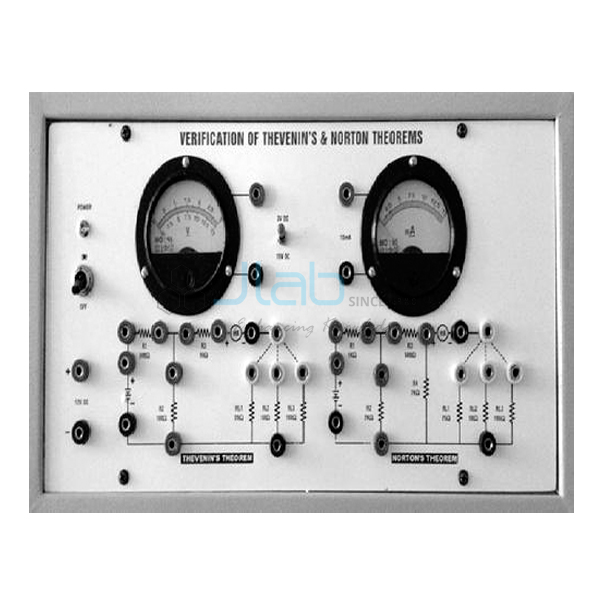
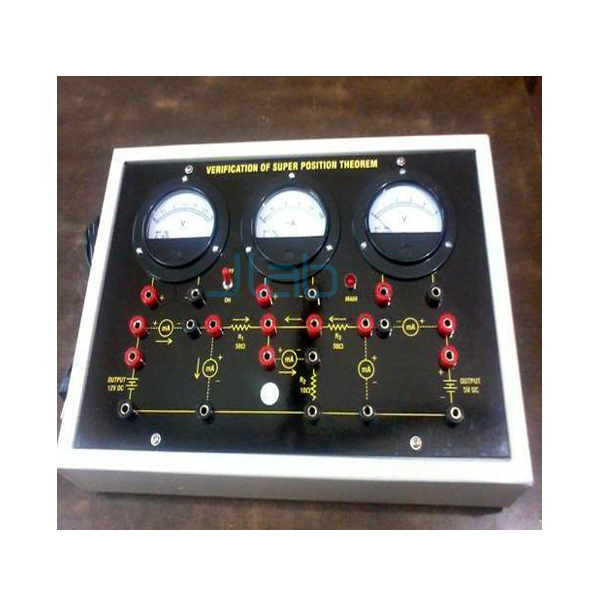
| Verification of Network Theorems | Maximum power transfer plus superposition, Norton’s and Thevenin’s | Three outputs, 12 V and 5 V at 100 mA | Four moving-coil meters; potentiometers |
| Network Theorems (Electronics Lab range) | Maximum power transfer plus superposition, Thevenin’s and Norton’s | Fixed regulated 12 V and 5 V DC | Dual-range moving-coil voltmeter and ammeter |
| Verification of Reciprocity Theorem | Reciprocity | 12 V at 300 mA | Two moving-coil meters |
Choose this dedicated trainer when maximum power transfer runs as its own practical with a full set of load readings; the four-theorem units cover it alongside other theorems on one panel.
What Is the Maximum Power Transfer Trainer Used For?
The maximum power transfer theorem states that a DC source network delivers the greatest power to a load when the load resistance equals the Thevenin (internal) resistance of the network as seen from the load terminals. It is part of network analysis in basic electrical engineering, polytechnic diploma and B.Sc. physics and electronics courses and in ITI/TVET electrical labs. Students vary the load, typically with the potentiometer, read the load voltage and current on the two meters for a series of settings, calculate the power as voltage × current and the load resistance as voltage ÷ current, and plot power against load resistance. The curve rises to a peak and then falls, and the peak should sit at the network’s Thevenin resistance.
The same readings show why matching is used in signal circuits, such as loudspeakers and receiving aerials, but avoided in power distribution: at the peak the load voltage is half the open-circuit voltage and only half the power drawn from the source reaches the load. Approach the lowest load resistance slowly, since that is where the current is highest, and switch off before rewiring.
What to Specify When Ordering
- Number of trainers, with 10 as the minimum order.
- Whether you need this single-theorem trainer, a four-theorem panel, or both.
- Connecting leads and the mains voltage at site, since the listing gives neither.
Frequently Asked Questions
At what load is maximum power transferred?
When the load resistance equals the Thevenin resistance of the source network seen from the load terminals. Plotting power against load resistance from the trainer’s readings shows the peak at that value.
Is maximum power transfer the same as maximum efficiency?
No. At the matched point only half of the power taken from the source reaches the load; efficiency keeps rising as the load resistance increases beyond that point, while the load power falls.
What supply and meters does the trainer have?
One fixed-output DC supply of 12 V at 300 mA and two moving-coil meters, with a potentiometer and resistances brought out on terminals. The meter ranges and the potentiometer value are not listed, so ask JLab for them.
Does it cover AC circuits?
It is listed for DC circuits. In AC circuits the condition becomes a load impedance equal to the complex conjugate of the source impedance, which needs AC sources and reactive components not described in this listing.
What are the minimum order and dispatch time?
At least 10 units, supplied individually. Dispatch is usually within 7–10 working days after a visual inspection of every trainer; export transit time depends on the destination.
Who manufactures this trainer?
JLab, the trading name of Jain Laboratory Instruments Pvt Ltd, makes it at its works in Ambala, Haryana, India.
OEM Manufacturer
JLab is the trading name of Jain Laboratory Instruments Pvt Ltd, a manufacturer of lab trainers and scientific instruments in India, incorporated in 2017 and based on Hargolal Road, Ambala, Haryana. This trainer is made at JLab’s own works rather than traded, so engineering colleges, polytechnics, ITIs, dealers and importers buy factory-direct, each unit is visually inspected before dispatch, and repeat orders and spares are handled by the maker. JLab exports worldwide and ships to buyers in every region — for example Kuwait in the Middle East, Fiji in Oceania, Singapore in Southeast Asia, Lesotho in Southern Africa and Canada in North America. For tenders, see the JLab lab tenders page.
Related Network Theorem Trainers
- Verification of Thevenins Theorem — finds the Thevenin resistance that sets the matched load.
- Verification of Nortons and Thevenins Theorems — both equivalent-circuit theorems in one listing.
- Verification of Superposition Theorem — two regulated supplies and three meters for the superposition experiment.
- Ohms Law Series and Parallel Circuits — Ohm’s law and series and parallel circuits, the basis of these calculations.
See all models in the Verification of Network Theorem range or the wider Scientific Instrument range.
Request a Quote
Quotes come direct from the manufacturer. Use the Add To Cart enquiry button on this page, or send the quantity (minimum 10 units), any other theorem trainers or leads, the mains voltage, the destination and, for exports, delivery terms such as FOB or CIF and any tender reference, through the contact page.
Last updated: 9 October 2026