

Verification of Network Theorems Manufacturer, Suppliers and Exporter in India
Jlabexport is a leading Verification of Network Theorems Manufacturer,and suppliers in India, United States, Indonesia, Brazil, Bangladesh, Mexico, Japan, Egypt, Philippines, Democratic Republic of the Congo, Vietnam, Iran, Turkey, Tanzania, United Kingdom, France, South Africa, Italy, Kenya, Colombia, Sudan, Uganda, South Korea, Argentina, Afghanistan, Yemen, Angola, Morocco, Poland, Uzbekistan, Mozambique, Malaysia, Ghana, Saudi Arabia, Peru, Madagascar, Côte d’Ivoire, Cameroon, Niger, Venezuela, Australia, Syria, Mali, Burkina Faso, Sri Lanka, Malawi, Zambia, Chad, Kazakhstan, Somalia, Chile, Senegal, Ecuador, Cambodia, Zimbabwe, Guinea, Benin, Rwanda, Burundi, Bolivia, South Sudan, Tunisia, Haiti, Belgium, Dominican Republic, Jordan, United Arab Emirates, Honduras, Tajikistan, Papua New Guinea, Portugal, Togo, Sierra Leone, Belarus, Laos, Turkmenistan, Libya, Kyrgyzstan, Nicaragua, Paraguay, Bulgaria, Serbia, Republic of the Congo, Lebanon, Liberia, Central African Republic, Palestine, Oman, Mauritania, New Zealand, Costa Rica, Kuwait, Panama, Croatia, Georgia, Eritrea, Mongolia, Uruguay, Qatar, Namibia, Bosnia and Herzegovina, Moldova, Armenia, Gambia, Jamaica, Lithuania, Albania, Gabon, Botswana, Lesotho, Guinea-Bissau, Slovenia, Equatorial Guinea, Latvia, North Macedonia, Bahrain, Trinidad and Tobago, Timor-Leste, Cyprus, Estonia, Eswatini, Mauritius, Djibouti, Fiji, Comoros, Solomon Islands, Guyana, Bhutan, Luxembourg, Suriname, Montenegro, Malta, Maldives, Cabo Verde, Brunei, Belize, Bahamas, Iceland, Vanuatu, Barbados, São Tomé and Príncipe, Samoa, Saint Lucia, Kiribati, Seychelles, Grenada, Saint Vincent and the Grenadines, Antigua and Barbuda.
Last updated: 13 November 2026
What Are Network Theorem Verification Trainers?
Network theorem verification trainers are panels on which students check circuit theorems against meter readings instead of only on paper. Most panels have the circuit diagram printed on the front, with built-in DC supplies, moving-coil meters and resistances brought out for wiring. The 7 trainers in this range cover the superposition, Thevenin, Norton, reciprocity and maximum power transfer theorems, on single-theorem panels or combined units. Basic electrical engineering, diploma, B.Sc. and ITI labs use them. JLab (Jain Laboratory Instruments Pvt Ltd), Ambala, India, makes all of them.
Request a quotation | Compare the trainers | See the practicals covered
Which Trainers Are in the Verification of Network Theorems Range?
| Group | Items | What it covers |
|---|---|---|
| Multi-Theorem Trainers | 2 | One panel for superposition, Norton, Thevenin and maximum power transfer with three fixed DC supplies and four meters, and one trainer for both Thevenin and Norton. |
| Single-Theorem Trainers | 5 | Separate panels for superposition, Norton, Thevenin, reciprocity and maximum power transfer in DC circuits, each with its own fixed DC supply (12 V, plus 5 V on the superposition panel) and two or three meters. |
Compare Network Theorem Trainers by Supply and Meters
Each table sets the trainers of one group side by side, as described on each product page. Every listed meter is a moving-coil type.
Multi-Theorem Trainers (2)
| Trainer | Theorems | DC supplies | Meters | Connections |
|---|---|---|---|---|
| Verification of Network Theorems | Superposition, Norton, Thevenin and maximum power transfer | Three fixed-output | Four | Terminals, with resistances and potentiometers |
| Verification of Nortons and Thevenins Theorems | Thevenin and Norton | Not listed | Not listed | Not listed |
Single-Theorem Trainers (5)
| Trainer | Theorem | DC supplies | Meters | Connections |
|---|---|---|---|---|
| Verification of Superposition Theorem | Superposition | Two regulated, 12 V and 5 V, 500 mA | Three | Terminals |
| Verification of Nortons Theorem | Norton | One fixed, 12 V, 250 mA | Two | 4 mm sockets |
| Verification of Thevenins Theorem | Thevenin | One fixed, 12 V, 250 mA | Two | 4 mm sockets |
| Verification of Reciprocity Theorem | Reciprocity | One fixed, 12 V, 300 mA | Two | Terminals |
| Verification of Maximum Power Transfer Theorem in DC Circuits | Maximum power transfer in DC circuits | One fixed, 12 V, 300 mA | Two | Terminals, with a potentiometer |
How to Choose Network Theorem Trainers
- Start from the theorem list. Match each theorem in your syllabus to a trainer in the practicals table below. Reciprocity is only on its own trainer; it is not one of the four theorems on the combined panel.
- One combined panel or one panel per bench. The Verification of Network Theorems panel carries four theorems with three supplies and four meters. Single-theorem trainers suit a lab where each bench runs a different experiment in the same session.
- Two supplies for superposition. Superposition needs two independent sources, so its trainer has 12 V and 5 V regulated supplies and three meters. The other single-theorem trainers work from one 12 V supply.
- Thevenin and Norton as a pair. The Thevenin and Norton trainers share the same 12 V, 250 mA supply, two meters and 4 mm sockets. Ordered together, they show that both equivalents give the same load current.
- Socket type and leads. The single Norton and Thevenin trainers use 4 mm sockets; the superposition, reciprocity, maximum power transfer and four-theorem panels use terminals. Add patch cords or leads to the order to suit, together with a multimeter for checking resistor values.
Practicals Covered by the Verification of Network Theorems Range
Who Uses Network Theorem Trainers?
Basic electrical engineering and network analysis labs in engineering colleges and polytechnics use these trainers for the network theorem practicals. B.Sc. physics and electronics labs and ITI and TVET electrical workshops use them as well.
Ordering, Minimum Quantity and Dispatch
| Point | Detail |
|---|---|
| Minimum order quantity | 10 units of each trainer, as shown on its product page |
| Pack quantity | Each trainer is sold individually |
| Dispatch time | Usually 7–10 working days |
| How to enquire | Use Add To Cart on a product page, or send the trainer names and quantities through the contact page |
| Tenders and OEM supply | Send the schedule through the tender enquiry page |
| Manufacturer | JLab (Jain Laboratory Instruments Pvt Ltd), Ambala, India |
Related Ranges in Scientific Instrument
Verification of Network Theorems is one of 22 subcategories of the Scientific Instrument range. These neighbouring ranges hold the groundwork experiments and the meters and resistances used with the trainers.
| Range | How it relates |
|---|---|
| Verification of Various Laws and Conservation of Signal | Ohm's law, series and parallel resistance, RC transient and LCR impedance apparatus, the groundwork before network theorems. |
| Decade Box | Decade resistance, inductance and capacitance boxes, resistance boxes and slide wire rheostats for variable loads. |
| Switchboard Panel, Ammeters, Voltmeters, Rectifier Type | Ammeters, voltmeters, DC ammeters and voltmeters and galvanometers for extra measuring points. |
| Electrical Measuring Instruments | Portable meters, ohm meters and galvanometers, including low ohms meters for checking resistances. |
| Power Supplies and Transformers | Regulated and dual DC power supplies for circuits built away from the trainers. |
| Amplifier Kits | Transistor amplifier trainers where Thevenin equivalents explain input and output impedance. |
Frequently Asked Questions
Why do measured values differ a little from calculated ones?
Resistors have a tolerance, and a meter adds its own resistance to the circuit. Reading errors on a moving-coil scale add a little more. Measure the actual resistor values with a multimeter, with the supply off, and use them in the calculation. The two results then agree closely.
How should the meters be connected?
The ammeter goes in series with the branch, and the voltmeter goes across the two points being measured. Watch the polarity on moving-coil meters. Check every connection before switching the supply on, and never connect an ammeter straight across a supply.
How is the Thevenin resistance found on the trainer?
Remove the load and replace the source by a short, then measure the resistance across the load terminals. Another way is to divide the open-circuit voltage by the short-circuit current. The second method also gives the Norton current, read with the ammeter across the load terminals.
Can superposition be used to add up power?
No. Superposition holds for currents and voltages in a linear circuit, but power depends on the square of the current. Find the total branch current by adding the currents from each source, then work out the power from that total.
Is maximum power transfer the same as maximum efficiency?
No. Maximum power reaches the load when the load resistance equals the Thevenin resistance of the network. At that point half the power is lost inside the network, so the efficiency is 50 percent. Efficiency rises as the load resistance grows, while the load power falls.
Request a Quote
Name each trainer and the number of units you need, for example ten Verification of Superposition Theorem, and add any patch cords or multimeters. Then send the request from the contact page.
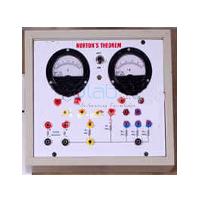
Verification of Network Theorems
Product Code : EL-VONT-1127
Instrument comprises of 3 Fixed output DC Power Supplies of 12V & 5V at 100 mA current, 4 moving coil meters, Circuit diagram for all the 4 Theorems Printed on the front panel & connections of Supplies, Meters, Resistances & Potentiometers bro
View Details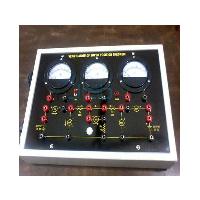
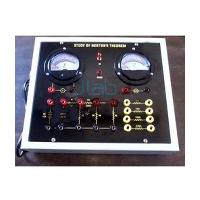
Verification of Nortons Theorem
Product Code : EL-VONT-1129
Two moving coil meters, Circuit diagram Printed on the front panel & connections of Supplies, Meters & Resistances brought out at 4mm Sockets.
View Details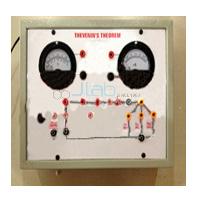
Verification of Thevenins Theorem
Product Code : EL-VONT-1130
Thevenin's theorem trainer with one fixed-output DC power supply of 12 V at 250 mA, two moving-coil meters and a printed circuit diagram, with connections at 4 mm sockets.
View Details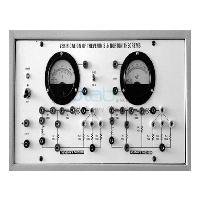
Verification of Nortons and Thevenins Theorems
Product Code : EL-VONT-1131
Nortons Theorem states that Any linear circuit containing several energy sources and resistances can be replaced by a single Constant Current generator in parallel with a Single Resistor
View Details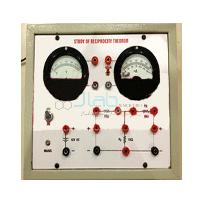
Verification of Reciprocity Theorem
Product Code : EL-VONT-1132
Reciprocity theorem trainer with one fixed-output DC power supply of 12 V at 300 mA, two moving-coil meters and a circuit diagram printed on the front panel, with connections on terminals.
View Details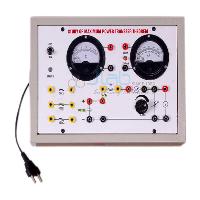
Verification of Maximum Power Transfer Theorem in DC Circuits
Product Code : EL-VONT-1133
Instrument comprises of One Fixed output DC Power Supply of 12V at 300 mA current, Two moving coil meters, Circuit diagram Printed on the front panel & connections of Supplies, Meters, Potentiometer & Resistances brought at terminals.
View Details