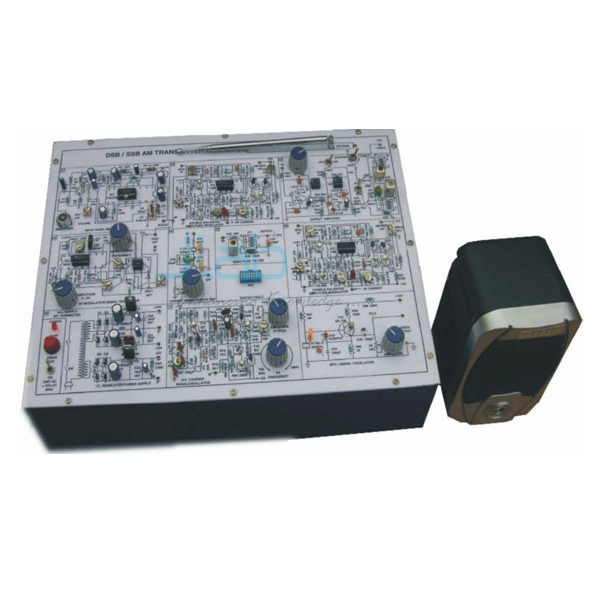
Amplitude Shift Key Modulation and Demodulation Manufacturer,Supplier and Exporter in India

Product Code : EL-CT-1502
Jlab Export is a leading Amplitude Shift Key Modulation and Demodulation Manufacturer,and suppliers in India
Amplitude Shift Key Modulation and Demodulation (code EL-CT-1502) is a digital communication trainer for generating an amplitude shift keyed (ASK) output and demodulating it. The board carries its own carrier signal generator (40 to 100 kHz) and clock generator (200 Hz to 15 kHz), so the whole keying process can be studied without external signal sources. It is made by Jain Laboratory Instruments Pvt Ltd (JLab) at its works in Ambala, India.
Specifications
| Parameter | Detail |
|---|---|
| Experiments | Generation of an amplitude shift keyed (ASK) output; demodulation of the ASK output |
| Built-in power supplies | ±12 V DC at 50 mA and ±5 V DC at 50 mA, IC regulated, internally connected |
| Clock generator | 200 Hz to 15 kHz |
| Word generator | 8-bit |
| Logic selection switches | 9, for high or low levels |
| Binary counter | Divide-by-16 counter |
| Carrier signal generator | 40 to 100 kHz |
| Modulator and demodulator | ASK modulator; ASK demodulator |
| Mains supply | 230 V ±10%, 50 Hz AC; mains ON/OFF switch, fuse and jewel light |
| Patch cords | Adequate number, stackable, 4 mm spring-loaded plugs, half-metre length |
| Connections | Terminals and sockets at appropriate places on the panel for connections and observation of waveforms |
| Documentation | Detailed operating instructions covering object, theory, design procedures, report suggestions and book references |
| Other apparatus required | Cathode ray oscilloscope, 20 MHz (separate item) |
| Quality check | Each trainer is visually inspected before dispatch |
| Pack quantity | Each (sold individually) |
| Minimum order quantity | 10 units |
| Dispatch time | Usually 7–10 working days |
| Product code | EL-CT-1502 |
| Manufacturer | Jain Laboratory Instruments Pvt Ltd (JLab) — OEM |
| Country of origin | India (made in Ambala, Haryana) |
What Is the ASK Modulation and Demodulation Trainer Used For?
Amplitude shift keying represents binary data by changing the amplitude of a carrier. In its simplest form, on-off keying, the carrier is present for a binary one and absent for a zero, so the modulated signal looks like bursts of carrier separated by gaps. It is the most direct of the digital keying methods to generate and detect, which makes it a natural first experiment before frequency and phase shift keying. With the oscilloscope on the panel terminals, students can compare the data stream, the carrier, the keyed output and the demodulated data side by side.
The operating instructions give the object, theory, design procedure, report suggestions and book references, and JLab’s FSK, PSK and DPSK boards, linked below, take the study on to the other keying methods.
What to Specify When Ordering
- How many ASK trainers you need.
- Your mains supply — the trainer is built for 230 V ±10%, 50 Hz AC.
- Any FSK, PSK or DPSK boards to quote at the same time; they are separate items.
Frequently Asked Questions
Which other signal circuits are on the board?
Besides the carrier and clock generators, there is an 8-bit word generator, a divide-by-16 binary counter and nine logic selection switches for setting high or low levels, all supplied by internal ±12 V and ±5 V DC regulated supplies rated at 50 mA.
How is an ASK signal demodulated?
The usual approach is envelope detection: the keyed signal is rectified and low-pass filtered so that the carrier bursts become a voltage level, and a comparator turns that level back into clean logic data. Coherent detection, which multiplies the signal by a locally generated carrier, gives better noise performance at the cost of a more complex receiver.
Where is ASK used in practice?
On-off keying is common in infrared remote controls, low-cost radio remote-control and RFID links and many optical fibre systems, where a light source is simply switched on and off.
What else is needed to use the trainer?
A 20 MHz cathode ray oscilloscope, which is a separate item; the patch cords come with the trainer. The Dual Trace Oscilloscope linked below can be included in the same quotation.
What should an export enquiry give?
Quantity, destination country and port or city, preferred delivery terms (for example FOB or CIF), packing or labelling instructions if any, and the tender reference for tender purchases.
Who manufactures this ASK trainer?
Jain Laboratory Instruments Pvt Ltd, trading as JLab, manufactures it at its works in Ambala, Haryana, India.
OEM Manufacturer
JLab is the trading name of Jain Laboratory Instruments Pvt Ltd, a manufacturer in India of communication and electronics trainers for teaching laboratories, incorporated in 2017 and based on Hargolal Road, Ambala, Haryana. The ASK trainer is assembled in JLab’s own works and not resold from a trader, so institutions, dealers and importers buy direct, and the same works handles repeat orders and spares. JLab exports worldwide and ships to buyers in every region — for example Finland in Northern Europe, Taiwan in East Asia, Kuwait in the Middle East, Guyana in South America and Angola in Central Africa. Tender details are on the JLab lab tenders page.
Related Keying Trainers
- Frequency Shift Keying Modulation and Demodulation — FSK generation and demodulation built from op-amp, timer, counter and NAND gate ICs.
- Phase Shift Keying Modulation and Demodulation — PSK generation and demodulation with multiplexer and EX-OR gate ICs.
- Differential Phase Shift Keying Modulation and Demodulation — a DPSK board with its own carrier, bit clock and data generation.
- Dual Trace Oscilloscope — a dual-channel 20 MHz CRT oscilloscope.
Other boards are in the Communication Trainer range of Electronics Lab Equipments.
Request a Quote
Click Add To Cart to start an enquiry, or reach JLab through the contact page with the quantity, the delivery city and country, and any related trainers you would like quoted.
Last updated: 22 October 2026