Differential Pulse Code Modulation and Demodulation Trainer Manufacturer,Supplier and Exporter in India
Product Code : EL-CT-1508
Jlab Export is a leading Differential Pulse Code Modulation and Demodulation Trainer Manufacturer,and suppliers in India
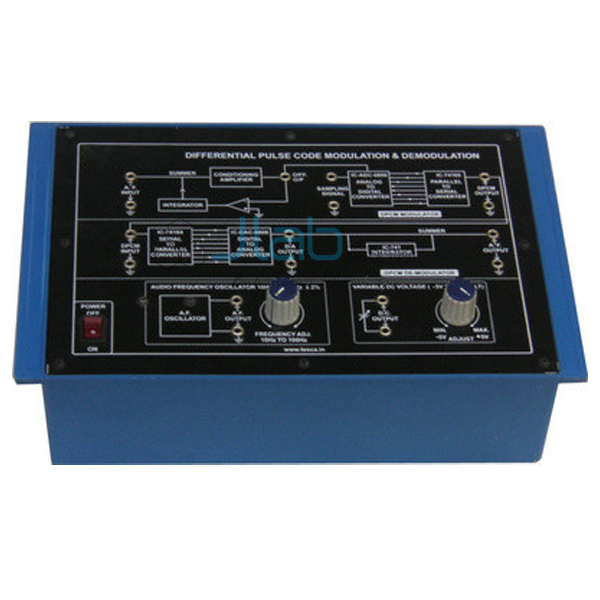
Differential Pulse Code Modulation and Demodulation Trainer (code EL-CT-1508) is a communication trainer for studying differential pulse code modulation (DPCM), in which the difference between successive samples is coded instead of each full sample, and its demodulation. A DPCM encoder and a DPCM decoder are built into the board. It is made by Jain Laboratory Instruments Pvt Ltd (JLab) at its works in Ambala, India.
Specifications
| Parameter | Detail |
|---|---|
| Modulator | DPCM modulator (DPCM encoder) |
| Demodulator | DPCM demodulator (DPCM decoder) |
| Built-in power supplies | 5 V DC at 100 mA and ±12 V DC at 100 mA, IC regulated, internally connected |
| Variable DC output | −5 V DC to +5 V DC |
| Modulating signal | Audio frequency oscillator, 10 Hz to 100 Hz |
| Mains supply | 230 V ±10%, 50 Hz AC; mains ON/OFF switch, fuse and jewel light |
| Patch cords | Adequate number, stackable from the rear at both ends, 4 mm spring-loaded plugs, half-metre length |
| Connections | Terminals and sockets at appropriate places on the panel for connections and observation of waveforms |
| Documentation | Detailed operating instructions covering object, theory, design procedures, report suggestions and book references |
| Other apparatus required | Dual trace cathode ray oscilloscope, 20 MHz (separate item) |
| Quality check | Each trainer is visually inspected before dispatch |
| Pack quantity | Each (sold individually) |
| Minimum order quantity | 10 units |
| Dispatch time | Usually 7–10 working days |
| Product code | EL-CT-1508 |
| Manufacturer | Jain Laboratory Instruments Pvt Ltd (JLab) — OEM |
| Country of origin | India (made in Ambala, Haryana) |
What Is the DPCM Trainer Used For?
Neighbouring samples of speech, audio and video signals are usually close in value, so coding every sample in full wastes bits. DPCM predicts each sample from the ones before it and sends only the coded prediction error, which is usually much smaller than the sample itself and so needs fewer bits for the same quality. The decoder adds each received difference to its own prediction to rebuild the signal. The same idea, refined, underlies the ADPCM coding used in telephony and many audio and image compression schemes. On the trainer, students compare the original, the coded differences and the decoded waveform to see how differential coding behaves.
Its operating instructions set out the object, theory, design procedure, report suggestions and book references.
What to Specify When Ordering
- Quantity — the number of DPCM trainers required.
- Mains supply — the trainer is built for 230 V ±10%, 50 Hz AC; check that this suits your laboratory.
- Related pulse coding trainers — the PCM, delta modulation and sampling boards below are separate items that can be quoted together.
Frequently Asked Questions
What input signals does the board provide?
An audio frequency oscillator covering 10 Hz to 100 Hz for modulation and a variable DC output from −5 V to +5 V. With a steady DC input the coded difference ideally settles near zero, which shows why DPCM saves bits on slowly changing signals; the low-frequency oscillator shows the differences rising and falling with the waveform.
How does DPCM compare with delta modulation?
Delta modulation is the simplest differential scheme, sending a single bit per sample to say whether the signal went up or down; DPCM codes the size of the difference in several bits, so it follows the signal more closely at the cost of a higher bit rate. JLab’s Delta Modulation and Demodulation trainer, linked below, runs from the same 5 V DC and ±12 V DC, 100 mA IC regulated supplies.
What else is needed for the experiments?
A 20 MHz dual trace cathode ray oscilloscope, a separate item, so that the original and decoded signals can be viewed together; patch cords are provided with the trainer. The Dual Trace Oscilloscope linked below can be quoted with it.
What should an export enquiry include?
The number of trainers, the destination country and port or city, the delivery terms preferred (for example FOB or CIF), any packing or labelling instructions, and the tender reference where relevant.
Who manufactures this DPCM trainer?
Jain Laboratory Instruments Pvt Ltd (JLab), at its works in Ambala, Haryana, India.
OEM Manufacturer
JLab is the trading name of Jain Laboratory Instruments Pvt Ltd, an Indian maker of communication and electronics trainers for teaching labs, incorporated in 2017 and based on Hargolal Road, Ambala, Haryana. The DPCM trainer is built at JLab’s own works, not bought from a trader, so institutions, distributors and importers order it from the maker, and repeat orders and spares are handled there too. The company is registered under GSTIN 06AADCJ9848D1ZE and holds Legal Entity Identifier 549300DTGS77DGYD6N03. JLab exports worldwide and ships to buyers in every region — for example Portugal in Southern Europe, Romania in Eastern Europe, Uzbekistan in Central Asia, Uganda in East Africa and DR Congo in Central Africa. Tender information is on the JLab lab tenders page.
Related Pulse Coding Trainers
- Pulse Code Modulation and Demodulation Trainer — full PCM coding with an encoder, a decoder and an LED data display.
- Delta Modulation and Demodulation — one-bit differential coding with a potentiometer for the modulating signal amplitude.
- Analog Signal Sampling and Reconstruction — natural, flat-top and sample/hold PAM sampling with low-pass filter reconstruction.
- Dual Trace Oscilloscope — 20 MHz, two-channel, cathode ray tube display.
The full Communication Trainer range sits within Electronics Lab Equipments.
Request a Quote
Use the Add To Cart button on this page or the contact page to request a quotation, stating the number of trainers, the delivery destination and any related boards.
Last updated: 22 October 2026