Analog Signal Sampling and Reconstruction Manufacturer,Supplier and Exporter in India

Product Code : EL-CT-1507
Jlab Export is a leading Analog Signal Sampling and Reconstruction Manufacturer,and suppliers in India
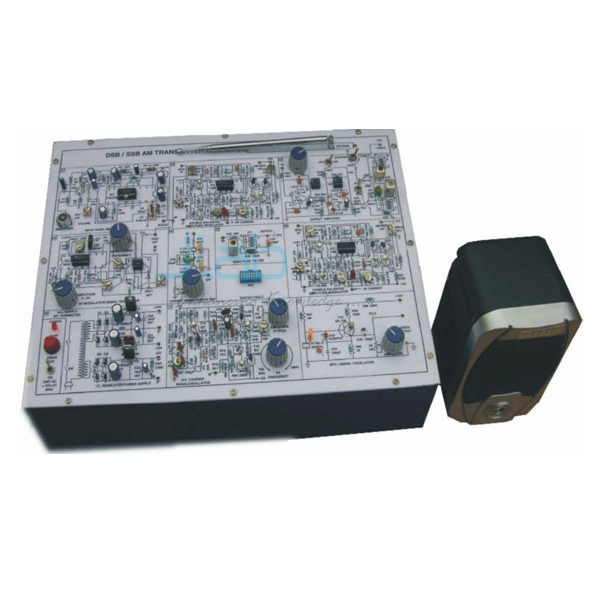
Analog Signal Sampling and Reconstruction (code EL-CT-1507) is a communication trainer for studying the sampling theorem through pulse amplitude modulation. An audio signal is sampled into PAM by three different methods and the original sine wave is then reconstructed with a low-pass filter. It is made by Jain Laboratory Instruments Pvt Ltd (JLab) at its works in Ambala, India.
Specifications
| Parameter | Detail |
|---|---|
| Experiments | Sampling theorem using pulse amplitude modulation and demodulation; PAM generation with an audio signal by natural sampling, by flat-top sampling and by a sample/hold circuit; demodulation with a low-pass filter to reconstruct the input sine wave |
| Built-in power supplies | ±15 V DC at 100 mA and +5 V DC at 100 mA, IC regulated |
| Signal sources | AF signal generator for the modulating signal; sampling clock generator providing the sampling clock and gate pulse |
| Modulator | Modulator circuit for flat-top, natural and sample/hold sampling |
| Demodulator | Demodulator circuit to reconstruct the input sine wave |
| Mains controls | Mains ON/OFF switch, fuse and jewel light |
| Patch cords | Adequate number, stackable, 4 mm spring-loaded plugs, half-metre length |
| Connections | Terminals and sockets at appropriate places on the panel for connections and observation of waveforms |
| Documentation | Detailed operating instructions covering object, theory, design procedures, report suggestions and book references |
| Other apparatus required | Dual scope cathode ray oscilloscope, 20 MHz (separate item) |
| Quality check | Each trainer is visually inspected before dispatch |
| Pack quantity | Each (sold individually) |
| Minimum order quantity | 10 units |
| Dispatch time | Usually 7–10 working days |
| Product code | EL-CT-1507 |
| Manufacturer | Jain Laboratory Instruments Pvt Ltd (JLab) — OEM |
| Country of origin | India (made in Ambala, Haryana) |
What Is the Sampling and Reconstruction Trainer Used For?
The sampling theorem says that a band-limited signal can in principle be rebuilt from its samples if they are taken at more than twice its highest frequency. In practice the sampled signal carries copies of the original spectrum around each multiple of the sampling frequency, and the reconstruction filter keeps only the baseband copy. When the sampling rate is too low these copies overlap, and the low-pass filter can no longer return a clean sine wave. Every digital audio, telephony and data acquisition system rests on this principle, which is why it is a core experiment in communication and signal processing labs.
The operating instructions provide the object, theory, design procedure, report suggestions and book references for each sampling method.
What to Specify When Ordering
- How many sampling trainers the lab needs.
- Companion trainers — the PAM, TDM PAM and PCM boards linked below are separate items that can share the enquiry.
Frequently Asked Questions
How do natural, flat-top and sample/hold sampling differ?
In natural sampling the top of each pulse follows the signal while the pulse lasts. In flat-top sampling each pulse keeps the value taken at the sampling instant, which is easier to process but slightly reduces the higher frequencies (the aperture effect). A sample/hold circuit holds each value until the next sample, giving a staircase waveform.
How does it differ from JLab’s Pulse Amplitude Modulation and Demodulation trainer?
Both sample a sine wave audio signal into PAM and recover it. This board covers the three sampling methods described above and runs from ±15 V and +5 V DC supplies; the PAM trainer runs from a ±9 V DC supply and is used to show how the sampling rate affects distortion in the recovered signal.
Why is a dual scope oscilloscope needed?
Comparing the original audio with the sampled or reconstructed waveform is the heart of the experiment, and that needs two traces on screen at once. A 20 MHz dual scope cathode ray oscilloscope is required and is a separate item; JLab’s Dual Trace Oscilloscope, linked below, can be quoted with it. Patch cords are provided with the trainer.
What should an export enquiry include?
The quantity, the destination country and port or city, the delivery terms (for example FOB or CIF), packing or labelling requirements, and the tender reference if the order is for a tender.
Who manufactures this sampling trainer?
JLab, the trading name of Jain Laboratory Instruments Pvt Ltd, makes it at its works in Ambala, Haryana, India.
OEM Manufacturer
JLab is the trading name of Jain Laboratory Instruments Pvt Ltd, a manufacturer in India of communication trainers and other electronics teaching equipment, incorporated in 2017 and based on Hargolal Road, Ambala, Haryana. The sampling trainer is made in JLab’s own works rather than bought from a trader, so institutions, dealers and importers order from the maker and come back to it for repeat orders and spares. JLab exports worldwide and ships to buyers in every region — for example Egypt in North Africa, Turkey in the Middle East, Kyrgyzstan in Central Asia, Chad in Central Africa and Eswatini in Southern Africa. For tender buying, see the JLab lab tenders page.
Related Sampling and Pulse Trainers
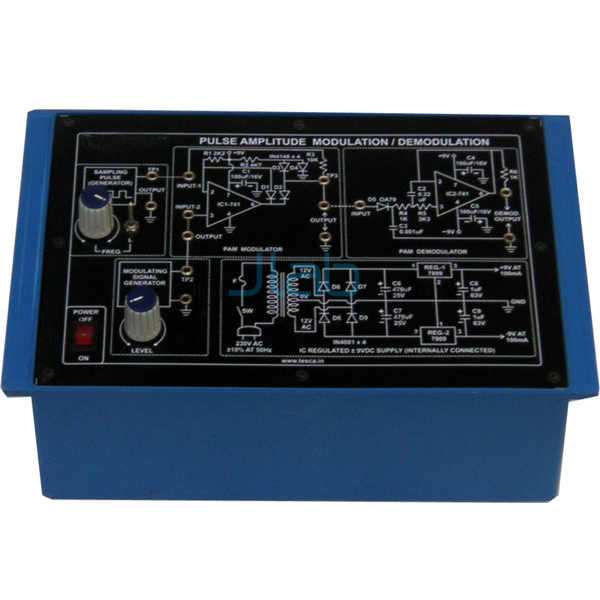
- Pulse Amplitude Modulation and Demodulation — a PAM trainer that shows the effect of sampling rate on distortion in the recovered sine wave.
- TDM Pulse Amplitude Modulation and Demodulation Kit — four analog channels time-division multiplexed and demultiplexed.
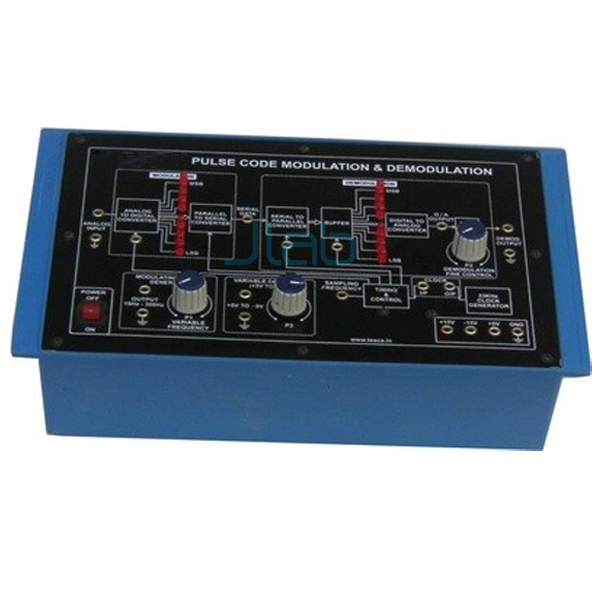
- Pulse Code Modulation and Demodulation Trainer — PCM encoder and decoder with a built-in TTL clock generator.
- Dual Trace Oscilloscope — a two-channel 20 MHz oscilloscope with a cathode ray tube.
Browse the Communication Trainer range in Electronics Lab Equipments.
Request a Quote
Enquire with the Add To Cart button on this page or through the contact page, giving the number of trainers, the delivery city and country, and any other boards to include.
Last updated: 22 October 2026