Ball Mill Manufacturer,Supplier and Exporter in India

Product Code : EL-PLE-2237
Jlab Export is a leading Ball Mill Manufacturer,and suppliers in India
A ball mill reduces a powder by turning a closed jar part-filled with balls. As the jar rotates, the balls are lifted and cascade back, breaking particles by impact and grinding them by attrition. This electrically operated, motor-driven mill is made of stainless steel and comes in 1, 2 and 5 litre capacities.
Specifications
| Operation | Electrically operated, motor driven |
| Mill capacities | 1, 2 and 5 litre |
| Mill material | Stainless steel |
| Minimum order quantity | 1 unit |
| Dispatch time | Usually 14–18 working days |
| Manufacturer | JLab (Jain Laboratory Instruments Pvt Ltd), Ambala, India |
Size Reduction Practicals with the Ball Mill
The usual pharmaceutics practical studies how milling time changes particle size. Students weigh a batch of a coarse crystalline solid such as common salt on an Electronic Balance, mill it and take out samples at set times. Each sample is shaken through a nest of Test Sieves on a Sieve Shaker, and the powder left on each sieve is weighed to plot a size distribution.
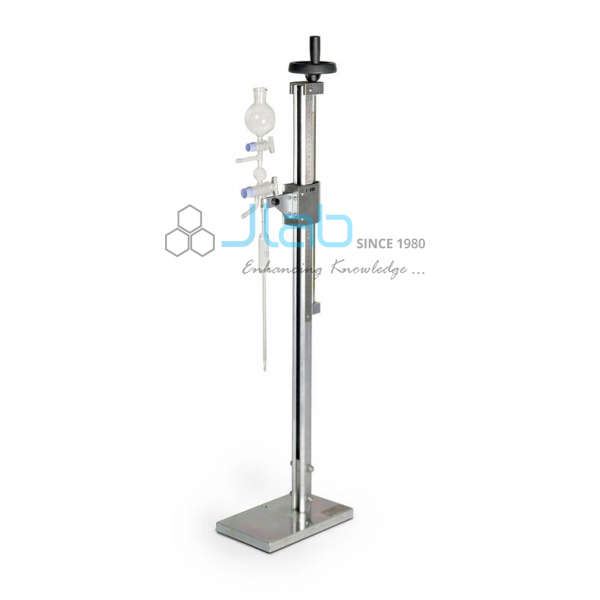
A second run changes the ball load or the batch size and compares the two distributions. Teachers use the exercise to explain the critical speed, at which the balls stay pinned to the wall and grinding stops. Students can also compare the milled salt with salt ground by hand in a Mortar and Pestle. The fines that pass the smallest sieve can go on to a sedimentation analysis with the Andreasen Pipette.
Frequently Asked Questions
Why does a ball mill have to run below its critical speed?
At the critical speed, centrifugal force holds the balls against the jar wall and they turn with it, so they stop falling onto the charge. Below that speed they cascade and strike the powder. The critical speed falls as the jar diameter grows, so a wider jar must turn more slowly.
How much of the jar should be filled with balls and powder?
A common start is to fill a third to a half of the jar with balls, add powder to fill the gaps and leave free space above. An overfilled jar gives the balls no room to cascade. In an underfilled jar the balls mostly strike each other and the wall.
Which capacity should I choose, 1, 2 or 5 litre?
Choose by the batch you need to grind. The litre figure is the jar volume, and the balls and free space take much of it, so a batch fills only part of the jar. The 1 and 2 litre mills suit small student batches, and the 5 litre mill takes larger ones.
Does longer milling always give a finer powder?
No. Particle size drops quickly at first and then more slowly, and after a point the finest particles can cling together again. That is why the practical takes samples at set times and sieves each one, to see when extra milling stops paying off.
Why should the material be dry before milling?
Damp powder cakes on the balls and the jar wall and cushions the impacts, so grinding slows and the sieve results become irregular. A soluble solid such as salt can also dissolve and stick. Dry the material first unless the method calls for wet grinding in a liquid.
Other Mills and Sieves for Powder Work
- Disintegrator (hammer mill with mesh screens)
- Laboratory Mill (Willey type mill for sample preparation)
- Hand Grind Mill (hand mill on a metallic stand)
- Granulating Sieves (wooden frames with stainless steel strips)
For a quote, use Add To Cart or send us a message through the contact page.
Last updated: 12 November 2026