Calibration of Voltmeter & Ammeter Manufacturer,Supplier and Exporter in India
Product Code : EL-SI-8126
Jlab Export is a leading Calibration of Voltmeter & Ammeter Manufacturer,and suppliers in India
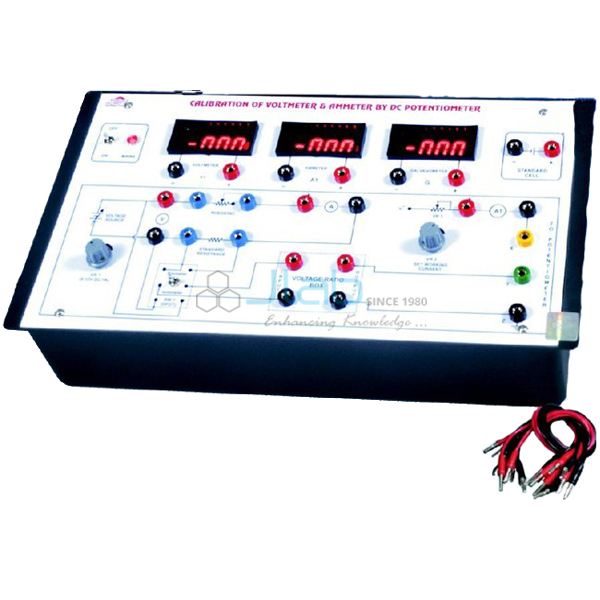
Calibration of Voltmeter & Ammeter (code EL-SI-8126) is a compact electronic unit for standardising a DC potentiometer and calibrating a voltmeter and an ammeter with it in college physics and electrical measurement labs. It brings together three digital panel meters, a built-in standard cell and built-in 0–12 V DC / 1 A power supplies, with the circuit diagram printed on the front panel. It is made by Jain Laboratory Instruments Pvt Ltd (JLab) at its works in Ambala, India.
Specifications
| Parameter | Detail |
|---|---|
| Purpose | Standardisation of a DC potentiometer; calibration of a voltmeter and an ammeter using a DC potentiometer |
| Digital panel meters (DPM) | Three: one for voltmeter measurement (V), one for current measurement (A), one used as the galvanometer (G) |
| Standard cell | Built in |
| Power supplies | Built in, 0–12 V DC / 1 A |
| Front panel | Circuit diagram with input and output sockets |
| Supplied with | A bunch of connecting leads |
| Quality check | Each unit is visually inspected before dispatch |
| Pack quantity | Each (sold individually) |
| Minimum order quantity | 10 units |
| Dispatch time | Usually 7–10 working days |
| Product code | EL-SI-8126 |
| Manufacturer | Jain Laboratory Instruments Pvt Ltd (JLab) — OEM |
| Country of origin | India (made in Ambala, Haryana) |
What Is the Calibration Unit Used For?
Calibrating meters with a potentiometer is a standard experiment in B.Sc. physics and engineering electrical measurement labs, because a potentiometer at balance draws no current and so gives a reference reading that a pointer or digital meter can be checked against. The first step is to standardise the potentiometer: its working current is adjusted until the voltage of the built-in standard cell balances, with the galvanometer meter showing zero. The voltmeter is then checked at several settings of the 0–12 V supply, each reading being compared with the value found on the potentiometer, and the differences are plotted as a correction curve. For the ammeter, the current is passed through a known resistance and the voltage across it is measured on the potentiometer; dividing that voltage by the resistance gives the true current.
With the supply, the reference cell and the meters in one housing, set-up time at the bench is short and wiring mistakes are fewer, since the circuit diagram on the front panel shows where each lead goes. Students still connect the external potentiometer and complete the circuit themselves, which keeps the method visible. Turn the supply down to zero before changing connections, and take each calibration point twice, once rising and once falling, to see any lag in the meter under test.
What to Specify When Ordering
- Quantity — the minimum order is 10 units.
- DC potentiometer — say whether you also need a potentiometer (wire, dial-pattern or Crompton type) so it can be quoted with the unit.
- Ranges and mains supply — if your syllabus or tender sets meter ranges, and give your mains voltage, so the unit can be confirmed for it.
- Extra items — a standard resistance or volt ratio box for wider calibration work.
Frequently Asked Questions
What is inside the calibration unit?
Three digital panel meters (for voltage, current and galvanometer use), a built-in standard cell, built-in 0–12 V DC / 1 A power supplies, and a front panel carrying the circuit diagram with input and output sockets. A bunch of connecting leads is supplied.
Is a potentiometer included?
The listing describes the unit as used with a DC potentiometer but does not include one among its parts. JLab offers wire, dial-pattern and Crompton potentiometers separately; confirm your choice when you enquire.
What is the third digital meter for?
It takes the place of a galvanometer, showing when the potentiometer circuit is balanced.
What supply does the unit provide?
Built-in power supplies of 0–12 V DC at 1 A, which drive the meter under test during calibration.
How is an ammeter calibrated with it?
The current is passed through the ammeter and a known resistance in series; the potentiometer measures the voltage across the resistance, and that voltage divided by the resistance gives the true current to compare with the ammeter reading.
Who manufactures this unit?
JLab (Jain Laboratory Instruments Pvt Ltd) builds it at its works in Ambala, Haryana, India, and quotes for it directly.
OEM Manufacturer
JLab is the trading name of Jain Laboratory Instruments Pvt Ltd, an Indian maker of physics and electrical measurement lab equipment, incorporated in 2017 and based on Hargolal Road, Ambala, Haryana. The calibration unit is assembled and wired at JLab’s own works rather than bought in from a trader, so colleges, polytechnics, dealers and importers buy from the manufacturer; each unit is visually inspected before it leaves, and repeat orders and the potentiometers it works with come from the same source. JLab exports worldwide and ships to buyers in every region, such as the Maldives in South Asia, Latvia in Northern Europe, Togo in West Africa, Uzbekistan in Central Asia and the UAE in the Middle East. Tender information is available on the JLab lab tenders page.
Potentiometers and Calibration Accessories
- Crompton Potentiometer — a DC potentiometer with 1/2 mV slide-wire divisions and self-standardisation.
- Potentiometer with Pencil Jockey — the four-wire constantan board for wire-potentiometer work.
- Potentiometer Dial Pattern — a compact dial-and-slide-wire potentiometer.
- Volt Ratio Box — extends a Crompton potentiometer to higher voltages for voltmeter calibration.
- Standard Resistance — aged manganin coils in oil-filled vessels for ammeter calibration.
- Standard Cell — a separate voltage reference in a small steel cabinet.
Browse the Scientific Instrument range or the Indian Instruments section for more.
Request a Quote
JLab quotes as the manufacturer. Use the Add To Cart enquiry button on this page, or send the quantity (minimum 10 units), whether you need a potentiometer or standard resistance with it, and your delivery location through the contact page.
Last updated: 8 October 2026