

Ice Plant Tutor Manufacturer,Supplier and Exporter in India
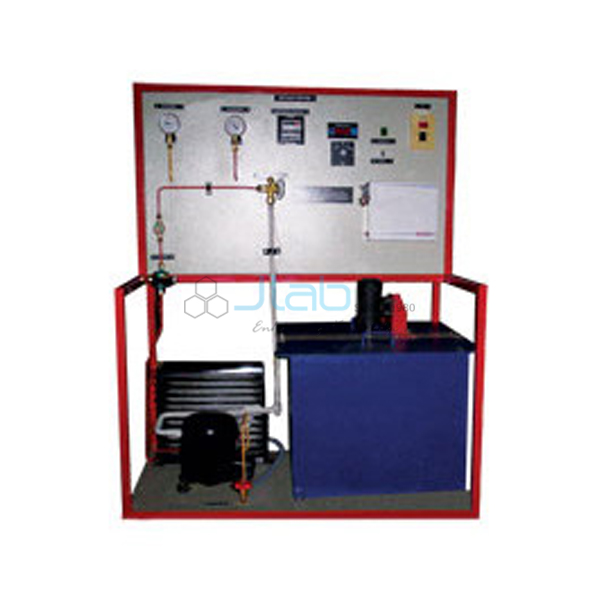
Product Code : EL-RACLE-9356
Jlab Export is a leading Ice Plant Tutor Manufacturer,and suppliers in India
An ice plant tutor shows how block ice is made with a vapour compression system. Refrigerant evaporates in a 3/8 in copper coil inside a stainless steel brine tank. The chilled brine draws heat from water in four GI ice cans until the water freezes. The unit sits on a mild steel angle frame with wheels and an instrumentation panel.
Specifications
| Frame | Mild steel angle frame on wheels |
| Instrumentation | Panel mounted |
| Condenser | Air cooled, 12 x 13 x 2 row |
| Evaporator cooling coil | 3/8 in copper, with accumulator |
| Brine tank | Stainless steel, grade 304 |
| Ice cans | GI, 4 nos |
| Pressure gauge ranges | 0–300 psi and 30 inHg vacuum to +150 psi |
| Voltage stabiliser | 2 kVA |
| Studies | Working of an ice plant, COP, refrigeration circuit |
| Minimum order quantity | 1 unit |
| Dispatch time | Usually 14–18 working days |
| Manufacturer | JLab (Jain Laboratory Instruments Pvt Ltd), Ambala, India |
Ice Plant Experiments for Students
Students first trace the refrigeration circuit on the unit. Hot vapour from the compressor gives up its heat in the air-cooled condenser. The liquid then passes the expansion device and boils in the copper coil under the brine. The accumulator after the coil holds back any liquid, so only vapour returns to the compressor. Teachers can then relate each part of the circuit to the two gauge readings.
For the COP test, students fill the cans with a known mass of water. They log the water and brine temperatures at intervals with a Type K Thermocouple on a suitable indicator. The heat removed from the water, divided by the energy drawn by the compressor over the same time, gives the actual COP. They then plot the cycle on a p-h chart from the gauge pressures and compare the two figures. After a service, the circuit can be evacuated and recharged with the Refrigerant Charging Unit.
Frequently Asked Questions
Why is brine used instead of plain water in the tank?
Brine is a salt solution that stays liquid well below 0 °C. It can be chilled below the freezing point of the water in the cans and carries heat from the cans to the evaporator coil. Plain water in the tank would freeze solid on the coil.
What does the accumulator on the coil do?
It sits at the outlet of the evaporator coil and traps liquid refrigerant that has not boiled off. Only vapour goes on to the compressor, which is built to pump vapour and can be damaged by liquid.
How is the COP of the ice plant worked out?
First find the sensible heat taken from the water to bring it down to 0 °C. Add the latent heat of freezing, about 335 kJ per kg of ice formed. Divide this total by the energy the compressor used over the same run.
How are the blocks taken out of the GI cans?
Lift the can out of the brine and dip it briefly in water at room temperature. A thin layer of ice at the can wall melts, and the block slides out when the can is tipped over.
How does this tutor differ from the Ice Plant Trainer?
This tutor has a 12 x 13 x 2 row air-cooled condenser and a grade 304 stainless steel brine tank. Its 3/8 in copper coil has an accumulator, and four GI cans sit in the tank. The Ice Plant Trainer is a separate can-type plant with its own tank and instruments.
Other Refrigeration Test Rigs
For a quote, use Add To Cart or send us a message through the contact page.
Last updated: 5 November 2026
