Refrigeration Test Rig Manufacturer,Supplier and Exporter in India
Product Code : EL-RACLE-9362
Jlab Export is a leading Refrigeration Test Rig Manufacturer,and suppliers in India
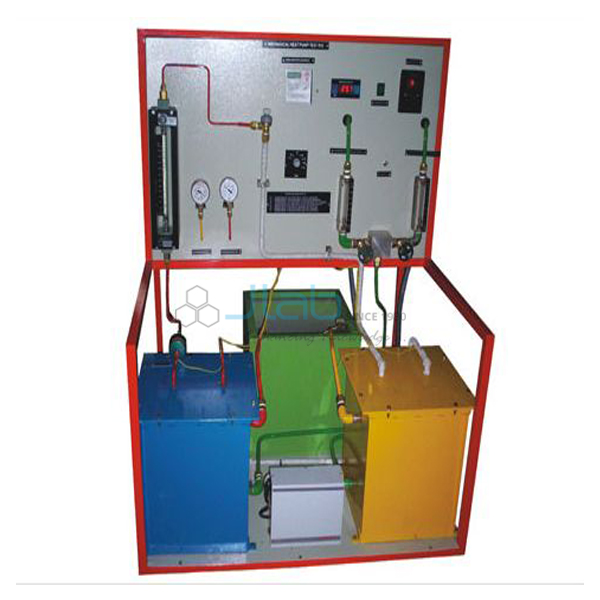
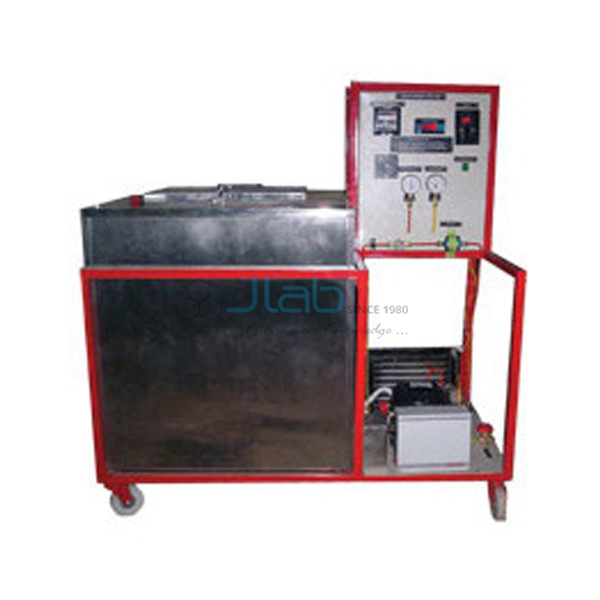
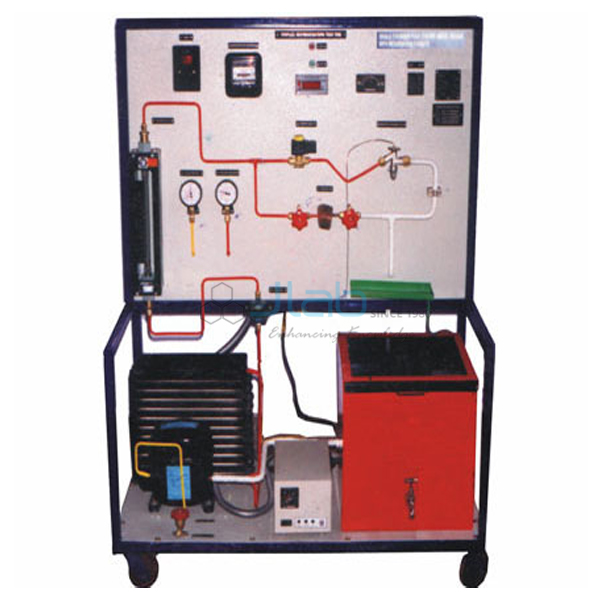
The basic vapour compression refrigeration cycle is laid out on this test rig, so students can follow the refrigerant through compressor, condenser, expansion device and evaporator. The rig stands on a mild steel square tube frame with cast iron wheels. An instrumentation panel carries the pressure gauges and a digital temperature indicator.
Specifications
| Frame | Mild steel square tube, on cast iron wheels |
| Instrumentation panel | Pressure gauges and digital temperature indicator |
| Gauge ranges | 0–300 psi (high side), 30 inHg vacuum to +150 psi (low side) |
| Studies | Vapour compression refrigeration cycle, COP |
| Optional extra | Line voltage corrector: 2 kVA, 230 V ±10% output |
| Minimum order quantity | 1 unit |
| Dispatch time | Usually 14–18 working days |
| Manufacturer | JLab (Jain Laboratory Instruments Pvt Ltd), Ambala, India |
Refrigeration Cycle Experiments
Students begin by naming each part of the circuit and the state of the refrigerant in each line. Low-pressure vapour enters the compressor and leaves it as hot, high-pressure vapour. The condenser turns it into warm liquid, and after expansion it is a cold mix of liquid and vapour. With the rig running steadily, they read both gauges and the line temperatures, then work out the superheat and the subcooling.
From the same readings they plot the cycle on a p-h chart and find the COP as refrigerating effect over compressor work. In the service part of the practical, the circuit is evacuated with one of the Small Vacuum Pumps. Students watch the compound gauge move into vacuum before the charge goes in. The pump oil is changed with Replacement Vacuum Pump Oil once it turns cloudy.
Frequently Asked Questions
How is the COP found from the p-h chart?
The evaporating and condensing pressures from the gauges fix the two pressure lines. With h1 at the compressor inlet, h2 at its outlet and h3 = h4 across the expansion device, the COP is (h1 − h4) divided by (h2 − h1).
What are superheat and subcooling?
Superheat is the suction line temperature minus the saturation temperature at the suction pressure. Subcooling is the saturation temperature at the condensing pressure minus the liquid line temperature. Together they show whether the charge and the expansion device are set right.
Why does one gauge read vacuum as well as pressure?
That is the compound gauge on the low side, reading from 30 inHg vacuum to +150 psi. It shows suction pressure in normal running and the depth of vacuum during evacuation. The high side uses the 0–300 psi gauge.
Why is the circuit evacuated before charging?
Air and moisture left inside raise the condensing pressure and cut the cooling. Moisture can also freeze at the expansion device and react with the oil to form acid. Evacuation pulls them out before the refrigerant goes in.
Other Rigs and Cut-Section Models
For a quote, use Add To Cart or send us a message through the contact page.
Last updated: 5 November 2026