Ignition and Charging System Manufacturer,Supplier and Exporter in India
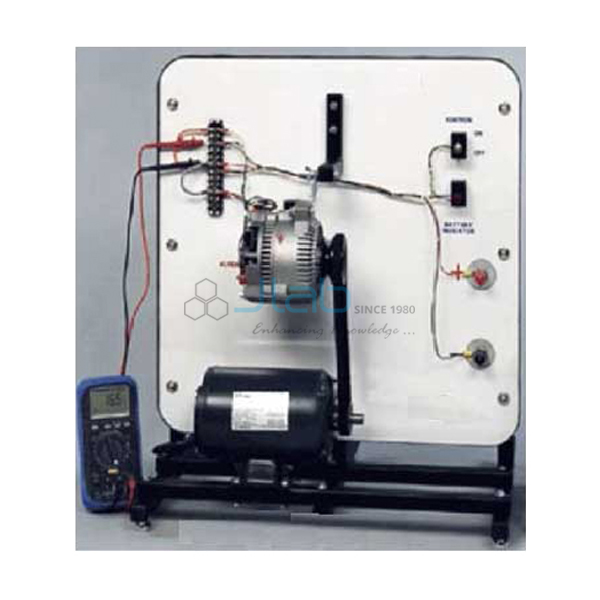
Product Code : EL-AELE-9372
Jlab Export is a leading Ignition and Charging System Manufacturer,and suppliers in India
Ignition has moved from contact breaker points to transistor switching and distributorless wasted spark systems. This trainer covers all three on one layout. It carries a distributor model, ignition coils, spark plug models, crankshaft and camshaft sensor circuits and the ignition part of an engine control unit. An alternator model brings in the charging system.
Specifications
| Type | Trainer for ignition and charging systems |
| Ignition types | Contact breaker, wasted spark and electronic ignition |
| Models on the trainer | Distributor, ignition coils, spark plugs, alternator |
| Circuits | Ignition circuit, camshaft and crankshaft sensor circuit |
| Control | Ignition part of the engine control unit |
| Electronics topics | Semiconductor familiarisation, basic transistor circuit |
| Charging | Alternator charging system |
| Minimum order quantity | 1 unit |
| Dispatch time | Usually 14–18 working days |
| Manufacturer | JLab (Jain Laboratory Instruments Pvt Ltd), Ambala, India |
Workshop Practice on Ignition and Charging
With the contact breaker system, students see the points close to build current in the coil primary and open to collapse it, inducing high voltage in the secondary. They then compare it with transistor switching after the semiconductor and transistor exercises. A Digital Multimeter is used to check primary and secondary winding resistance and the sensor circuits.
The wasted spark section shows one coil firing two companion cylinders at once. Students can then carry the work to a running engine such as the EFI Petrol Engine Test Bed. There they read ignition timing and advance with a Digital Advance Timing Light. Charging tests on a vehicle battery, alternator and regulator are made with a Battery Load Tester.
Frequently Asked Questions
What is a wasted spark ignition system?
Each coil serves two cylinders whose pistons reach top dead centre together. It fires both plugs at once: one cylinder is on compression and gets the working spark, the other is on exhaust and the spark is wasted. No distributor is needed.
How does the alternator charge the battery?
The engine turns the rotor, whose magnetic field induces alternating current in the stator windings. Rectifier diodes turn it into direct current. The voltage regulator controls the rotor field current so the charging voltage stays steady as engine speed and electrical load change.
Why did contact breakers give way to electronic ignition?
Points wear and burn, so their gap, dwell and timing drift between services. Electronic ignition switches the coil with a transistor triggered by a sensor. Nothing wears at the switching point, so the timing stays where it was set.
What do the crankshaft and camshaft sensors tell the control unit?
The crankshaft sensor gives engine speed and crank position. The camshaft sensor shows which cylinder is on its compression stroke. With both signals, the control unit knows when to fire each coil.
Which ignition topics are covered?
Semiconductor familiarisation, a basic transistor circuit, contact breaker ignition, wasted spark ignition, electronic ignition systems and spark plugs, together with the alternator charging system.
Other Ignition and Charging Equipment
- Coil Ignition System of An Automobile
- Electronic Ignition System of An Automobile
- Hand Held Tune-Up Analyzer
- Battery Quick Charger
For a quote, use Add To Cart or send us a message through the contact page.
Last updated: 5 November 2026