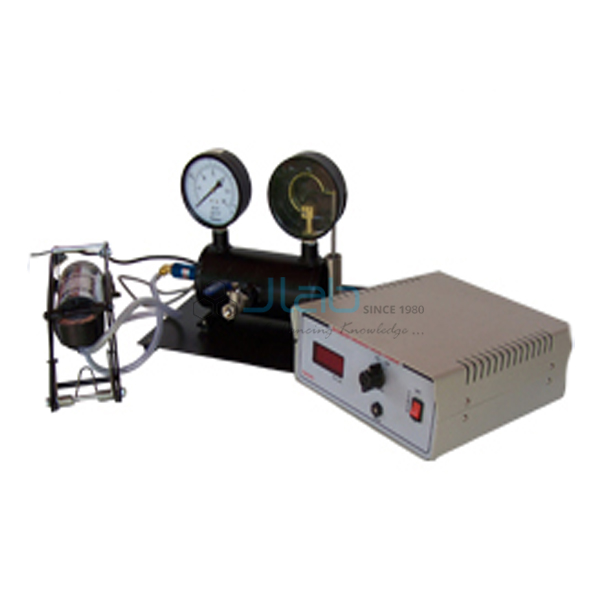
Strain Gauge Transducers Manufacturer,Supplier and Exporter in India
Product Code : EL-MLLE-9158
Jlab Export is a leading Strain Gauge Transducers Manufacturer,and suppliers in India
This trainer shows how strain in a bent beam becomes an electrical signal. Strain gauges are mounted on a cantilever and wired as a half or a full Wheatstone bridge, and the sensor is a piezoresistive transducer. A micrometer with 0–20 mm travel deflects the cantilever, while an instrumentation amplifier with zero and span controls conditions the bridge output for calibration.
Specifications
| Strain sensor | Piezoresistive strain transducer |
| Mounting | Strain gauges on a cantilever |
| Bridge connections | Half and full Wheatstone bridge |
| Strain generation | Micrometer, 0–20 mm, accuracy 0.01 mm |
| Signal conditioning | Instrumentation amplifier with zero and span adjustment |
| Experiments | Gauge factor, strain indicator, displacement measurement |
| Minimum order quantity | 1 unit |
| Dispatch time | Usually 7–10 working days |
| Manufacturer | JLab (Jain Laboratory Instruments Pvt Ltd), Ambala, India |
Experiments with the Strain Gauge Trainer
The usual first practical is the gauge factor. Students set the amplifier zero with the cantilever at rest, turn the micrometer in equal steps and note the output at each step. From the deflection and the beam dimensions they work out the strain, and the gauge factor follows as (dR/R) divided by strain. The class then rewires the gauges from half bridge to full bridge and compares the output for the same deflection. The same bridge and amplifier chain sits inside the Load Measurement Using Strain Gauge Kit, whose cantilever load cell weighs loads up to 3 kg.
For a displacement exercise, students calibrate the output against micrometer readings and then use the cantilever as a displacement sensor. They can repeat the test on the Displacement Measurement Using LVDT Trainer Kit, which takes its reference from a screw gauge, and compare the two sensors. Teachers who want a direct microstrain reading on foil gauges can add the 2 Channel Digital Strain Meter, which works with half and full bridge circuits.
Frequently Asked Questions
How is the gauge factor found on this trainer?
Deflect the cantilever in steps with the micrometer and record the bridge output at each step. Work out the strain from the deflection and the beam dimensions, and the resistance change from the bridge output. The gauge factor is the slope of dR/R plotted against strain.
Why wire the gauges as a half or full bridge?
A single active gauge gives a small output and drifts with temperature. When two or four active gauges are placed so that some stretch while others compress, their outputs add, and matched gauges cancel most of the temperature effect. A full bridge gives about twice the output of a half bridge.
What are the zero and span controls for?
Zero trims the amplifier so the display reads nothing with the cantilever at rest. Span sets the gain so that a known micrometer deflection gives the correct reading. Set zero first, then span, and check zero again, because the two settings affect each other.
What does piezoresistive mean?
A piezoresistive element changes its resistance when strained, mainly because the resistivity of the material itself changes. The change per unit strain is larger than in a plain metal foil gauge, where it comes mostly from the change in length and cross-section.
Can the trainer measure displacement as well as strain?
Yes. Displacement measurement with strain gauges is one of its set experiments. Once the amplifier output has been calibrated against micrometer readings, the cantilever works as a displacement sensor whose output follows the movement of its free end.
Other Sensor Trainer Kits
- Speed Measurement Kit (magnetic and photo pick-up)
- Pressure Measurement Kit (resistive pressure transducer)
- Level Indicator Kit (capacitive level transducer)
- Ultrasonic Displacement Kit
For a quote, use Add To Cart or send us a message through the contact page.
Last updated: 5 November 2026