Tap Density Tester Manufacturer,Supplier and Exporter in India
Product Code : EL-RE-2221
Jlab Export is a leading Tap Density Tester Manufacturer,and suppliers in India
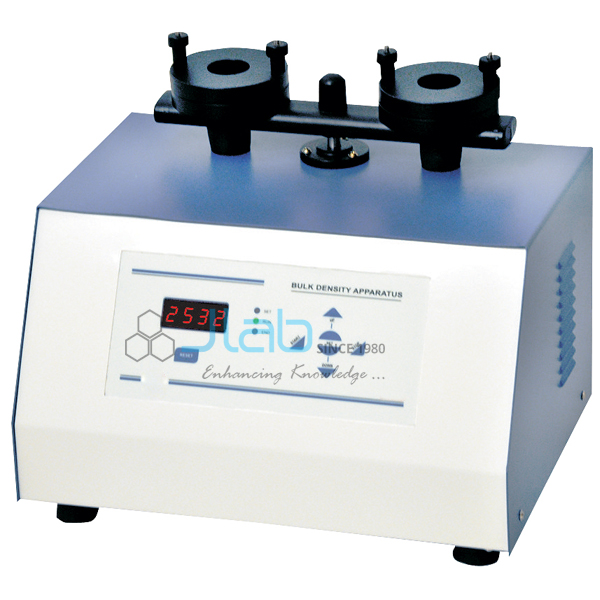
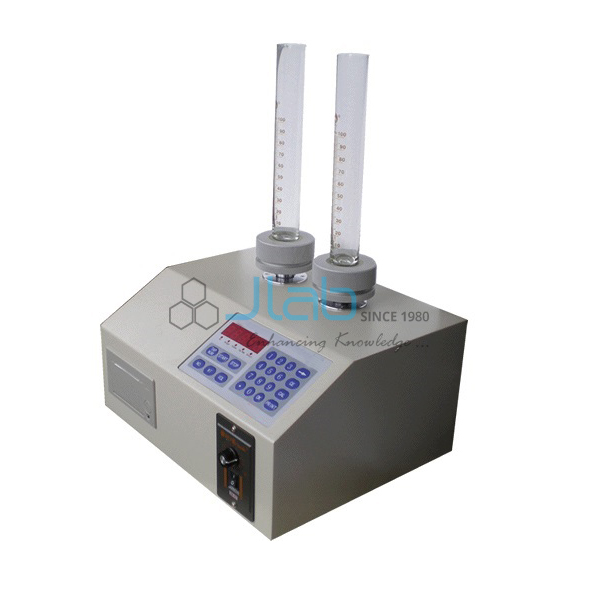
Tapped density is found by tapping a measuring cylinder of powder a set number of times and reading the settled volume. This microprocessor tester has two stations and two tapping methods: a 14 mm drop at 300 taps a minute and a 3 mm drop at 250 taps a minute. It works out tap density, initial density, compressibility index and Hausner ratio itself.
Specifications
| Stations | 2, with snap-lock holders for 100 ml and 250 ml cylinders |
| Tap height | Method I: 14 ± 2 mm, Method II: 3 ± 0.3 mm |
| Tapping rate | Method I: 300 ± 15 taps/min, Method II: 250 ± 15 taps/min |
| Tap count | 1 to 9999 |
| Drive | Direct drive with stepper motor |
| Display and keys | 20 x 4 backlit alphanumeric LCD, 16 soft-touch membrane keys |
| Calculated results | Tap density, initial density, compressibility index, Hausner ratio |
| Printer | RS232 serial printer attachment |
| Supplied with | 100 ml and 250 ml cylinders and holders, one each |
| Power, size and weight | 230 V AC ±10%, 50/60 Hz, 44 VA, 360 x 340 x 190 mm without holder, 15 kg |
| Minimum order quantity | 1 unit |
| Dispatch time | Usually 7–10 working days |
| Manufacturer | JLab (Jain Laboratory Instruments Pvt Ltd), Ambala, India |
Micromeritics Practicals in Pharmaceutics
Students weigh a powder or granule sample on an Electronic Balance Analytical, pour it gently into the 100 ml or 250 ml cylinder and note the bulk volume. After tapping, the tester gives the tapped volume and the results. Carr’s index = 100 × (tapped density - bulk density) / tapped density, and Hausner ratio = tapped density / bulk density.
Granules sized on Granulating Sieves can be compared with the fine powder they came from, and a glidant can be added to see how far the index falls. Many courses pair the test with angle of repose, where the powder flows through one of the Powder Filter Funnels JLab onto a flat surface.
Frequently Asked Questions
When do I use Method I or Method II?
Method I drops the cylinder 14 ± 2 mm at 300 taps a minute. Method II drops it 3 ± 0.3 mm at 250 taps a minute. Follow the method your monograph or lab manual names and quote it with the result, since the two give different tapped volumes.
Should I use the 100 ml or the 250 ml cylinder?
Use the 250 ml cylinder for most powders, because a larger volume is easier to read. The 100 ml cylinder suits small or costly samples. Weigh enough sample to fill a good part of the cylinder you choose, and record which one you used.
How many taps should I set?
The count can be set from 1 to 9999. A common approach is to tap in stages and read the volume after each stage, stopping when it no longer changes noticeably. Record the total number of taps with the result.
What do Carr’s index and Hausner ratio tell me?
Both compare tapped and bulk density. A powder that packs down a lot on tapping gives a high index and ratio, which points to poor flow and cohesive particles. Free-flowing granules change little on tapping and give low values.
What mistakes give a wrong bulk density?
Pressing or shaking the powder while filling, pouring it through a narrow neck and levelling the top by tapping all pack it down. Pour gently through a funnel, level the surface without compacting it and read the volume at eye level.
Other Powder and Density Testers
- Bulk Density Apparatus (stroke counter for two cylinders)
- Sieve Shaker
- Infra Red Moisture Balance
For a quote, use Add To Cart or send us a message through the contact page.
Last updated: 6 November 2026