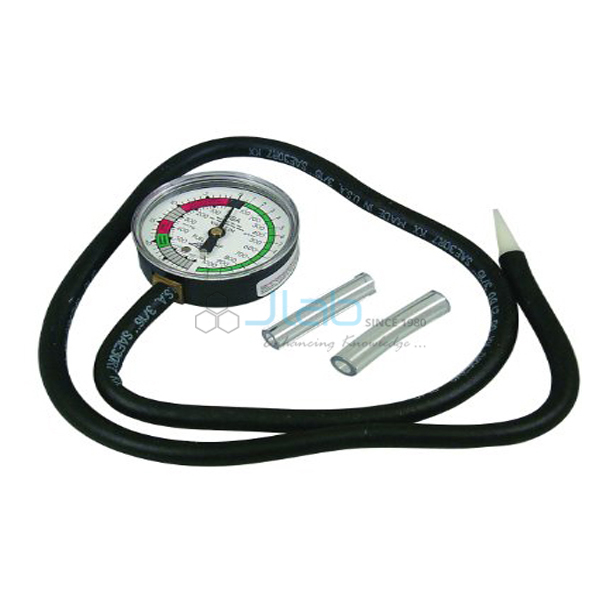
Universal Radiator Pressure Tester Manufacturer,Supplier and Exporter in India
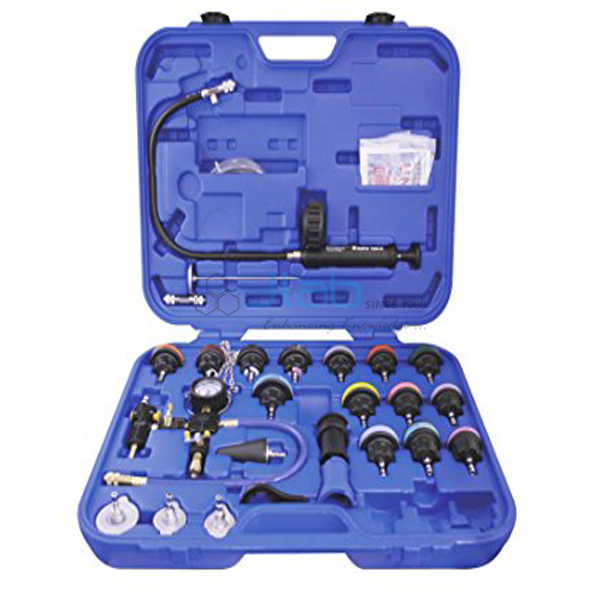
Product Code : EL-AELE-9395
Jlab Export is a leading Universal Radiator Pressure Tester Manufacturer,and suppliers in India
A cooling system that loses coolant with no obvious leak is checked with a pressure test, and this kit does that job. It has a heavy duty pump and gauge unit with a colour-coded scale, a thermometer and colour-coded aluminium radiator adaptors. A quick release fitting with a pressure release valve joins them, and the kit comes in a rugged case.
Specifications
| Pump gauge unit | Heavy duty, smooth action, colour-coded scale |
| Adaptors | Multi-colour coded aluminium radiator adaptors |
| Fitting | Quick release, with pressure release valve |
| Included | Pump gauge unit, thermometer, multiple adaptors |
| Vehicles | Adaptors suit many makes of vehicle |
| Case | Rugged carry case |
| Minimum order quantity | 5 units |
| Dispatch time | Usually 7–10 working days |
| Manufacturer | JLab (Jain Laboratory Instruments Pvt Ltd), Ambala, India |
Cooling System Lab Exercises
With the engine cold, students take off the radiator cap, fit the matching adaptor to the filler neck and pump to the pressure marked on the cap. They watch the gauge for several minutes. If it falls, they look for drips at the hoses, the radiator core, the water pump and the heater connections.
A falling gauge with no outside leak points to an internal leak, often the head gasket. Students can follow that up with the Cylinder Compression Tester for Petrol Engine. They also use the thermometer while the engine warms up to see when the thermostat opens, and check the coolant strength with the Antifreeze Tester.
Frequently Asked Questions
Can I pressure test a hot engine?
No. Let the engine cool before removing the radiator cap, because hot coolant under pressure can boil and spray out. Test a cold system, and use the release valve to let the pressure out before taking the adaptor off.
How much pressure should I pump?
Pump to the pressure rating stamped on the radiator cap, which is the working pressure of the system. Going far above it can split an old hose or radiator tank. The colour-coded scale makes the target easy to see.
How long should the pressure hold?
Watch the gauge for several minutes after pumping. A steady reading means the system is tight. A slow fall points to a small leak, and a fast fall to a larger one at a hose, the core, the pump seal or the head gasket.
Why are the adaptors colour coded?
Each adaptor fits a different filler neck. The colour code lets students pick the right one for the vehicle quickly and put it back in its place in the case after the test.
What is the thermometer used for?
It measures coolant temperature during a cooling system check, for example the temperature at which the thermostat opens as the engine warms up. Students compare that figure with the one marked on the thermostat.
Other Workshop Testers
For a quote, use Add To Cart or send us a message through the contact page.
Last updated: 5 November 2026