8-Bit Multiplying Digital to Analog Converter Manufacturer,Supplier and Exporter in India
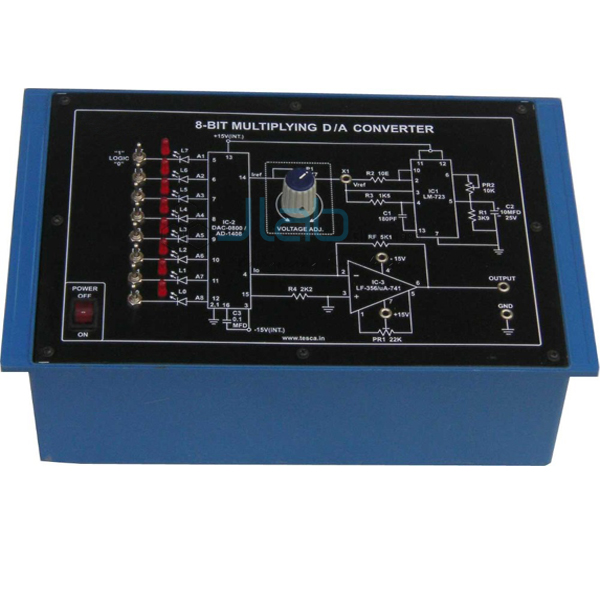
Product Code : EL-DET-1522
Jlab Export is a leading 8-Bit Multiplying Digital to Analog Converter Manufacturer,and suppliers in India
8-Bit Multiplying Digital to Analog Converter (code EL-DET-1522) is a training board for studying how an 8-bit digital input is converted into an equivalent analog signal by a multiplying D to A converter, whose analog output represents the product of the digital input and a reference source. An 8-bit D to A converter and an op-amp are set on one panel with SPDT input switches and status LEDs. It is made by Jain Laboratory Instruments Pvt Ltd (JLab) at its works in Ambala, India.
Specifications
| Parameter | Detail |
|---|---|
| Experiment | 8-bit multiplying digital to analog converter with 8-bit digital input signals and an analog output representing the product of the inputs and a reference source |
| Converter | 8-bit D to A converter |
| Other circuit blocks | Op-amp; voltage regulator |
| Inputs | SPDT switches for logic selection / input data |
| Indicators | LEDs for visual indication of status / binary data input |
| Built-in power supplies | ±15 V DC at 50 mA and +5 V DC at 50 mA, IC regulated, internally connected |
| Mains controls | Mains ON/OFF switch, fuse and jewel light |
| Supply required | 230 V ±10% at 50 Hz AC mains |
| Panel terminals | Terminals and sockets on the panel for connections and observation of waveforms and voltages |
| Operating instructions | Detailed instructions giving the object, theory, design procedures, report suggestions and book references |
| Other apparatus required | Digital multimeter, 3¾ digit |
| Quality check | Each board is visually inspected before dispatch |
| Pack quantity | Each (sold individually) |
| Minimum order quantity | 10 units |
| Dispatch time | Usually 7–10 working days |
| Product code | EL-DET-1522 |
| Manufacturer | Jain Laboratory Instruments Pvt Ltd (JLab) — OEM |
| Country of origin | India (made in Ambala, Haryana) |
How Does It Compare with the JLab 4-Bit Digital to Analog Converter?
| Board | Digital input | Conversion | Built-in DC supplies | Output reading |
|---|---|---|---|---|
| 8-Bit Multiplying Digital to Analog Converter (EL-DET-1522) | 8 bits, set on SPDT switches | 8-bit D to A converter with an op-amp; output represents the product of the input and a reference source | ±15 V and +5 V | A 3¾-digit digital multimeter is the other apparatus required |
| Digital to Analog Converter | 4 bits, set on four switches and held in a 4 D-type flip-flop register | Binary weighted ladder network | +5 V, +10 V and −10 V | Built-in 0–5 V voltmeter; requires no other apparatus |
The 4-bit board explains the ladder-network principle on its own meter, while this board moves on to an 8-bit converter IC and the multiplying action, where the reference as well as the digital code sets the output.
What Is the Multiplying DAC Board Used For?
In any digital to analog converter the output is a fraction of a reference set by the digital code. In a multiplying converter the reference itself can be varied, so the output is the product of the code and the reference: change the code and the output scales in steps, change the reference and the whole range scales with it. That makes the multiplying DAC a digitally controlled attenuator or gain stage, used for programmable gain, digital volume control and scaling of a varying reference signal. On this board students set the 8-bit word on the switches, watch it on the LEDs, and measure the analog output with a digital multimeter to compare it with the value expected from the code and the reference.
What to Specify When Ordering
- Resolution — this 8-bit multiplying board, or the 4-bit Digital to Analog Converter for the ladder-network principle.
- Quantity — the number of boards for your electronics lab.
- Measuring instrument — the board needs a 3¾-digit digital multimeter as other apparatus; it is a separate instrument.
Frequently Asked Questions
What does “multiplying” mean in a multiplying DAC?
It means the analog output is proportional to the product of the digital input and the reference source. Doubling the reference doubles every output level, while the digital code selects which fraction of the reference appears at the output.
What resolution does an 8-bit converter give?
An 8-bit input has 256 possible codes, so the output can take 256 levels between zero and full scale.
How is the digital input set and shown?
The input data are set on SPDT switches, and LEDs give a visual indication of the status and of the binary data input.
What power supply does the board use?
It runs from 230 V ±10% at 50 Hz AC mains; the ±15 V and +5 V DC supplies for the circuits are built in and IC regulated.
What information is needed for an export quotation?
Send the number of boards, the destination country and port or city, your preferred delivery terms (for example FOB or CIF), any packing or labelling requirements, and the tender reference if the order is for a tender.
Who manufactures this multiplying DAC board?
Jain Laboratory Instruments Pvt Ltd, trading as JLab, makes it at its works in Ambala, Haryana, India, and quotes for it directly.
OEM Manufacturer
JLab is the trading name of Jain Laboratory Instruments Pvt Ltd, a manufacturer of electronics training boards and laboratory equipment in India, incorporated in 2017 and based on Hargolal Road, Ambala, Haryana. The multiplying DAC board is made at JLab’s own works rather than bought in, so colleges, polytechnics, dealers and importers order it factory-direct, every board is visually inspected before dispatch, and repeat orders and spare parts are handled by the manufacturer. JLab exports worldwide and ships to buyers in every region — for example Sweden in Northern Europe, Bangladesh in South Asia, Nigeria in West Africa, Austria in Western Europe and Rwanda in East Africa. Tender information is on the JLab lab tenders page.
Related Converter Trainers
- Digital to Analog Converter — a 4-bit binary weighted ladder network with its own 0–5 V voltmeter.
- 8-Bit Analog to Digital Converter — the reverse conversion at 8 bits, by successive approximation.
- Analog to Digital Converter — a 4-bit board with voltmeter and seven-segment displays for the conversion principle.
See the full Digital Electronics Trainer range or all Electronics Lab Equipments.
Request a Quote
Ask for a quotation with the Add To Cart button, or send the quantity, the delivery destination and any related converter boards through the contact page.
Last updated: 22 October 2026