Cross Cut Saw Manufacturer,Supplier and Exporter in India
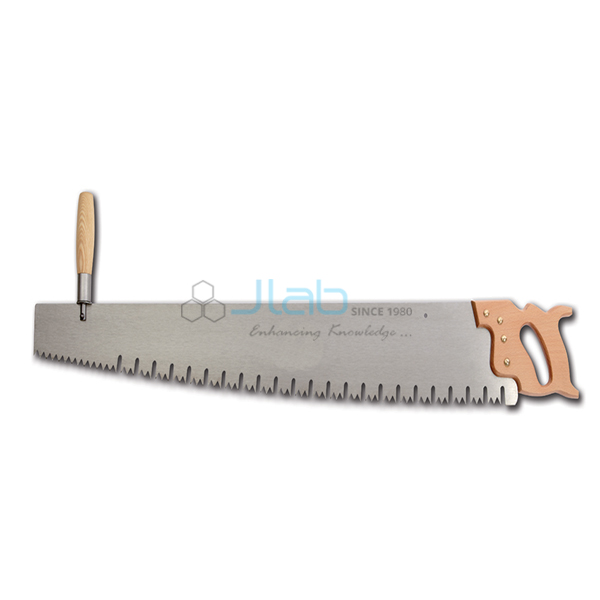
Product Code : EL-MWLE-9214
Jlab Export is a leading Cross Cut Saw Manufacturer,and suppliers in India
A cross cut saw cuts timber across the grain, for sawing boards and battens to length. The teeth on this saw stand at a right angle to the grain. They follow the Great American pattern, with gullets that clear the waste wood from the cut. Saw lengths run from 21 to 27 in. The beech handle has a clear finish, and an auxiliary handle fits at the front of the blade.
Specifications
| Saw length | 21 to 27 in |
| Teeth range | 8 to 12 |
| Tooth pattern | Great American style, with gullets |
| Teeth | At a right angle to the wood grain |
| Handle | Clear finished beech |
| Auxiliary handle | Fits at the front of the blade |
| Minimum order quantity | 10 units |
| Dispatch time | Usually 4–6 working days |
| Manufacturer | JLab (Jain Laboratory Instruments Pvt Ltd), Ambala, India |
Carpentry Workshop Exercises
Sawing stock to length is one of the first carpentry exercises. Students square a pencil line across the board with a Square Ruler, hold the board on a Work Bench and saw on the waste side of the line. The cut end is then checked for square on both faces.
Joint work follows. The saw cuts the shoulders of halving and bridle joints across the grain. The waste between the cuts is then pared away with a chisel from the Chisel Set. Teachers can compare the cut with a rip cut along the grain to show how the tooth shape suits the direction of cut.
Frequently Asked Questions
What is the difference between a cross cut saw and a rip saw?
A cross cut saw cuts across the grain. Its teeth are sharpened to knife-like points that sever the wood fibres. A rip saw cuts along the grain and has chisel-shaped teeth that chop the fibres out. A cross cut saw used along the grain cuts slowly.
What do the gullets between the teeth do?
The gullets are the gaps between the teeth. They carry sawdust and waste wood out of the cut on each stroke. Without them the blade would clog and bind, most of all in thick or damp timber.
Which tooth count should I choose?
The teeth range from 8 to 12. The finer count of 12 leaves a cleaner cut for joinery and trim work. The coarser count of 8 removes wood faster on rough stock and large sections.
How is the saw kept sharp?
Clamp the blade in a Saw Clamp For Filing and set the teeth evenly with Saw Teeth Setting Pliers. Then file each tooth with a triangle file from the Saw Sharpening File Set. Setting the teeth makes the cut wider than the blade, so it does not bind.
What is the auxiliary handle for?
It fits at the front of the blade. A second person can hold it to share the work on large timber. One user can also hold it with the other hand to push the blade through long cuts.
Other Hand Saws in the Workshop
- Key Hole Saws or Compass Saws (fine cuts in plywood and hardwood)
- Coping Saws (blade turns right round)
- Hacksaw (for metal)
For a quote, use Add To Cart or send us a message through the contact page.
Last updated: 5 November 2026