Four Stroke Four Cylinder Petrol Engine Test Rig With Morse Test Manufacturer,Supplier and Exporter in India
Product Code : EL-TELE-9430
Jlab Export is a leading Four Stroke Four Cylinder Petrol Engine Test Rig With Morse Test Manufacturer,and suppliers in India
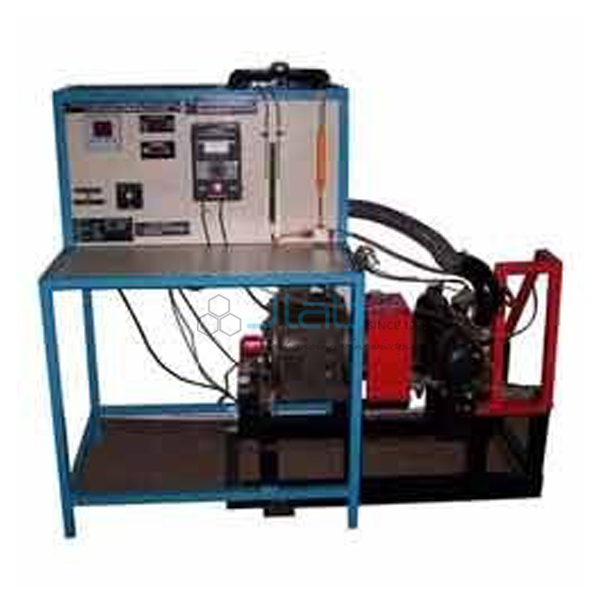
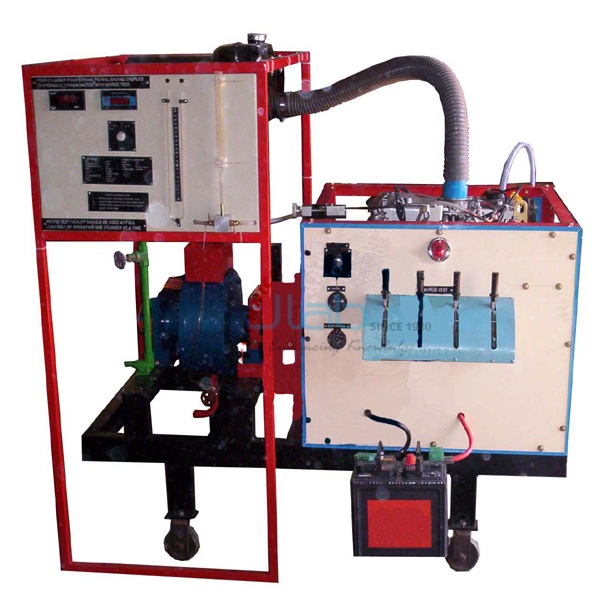
The Morse test finds the indicated power of a multi-cylinder engine without an indicator, and this rig runs a four cylinder, four stroke petrol engine for it. A welded steel base plate carries the engine, a dynamometer, a guarded drive shaft, a 12 V starting battery and the cooling water arrangement. A panel board holds the burette fuel system, air flow measurement and temperature and speed indicators.
Specifications
| Engine | Four cylinder, four stroke, petrol |
| Base | Welded steel base plate |
| Loading | Dynamometer, drive shaft with safety guard |
| Starting | Engine starting battery, 12 V |
| Cooling | Cooling water arrangement |
| Panel board | Fuel system with burette flow measurement, air flow measurement system, temperature and speed indicator |
| Special test | Morse test |
| Minimum order quantity | 1 unit |
| Dispatch time | Usually 14–18 working days |
| Manufacturer | JLab (Jain Laboratory Instruments Pvt Ltd), Ambala, India |
Morse Test and Performance Experiments
Students first run the engine at a set speed and load with all four cylinders firing and find the brake power, BP. They then cut out cylinder 1 by shorting its spark plug and reduce the load until the speed is back to the set value. The drop, BP with all cylinders minus BP without cylinder 1, is the indicated power of cylinder 1.
The step is repeated for cylinders 2, 3 and 4 in turn. Adding the four values gives the indicated power of the engine, IP, so mechanical efficiency is BP/IP and friction power is IP minus BP. Before the test, a Cylinder Compression Tester for Petrol Engine shows whether all four cylinders are sound. Burette fuel timing with a Digital Stop Watch adds brake thermal efficiency and specific fuel consumption.
Frequently Asked Questions
What does the Morse test assume?
It assumes that friction and pumping losses stay the same when one cylinder is cut out, as long as the speed is restored. On that basis the fall in brake power equals the indicated power of the cylinder that stopped firing.
Why must the speed be brought back each time?
Friction power changes with speed. Easing the dynamometer load brings the engine back to the set speed and keeps friction losses unchanged. The drop in brake power then belongs to the missing cylinder alone.
How does it differ from the three cylinder Morse test rig?
This engine has four cylinders, so a full Morse test takes four cut-out readings. The Three Cylinder Four Stroke Petrol Engine Test Rig With Morse Test needs three, and its panel also measures cooling water and calorimeter flows.
Which results can students plot?
Students plot brake power, brake thermal efficiency, brake specific fuel consumption, air-fuel ratio and mechanical efficiency against load at constant speed. The Morse test adds the indicated power of each cylinder.
What is the 12 V battery for?
It powers the starter that cranks the engine for each run. Keep it charged between lab sessions so the engine starts readily on practical days.
Other Multi-Cylinder Engine Test Rigs
- Multi Cylinder Four Stroke Petrol Engine Test Rig
- Two Cylinder Four Stroke Diesel Engine Test Rig
- Multi Cylinder Four Stroke Water Cooled Diesel Engine Test Rig
For a quote, use Add To Cart or send us a message through the contact page.
Last updated: 5 November 2026