Single Cylinder Two Stroke Petrol Engine Test Rig Manufacturer,Supplier and Exporter in India
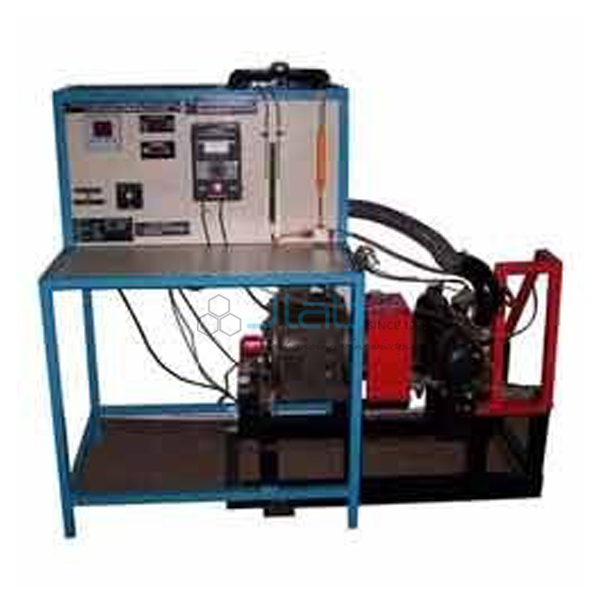
Product Code : EL-TELE-9428
Jlab Export is a leading Single Cylinder Two Stroke Petrol Engine Test Rig Manufacturer,and suppliers in India
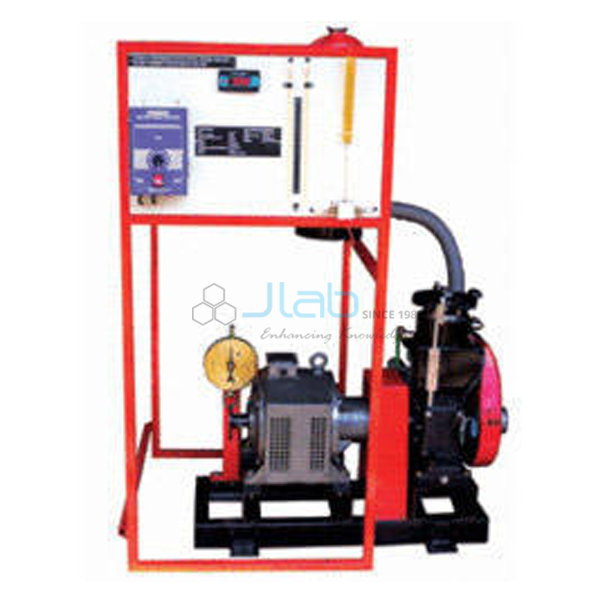
Two-stroke petrol engines fire once every revolution, and this rig lets students measure what one of them delivers under load. Its single cylinder engine rests on anti-vibration mounts on a welded steel base plate, and the drive coupling has a safety guard. Above the base, a panel board holds the fuel burette, the air flow meter and a temperature indicator.
Specifications
| Engine | Single cylinder, two stroke, petrol |
| Base | Welded steel base plate with anti-vibration mounting |
| Drive | Drive coupling with safety guard |
| Loading options | Mechanical brake, AC alternator, DC generator or eddy current dynamometer |
| Resistance loading | Resistance bank with selector switches, no load to full load (AC alternator and DC generator only) |
| Fuel flow measurement | Burette |
| Panel board | Fuel system, air flow measurement system, temperature indicator |
| Minimum order quantity | 1 unit |
| Dispatch time | Usually 14–18 working days |
| Manufacturer | JLab (Jain Laboratory Instruments Pvt Ltd), Ambala, India |
Performance Experiments on the Two-Stroke Rig
The standard practical is a load test at constant speed. Students add load in steps from no load to full load, holding the speed with the throttle, and record the brake load and speed at each step. At every step they time a set volume of fuel from the burette with a Digital Stop Watch and note the air flow and temperatures.
From these readings they work out brake power, fuel consumption, brake specific fuel consumption, brake thermal efficiency and air-fuel ratio, then plot each against load. Before the run, the teacher can show how the ports open on the Port Timing Diagram and the Cut Section Model of Two Stroke Single Cylinder Engine (Working).
Brake Power with Each Loading Option
With the mechanical brake or the eddy current dynamometer, brake power comes from the measured torque: BP = 2πNT/60000 kW, with N in rpm and T in N m. With the AC alternator or DC generator, the resistance bank absorbs the output, and brake power is the electrical output divided by the generator efficiency. Brake thermal efficiency is then BP divided by the fuel mass flow times its calorific value.
Frequently Asked Questions
Why is the load test run at constant speed?
Holding the speed fixed means each step changes only the load, so fuel use and efficiency can be compared fairly across the range. As load is added, the throttle is opened a little more to keep the speed steady.
Why does a two-stroke engine use more fuel per kWh than a four-stroke?
During scavenging, part of the fresh charge escapes through the exhaust port before it can burn. Students usually find a higher brake specific fuel consumption and a lower brake thermal efficiency than on a four-stroke petrol engine of similar size.
How is fuel consumption measured on this rig?
Fuel reaches the engine through a burette. The student shuts off the tank supply and times how long the engine takes to use a set volume from the burette. That volume is converted to mass with the fuel density.
What does the air flow reading tell us?
It gives the mass of air the engine draws in. Divided by the fuel mass flow it gives the air-fuel ratio. Compared with the swept volume per revolution, it shows how well the cylinder is charged at each load.
Other IC Engine Test Rigs
- Single Cylinder Four Stroke Petrol Engine Test Rig
- Single Cylinder Four Stroke Diesel Engine Test Rig
- Variable Compression Ratio Engine Test Rig
For a quote, use Add To Cart or send us a message through the contact page.
Last updated: 5 November 2026