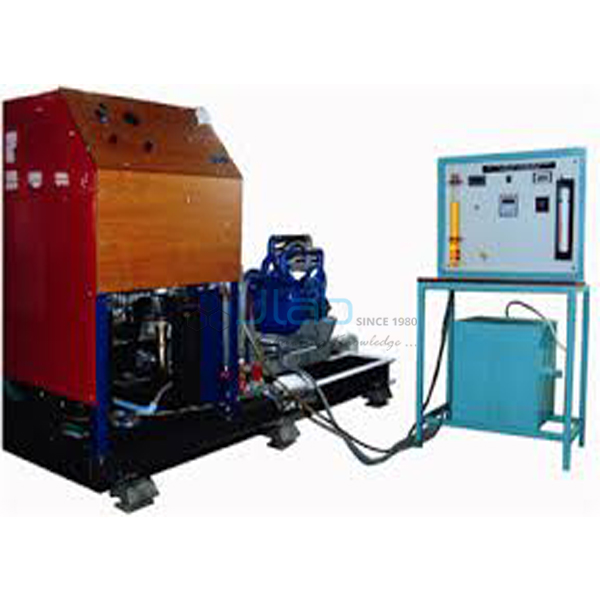
Variable Speed Air Blower Test Rig Manufacturer,Supplier and Exporter in India
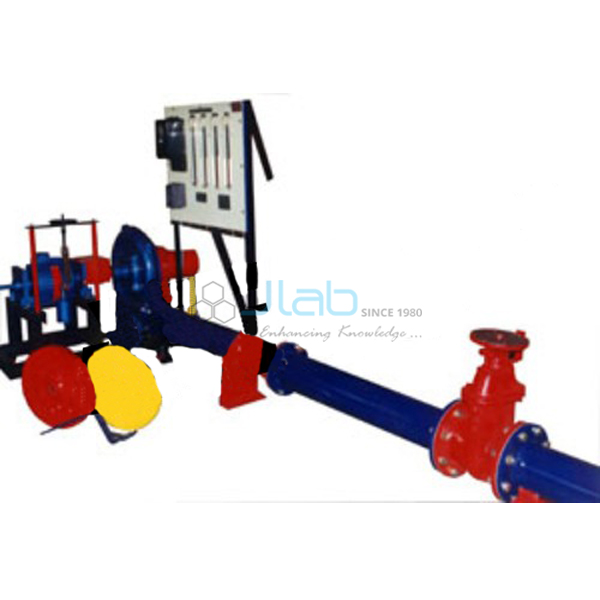
Product Code : EL-TELE-9439
Jlab Export is a leading Variable Speed Air Blower Test Rig Manufacturer,and suppliers in India
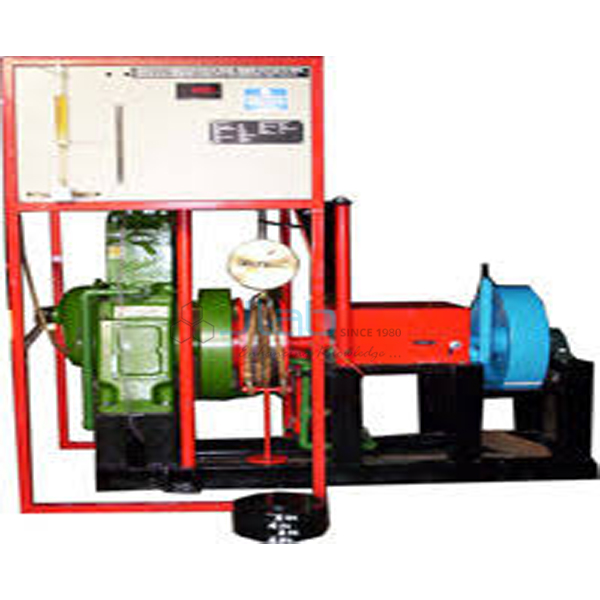
This rig runs a centrifugal air blower at three set speeds, so students can see how flow, pressure and power change with speed. A stepped pulley gives the three speeds. Backward, radial and forward curved impellers can be swapped in, and the blower delivers about 30 m³/min at 25 cm water column.
Specifications
| Blower type | Centrifugal, for experiments |
| Impellers | Backward curved, radial and forward curved vanes, interchangeable |
| Air discharge | About 30 m³/min at 25 cm water column |
| Speed change | Stepped pulley, three speeds |
| Drive | 3 HP induction motor, dynamometer type, with balance arm and large-dial spring balance |
| Flow measurement | Orifice meter and 1.0 m differential manometer |
| Pressure measurement | Pitot tubes in the inlet and outlet ducts |
| Temperature | Digital indicator for suction and delivery air |
| Stage pressure | Pressure gauges |
| Minimum order quantity | 1 unit |
| Dispatch time | Usually 14–18 working days |
| Manufacturer | JLab (Jain Laboratory Instruments Pvt Ltd), Ambala, India |
Speed Trials and Other Blower Experiments
Speed is the variable in the core exercise. Students fit one impeller, take a full set of readings on the lowest pulley step, then move the belt to the other two steps. The orifice manometer head gives the discharge, the pitot tubes give the total pressure rise and the spring balance gives the torque on the motor body.
Dividing each set by the readings at the lowest speed tests the fan laws: flow follows speed, pressure its square and power its cube. A Handheld Anemometer Digital held at the outlet gives a quick check on the air velocity worked out from the pitot readings. Labs that also run a Centrifugal Blower Test Rig can compare fixed pulley steps with the smooth speed control of its DC motor.
Frequently Asked Questions
How do you change the blower speed?
Stop the motor and move the belt to another step of the stepped pulley. The three steps give three fixed speeds. Measure the actual speed at each step with a tachometer, because belt slip makes it a little lower than the pulley ratio suggests.
What does 25 cm water column mean as a pressure?
It is the pressure that holds up a column of water 25 cm high, about 2.45 kPa. Blowers work at low pressures like this, which is why their pressures are read on water manometers rather than on Bourdon gauges.
How is the discharge found from the orifice meter?
Read the head on the differential manometer and convert it to an equivalent head of air using the densities of water and air. The discharge is the orifice coefficient times the orifice area times the square root of 2gh.
Why record suction and delivery temperatures?
Air density depends on temperature, and density enters both the orifice flow and the air power sums. The temperature rise across the blower is small at these pressures, but reading it shows students where part of the input energy goes.
What readings make up one set?
Each set has the pulley step, the measured speed and the orifice manometer head. It also has the two pitot tube readings, the spring balance reading, the suction and delivery temperatures and the stage pressures.
Other Air Flow and Fan Equipment
- Air Blower Test Rig (same blower and impeller set)
- Pitot Tube Setup
- Two Stage Air Compressor Test Rig
For a quote, use Add To Cart or send us a message through the contact page.
Last updated: 5 November 2026