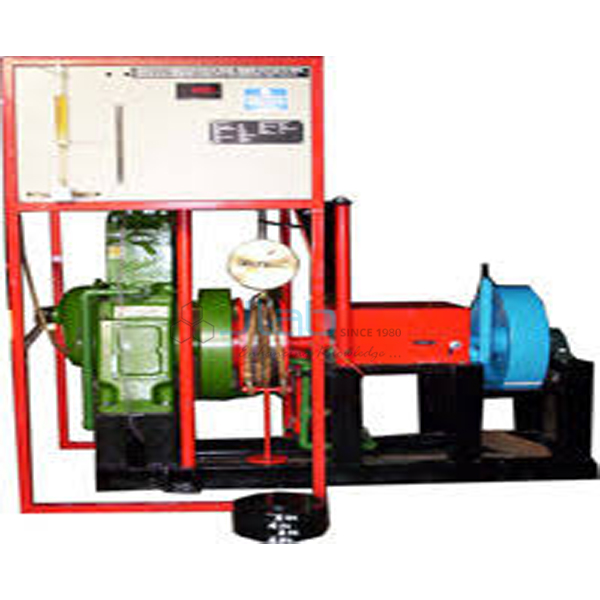
Air Blower Test Rig Manufacturer,Supplier and Exporter in India
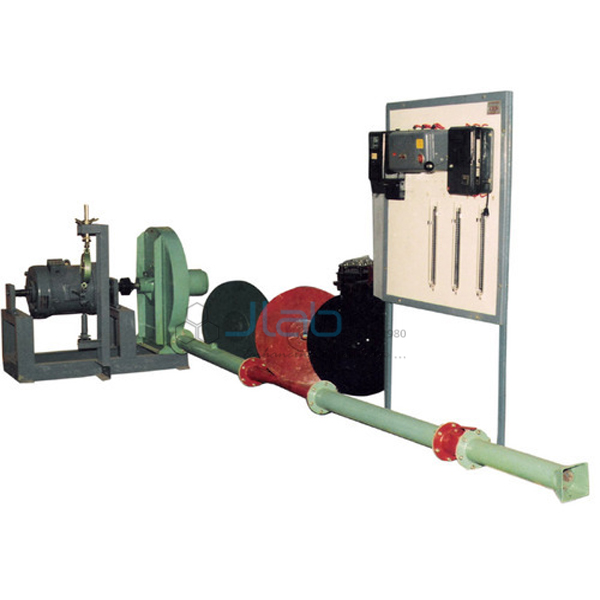
Product Code : EL-TELE-9436
Jlab Export is a leading Air Blower Test Rig Manufacturer,and suppliers in India
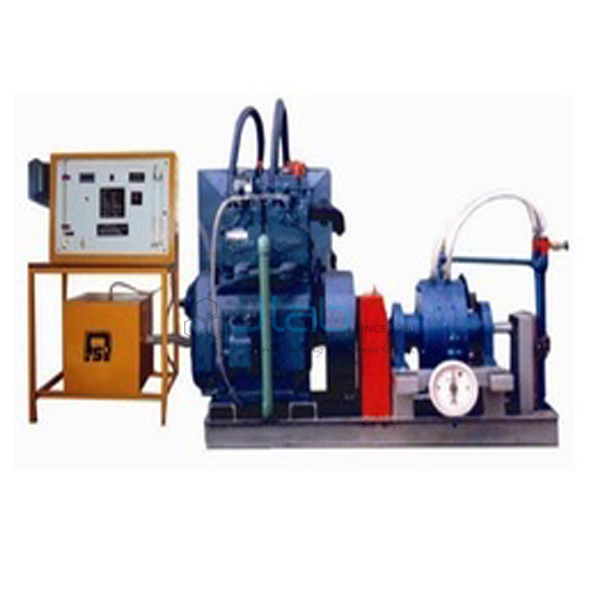
Swapping the impeller is the main lesson on this centrifugal air blower rig. Backward curved, radial and forward curved vane impellers are supplied, so students compare blade shapes on one casing. The blower delivers about 30 m³/min at 25 cm water column. A 3 HP dynamometer type induction motor drives it through a stepped pulley at three speeds.
Specifications
| Blower | Centrifugal type |
| Impellers | Interchangeable: backward curved, radial and forward curved vanes |
| Approximate discharge | 30 m³/min at 25 cm water column |
| Discharge measurement | Orifice meter with 1.0 m differential manometer |
| Pressure measurement | Two pitot tubes, in the inlet and outlet ducts, for total pressure |
| Motor | 3 HP induction motor, dynamometer type |
| Speeds | Three, by stepped pulley |
| Input power measurement | Balance arm and dial type spring balance with large dial |
| Minimum order quantity | 1 unit |
| Dispatch time | Usually 14–18 working days |
| Manufacturer | JLab (Jain Laboratory Instruments Pvt Ltd), Ambala, India |
Blower Performance Experiments in the Lab
With one impeller fitted, students run the blower at each of the three pulley speeds. At each speed they read the orifice manometer for flow and the two pitot tubes for total pressure at inlet and outlet. The spring balance on the motor arm gives the torque. Repeating the set with the other two impellers shows how blade shape changes pressure, flow and power.
Many labs teach the instruments first. The Pitot Static Tube Set-Up covers velocity and total pressure, and the Venturi meter and Orifice Meter Apparatus covers the orifice discharge coefficient. An Aneroid Barometer reading gives the air density used in the flow sums.
How Blade Shape Changes Performance
Backward curved vanes give a pressure that falls steadily as flow rises and a power draw that levels off. Forward curved vanes move more air at a given speed, but their power keeps climbing with flow. Radial vanes sit between the two. Air power is the flow times the total pressure rise, and efficiency is air power divided by input power.
Frequently Asked Questions
Which impeller is usually the most efficient?
In most class results the backward curved impeller gives the highest efficiency. The forward curved impeller gives more flow for its speed but draws more power as flow rises, so its efficiency is lower.
How is the blower input power measured?
The motor is a dynamometer type. Its body reacts against a balance arm and a dial spring balance, so the balance force times the arm length gives the torque. Input power is 2πNT/60000 kW, with N in rpm.
What do the fan laws predict for the three speeds?
For one impeller, flow rises in proportion to speed, pressure with the square of speed and power with the cube of speed. Readings at the three pulley speeds let students check these ratios.
Why are two pitot tubes fitted?
One sits in the inlet duct and one in the outlet duct, giving the total pressure on each side of the blower. Their difference is the total pressure the blower develops.
How does it differ from the Centrifugal Blower Test Rig?
This rig sets three speeds with a stepped pulley and measures flow with an orifice meter. The Centrifugal Blower Test Rig uses a variable speed DC motor and a venturi for the discharge.
Other Blower and Air Flow Equipment
For a quote, use Add To Cart or send us a message through the contact page.
Last updated: 5 November 2026