
Gas Syringe Manufacturer,Supplier and Exporter in India
Product Code : EL-SLE-5734
Jlab Export is a leading Gas Syringe Manufacturer,and suppliers in India
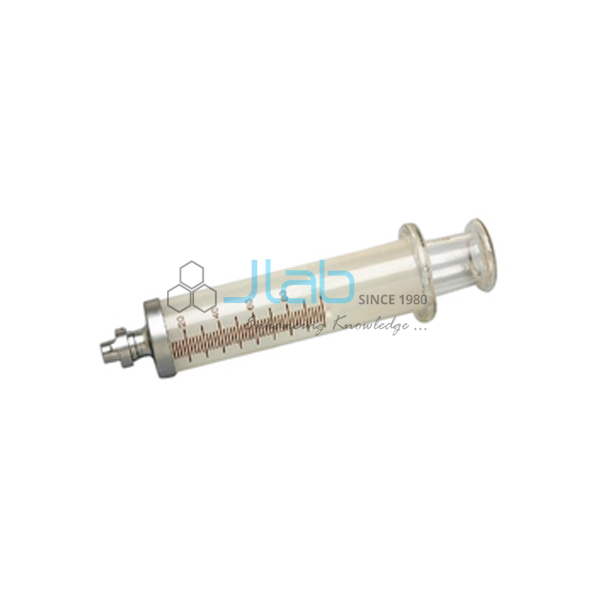
Gas Syringe (code EL-SLE-5734) is a 50 ml graduated syringe for measuring and holding small amounts of gases or liquids, read on a 1 ml scale marked on two sides of the cylinder. In school and college chemistry it collects the gas given off by a reaction so that its volume can be read at timed intervals. It is made by Jain Laboratory Instruments Pvt Ltd (JLab) at its works in Ambala, India.
Get a quote: use the Add To Cart enquiry button below, or send your quantity and destination through the contact page.
Specifications
| Parameter | Detail |
|---|---|
| Capacity | 50 ml |
| Graduation | 1 ml |
| Scale | Marked on two sides of the cylinder |
| Purpose | Measuring and holding small amounts of gases or liquids |
| Barrel and plunger materials | To be confirmed with your quotation |
| Quality check | Each gas syringe is visually inspected before dispatch |
| Pack quantity | Each (sold individually) |
| Minimum order quantity | 10 units |
| Dispatch time | Usually 7–10 working days |
| Product code | EL-SLE-5734 |
| Manufacturer | Jain Laboratory Instruments Pvt Ltd (JLab) — OEM |
| Country of origin | India (made in Ambala, Haryana) |
How Does It Compare with the JLab Glass Syringe?
| Model | Capacities listed | Listed details |
|---|---|---|
| This gas syringe (EL-SLE-5734) | 50 ml | Graduated in 1 ml; scale on two sides; for gases or liquids |
| Glass Syringe | 1 ml to 50 ml | Glass; multi-fit interchangeability; supplied non-sterile |
Choose the gas syringe for collecting and reading gas volumes in reaction-rate and gas-law work. The glass syringe listing covers a range of capacities from 1 ml up to 50 ml with multi-fit interchangeability.
What Is the Gas Syringe Used For?
A gas syringe is the standard way to measure how much gas a reaction gives off. The reaction flask is closed with a bung carrying a delivery tube, the tube is joined to the syringe, and as gas forms it pushes the plunger out along the scale. Reading the volume every few seconds with a stop clock gives the data for a rate-of-reaction graph — for example magnesium ribbon or marble chips reacting with dilute acid, or hydrogen peroxide decomposing over a catalyst — in class 12 chemical kinetics and college labs. The same syringe can hold a fixed sample of gas for simple pressure–volume demonstrations, and the two-sided scale lets students read it from either side of the bench.
Clamp the syringe horizontally so the plunger moves freely, check that it reads zero before the reaction starts, and use amounts of reactant that will not drive the plunger past the 50 ml mark. Keep the barrel and plunger clean and dry, store them together as a matched pair, and never force a plunger that sticks.
What to Specify When Ordering
- Quantity — the minimum order is 10 units; reaction-rate practicals usually need one syringe per group.
- Materials — ask JLab to confirm the barrel and plunger materials in the quotation.
- Set-up items — stop clocks, rubber bungs, delivery tubes and magnesium ribbon for complete rate-of-reaction benches.
Frequently Asked Questions
What is a gas syringe used for?
Measuring and holding small amounts of gases or liquids. In practicals it collects the gas from a reaction so its volume can be read against time.
What is its capacity and graduation?
50 ml, graduated in 1 ml divisions, with the scale marked on two sides of the cylinder.
What is it made of?
The materials of the barrel and plunger are confirmed with the quotation; ask JLab if your specification requires a particular material.
How do I connect it to a reaction flask?
Fit the flask with a one-hole rubber bung and a delivery tube, join the tube to the syringe nozzle with a short length of rubber tubing, and clamp the syringe horizontally so the plunger can slide out freely.
What happens if more than 50 ml of gas is produced?
The plunger can be pushed out of the barrel. Reduce the amount of reactant so the total gas stays within the 50 ml scale.
What are the minimum order and dispatch time?
The minimum order is 10 units, sold individually. Dispatch is usually within 7–10 working days after each syringe is visually inspected; export transit time depends on the destination.
What should an export quotation request include?
The quantity, destination country and port or city, delivery terms such as FOB or CIF, packing or labelling instructions and the tender reference if relevant.
Who manufactures the gas syringe?
Jain Laboratory Instruments Pvt Ltd, trading as JLab, at its works in Ambala, Haryana, India, quoting directly as the manufacturer.
OEM Manufacturer
JLab is the trading name of Jain Laboratory Instruments Pvt Ltd, a manufacturer of chemistry and physics teaching apparatus in India, incorporated in 2017 and based on Hargolal Road, Ambala, Haryana. The gas syringe is made at JLab’s own works, not bought in from a trader, so schools, colleges, dealers and importers order factory-direct; each syringe is visually inspected before dispatch, and repeat orders are handled by the manufacturer. JLab exports worldwide and ships to buyers in every region — Canada in North America, Kyrgyzstan in Central Asia, Taiwan in East Asia, Slovakia in Eastern Europe and Mauritius in East Africa, for instance. For tenders, see the JLab lab tenders page.
Reaction Rate and Gas Apparatus
- Stop Clock — a laboratory stop clock with start, stop and reset for timing readings.
- Magnesium Ribbon (25 Grams) — magnesium ribbon for reactions with dilute acid.
- Bungs Rubber — bored rubber bungs to seal the reaction flask around the delivery tube.
- Delivery Tube Glass — soda lime glass delivery tubes to carry the gas to the syringe.
- Boyles Law Apparatus — a bench apparatus for studying pressure and volume of a fixed sample of gas.
See the full School Lab Equipment range for more chemistry lab equipment.
Request a Quote
Quotes come direct from the manufacturer. Use the Add To Cart enquiry button on this page, or send the quantity (minimum 10 units), any stop clocks, bungs or tubes to add, and your delivery location through the contact page.
Last updated: 4 October 2026