Joints, Socket, Single Manufacturer,Supplier and Exporter in India
Product Code : EL-SDAJ-1676
Jlab Export is a leading Joints, Socket, Single Manufacturer,and suppliers in India
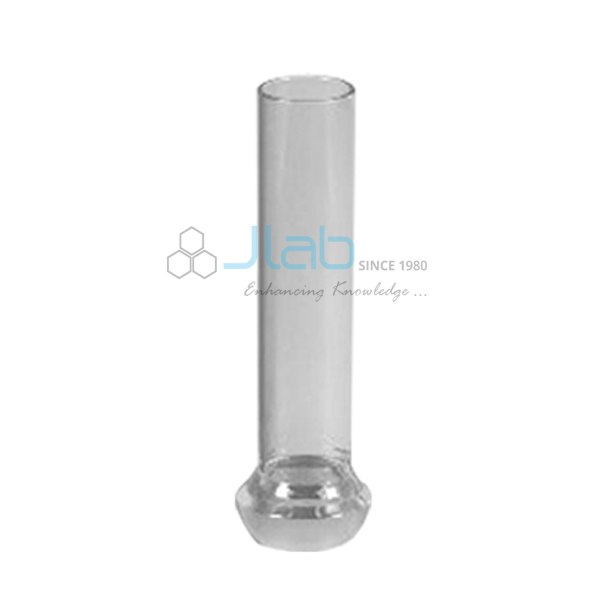
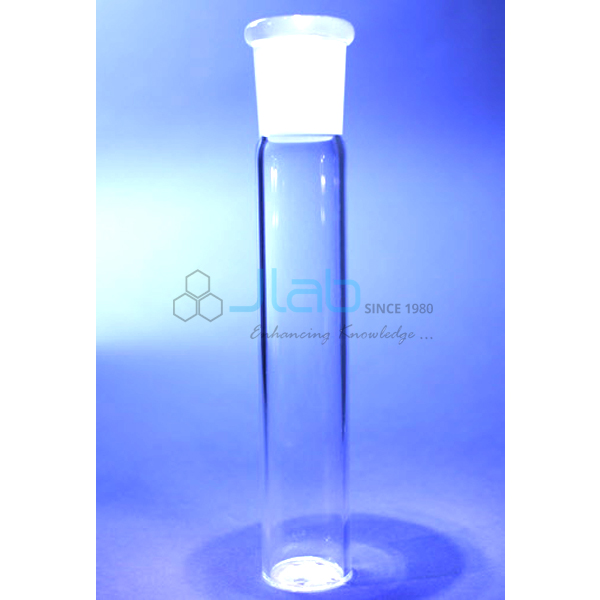
Sealed onto a tube or a flask neck, this ground glass socket gives the piece a standard joint that any cone of the same B number will fit. The socket is on a 110 mm shank and is made in twelve sizes, from B7 to B55.
Specifications
| Type | Single socket (female) ground glass joint |
| Shank length | 110 mm |
| Socket sizes | B7, B10, B12, B14, B19, B24, B29, B34, B40, B45, B50 and B55 |
| Minimum order quantity | 50 units |
| Dispatch time | Usually 3–5 working days |
| Manufacturer | JLab (Jain Laboratory Instruments Pvt Ltd), Ambala, India |
Glassblowing Workshop Practice with Sockets
In glassblowing workshop practice, trainees seal this socket onto a plain tube or the neck of a bulb to give it a standard joint. A good first piece is a jointed side arm. Its socket then takes an Adapters - Cone and Rubber Tubing Straight Connection of the same B size, so a hose can be fitted and removed easily.
Pieces made this way go into college reflux and distillation practicals with parts such as Condensers Allihn. Students learn to hold each piece with its own clamp, so a socket never carries the weight of the part above it.
Frequently Asked Questions
Is there a joint type that sticks less than a tapered socket?
Screw thread and flat flange joints seal on a ring or gasket, so ground glass does not press on ground glass and they seldom seize. A tapered socket is still the usual choice for standard apparatus, because every cone of the same B size fits it.
Can two different B sizes be joined?
Not directly, as a cone only fits a socket with the same B number. Fit one of the Reduction Adapters or Expansion Adapters between them. Each has a cone of one size and a socket of another.
How should a jointed set-up be clamped?
Clamp each piece at its neck or body close to the joint, never on the ground surfaces. If one part hangs its weight on a joint, the cone can slip out or the socket can crack once the glass warms up.
Why can a matching cone still wobble in the socket?
Usually one of the ground surfaces is worn or chipped, or the two parts are of different ground lengths. Try the cone in another socket of the same size. If the wobble follows one part, that part is at fault.
Other Joints and Joint Clips
For a quote, use Add To Cart or send us a message through the contact page.
Last updated: 14 November 2026