Microprocessor Conductivity/TDS Meter Manufacturer,Supplier and Exporter in India

Product Code : EL-CM-2190
Jlab Export is a leading Microprocessor Conductivity/TDS Meter Manufacturer,and suppliers in India
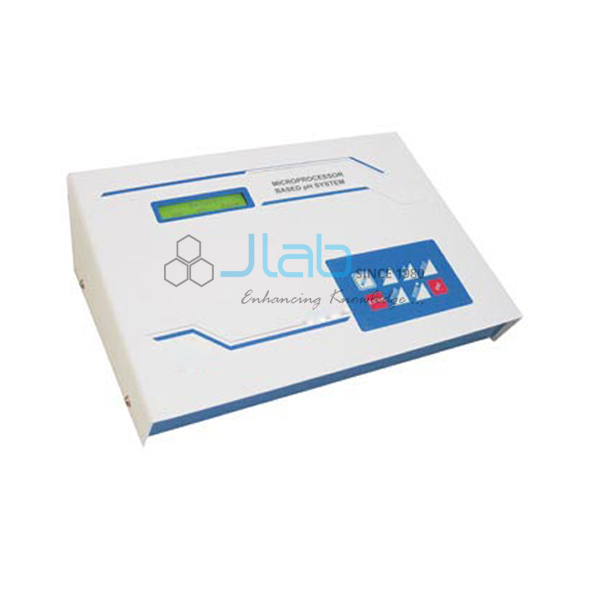
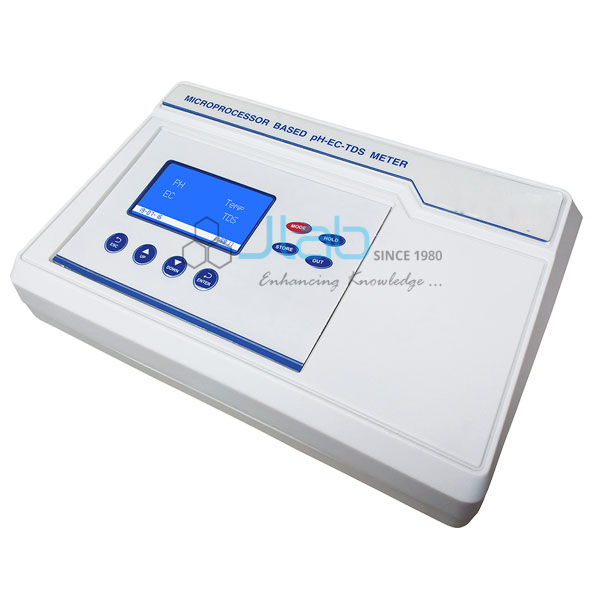
Where a lab needs conductivity and TDS without pH or salinity, this microprocessor bench meter covers both, along with temperature. It ranges automatically from 0–20 µS up to 0–200 mS, corrects readings with automatic temperature compensation and stores up to 90 results, even when switched off. It comes with a conductivity/TDS cell and a temperature probe.
Specifications
| Measures | Conductivity, TDS and temperature |
| Conductivity | Five auto ranges, 0–20 µS up to 0–200 mS, accuracy ±0.5% FS ±1 digit, resolution 0.01 µS |
| TDS | Five auto ranges, 0–20 ppm up to 0–200 ppt, accuracy ±1% FS ±1 digit, resolution 0.01 ppm |
| Temperature | 0–100 °C, resolution 0.1 °C |
| Cell constant | Adjustable, 0.05–10.5 |
| Temperature compensation | Auto or manual, 0–50 °C, coefficient adjustable 0.1–4.0% |
| Readout and keys | 16 x 2 line alphanumeric LCD, 8 soft-touch membrane keys |
| Memory and printer | Up to 90 samples, Centronics interface for a dot matrix printer |
| Power | 230 V ±10% AC, 50 Hz |
| Supplied with | Conductivity/TDS cell, temperature probe, dust cover, instruction manual |
| Minimum order quantity | 1 unit |
| Dispatch time | Usually 7–10 working days |
| Manufacturer | JLab (Jain Laboratory Instruments Pvt Ltd), Ambala, India |
Finding a Cell Constant and Other Practicals
Finding the cell constant is a standard college practical. Students make up a standard solution of Potassium Chloride, note its temperature with a Laboratory Thermometer and read its conductance. Dividing the known conductivity of that KCl solution by the measured conductance gives the cell constant, which is then entered on the meter.
The meter also suits a conductometric titration of a strong acid with a strong base. The base is added from a Burette, Borosilicate Glass, with PTFE Stopcock in small portions, with a conductivity reading after each one. Plotted against volume, the points form two straight lines in a V shape, and the lowest point marks the end point.
Frequently Asked Questions
What happens to stored readings when the meter is switched off?
They stay in memory. The meter holds up to 90 sample results after power-off, and any of them can be printed later on a dot matrix printer connected through the Centronics interface. Number your samples in the same order in your notebook so each printout can be matched.
How do I keep the conductivity/TDS cell in good condition?
Rinse the cell with distilled water after use and store it clean. Do not rub or scratch the electrode surfaces, because a damaged surface changes the cell constant. If readings drift after cleaning, check the constant again with a standard KCl solution.
Why is the TDS figure smaller than the conductivity figure?
TDS is calculated by multiplying conductivity by a factor below one, so the TDS value in ppm comes out smaller than the conductivity in µS. The two always move together, so a rise in one shows as a rise in the other.
What is supplied with the meter?
It is supplied with a conductivity/TDS cell, a temperature probe for the automatic compensation, a dust cover and an instruction manual. It runs on 230 V AC mains at 50 Hz.
Other Microprocessor and Digital Conductivity Meters
- Microprocessor EC-TDS-Sal Meter (adds salinity)
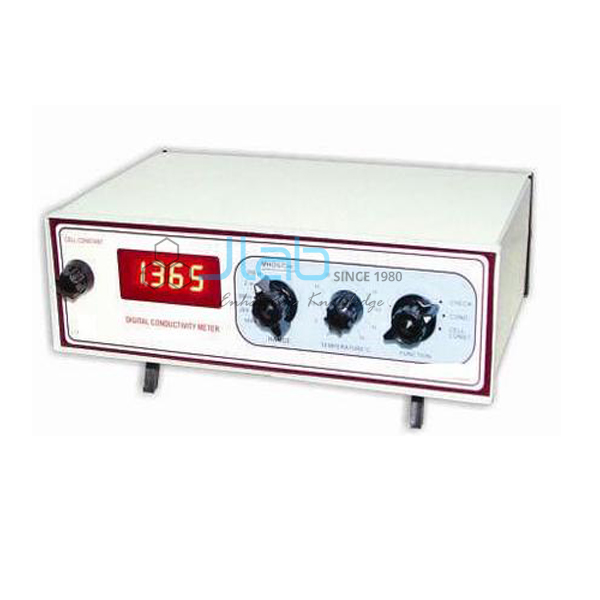
- Digital Conductivity Meter (3½ digit LED, microcontroller based)
- Conductivity Meter (portable, battery powered)
- Conductivity Bridge
For a quote, use Add To Cart or send us a message through the contact page.
Last updated: 6 November 2026