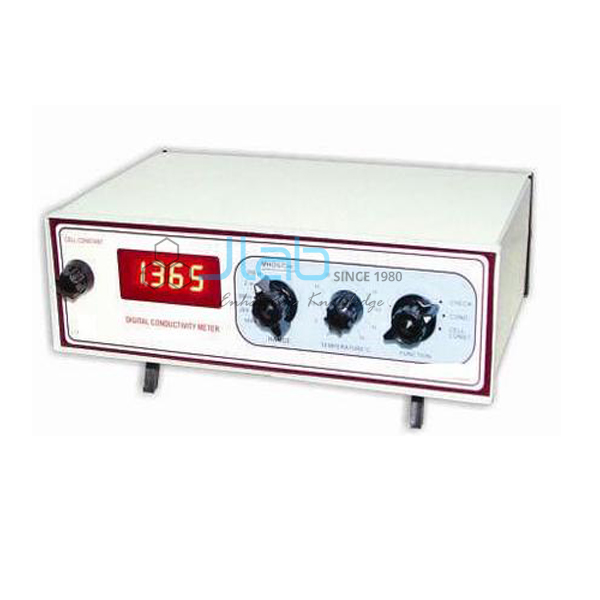
Digital Conductivity/TDS Meter Manufacturer,Supplier and Exporter in India
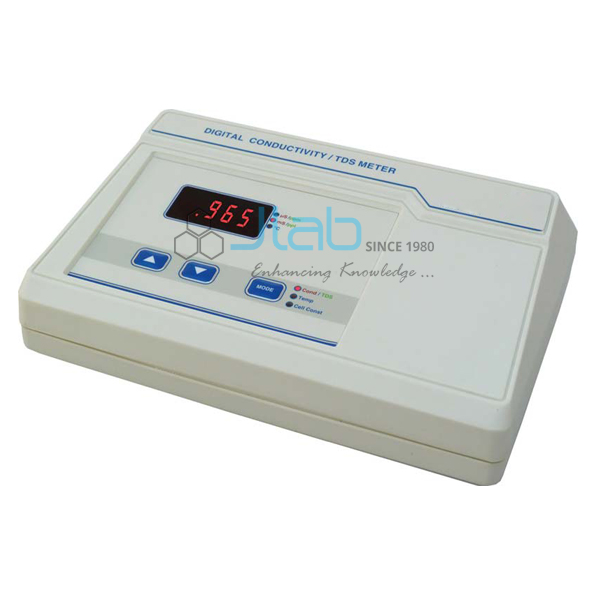
Product Code : EL-CM-2191
Jlab Export is a leading Digital Conductivity/TDS Meter Manufacturer,and suppliers in India
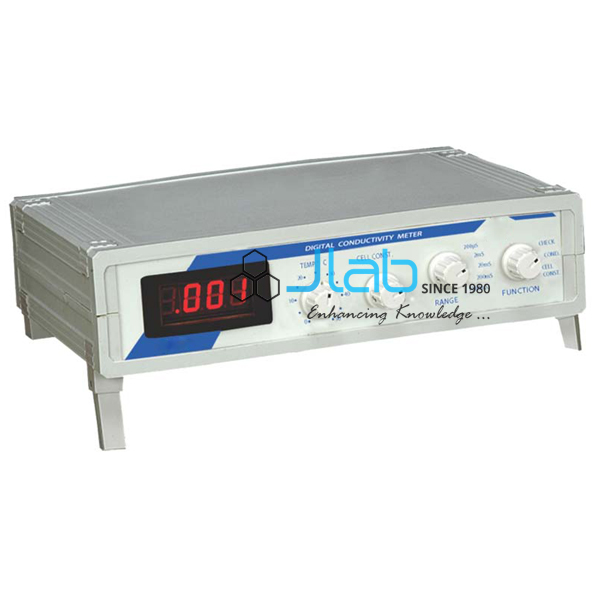
This microcontroller meter can find its own cell constant. Dip the platinum dip-type cell in a standard solution of known conductivity and the meter sets the constant itself. It reads conductivity up to 1000 mS/cm and TDS up to 1000 ppt in five automatic ranges, shown on a bright red 3½ digit LED display.
Specifications
| Measures | Conductivity and TDS |
| Display | 3½ digit bright red LED |
| Conductivity ranges (automatic) | Five, 0–200 µS/cm, 0–2, 0–20, 0–200 and 0–1000 mS/cm |
| TDS ranges (automatic) | Five, 0–200 ppm up to 0–1000 ppt |
| Resolution | 0.1 µS/cm and 0.1 ppm in the lowest range |
| Accuracy | ±0.5% FS ±1 digit |
| Cell constant | Adjustable on the digital display, automatic measurement with any standard solution |
| Temperature compensation | Manual, 0–50 °C |
| Measuring cell and power | Platinum dip-type cell, 12 V DC adapter for 110–250 V AC, 50 Hz |
| Size, weight and accessories | 270 x 202 x 80 mm, about 0.8 kg, supplied with cell, cell stand, 12 V adapter, dust cover and manual |
| Minimum order quantity | 1 unit |
| Dispatch time | Usually 7–10 working days |
| Manufacturer | JLab (Jain Laboratory Instruments Pvt Ltd), Ambala, India |
Conductometric Titration and Cell Constant Practicals
In a physical chemistry lab, students run the automatic cell constant function with a standard solution made from Potassium Chloride. Between solutions they rinse the cell with distilled water from a Wash Bottle. They then compare the value the meter finds with one worked out by hand from the known conductivity of the standard.
For a conductometric titration, a measured volume of Hydrochloric Acid Dilute is stirred on a Magnetic Stirrer while sodium hydroxide solution goes in a little at a time. The conductivity falls to a minimum at the end point and rises after it. Since this meter uses manual temperature compensation, students set the sample temperature first and keep the beaker at a steady temperature through the run.
Frequently Asked Questions
How does the automatic cell constant measurement work?
Place the cell in a standard solution whose conductivity you know, such as a potassium chloride standard, and start the cell constant function. The meter works out the constant from that solution and flashes it on the display. You can also adjust the constant by hand from the front panel.
How do I use the manual temperature compensation?
Measure the sample temperature with a thermometer and set that value on the meter, anywhere from 0 to 50 °C. The meter then corrects the conductivity reading for it. Set it again whenever the sample temperature changes, for example when a titration warms the solution.
Can one meter test both RO water and strong brines?
Yes, within its ranges. The lowest range, 0 to 200 µS/cm with 0.1 µS/cm resolution, suits RO and drinking water, while the top range reaches 1000 mS/cm for concentrated salt solutions. The meter picks the range on its own.
How should the platinum dip cell be cleaned?
Rinse it in distilled water after every sample, and soak a cell that has dried out in clean water before use. Never wipe or scratch the platinum plates, as any change to their surface alters the constant. If readings turn sluggish, clean the cell gently and repeat the automatic cell constant check.
Other Bench Conductivity Meters
- Digital Conductivity Meter (models with temperature probe and ATC)
- Digital Conductivity Meter (conductivity only, mains powered)
- Microprocessor Conductivity/TDS Meter (sample memory and printer port)
- Conductivity Meter (hand-held)
For a quote, use Add To Cart or send us a message through the contact page.
Last updated: 6 November 2026