Minerals Luster Collection (Set of 10) Manufacturer,Supplier and Exporter in India
Product Code : EL-ERAM-4375
Jlab Export is a leading Minerals Luster Collection (Set of 10) Manufacturer,and suppliers in India
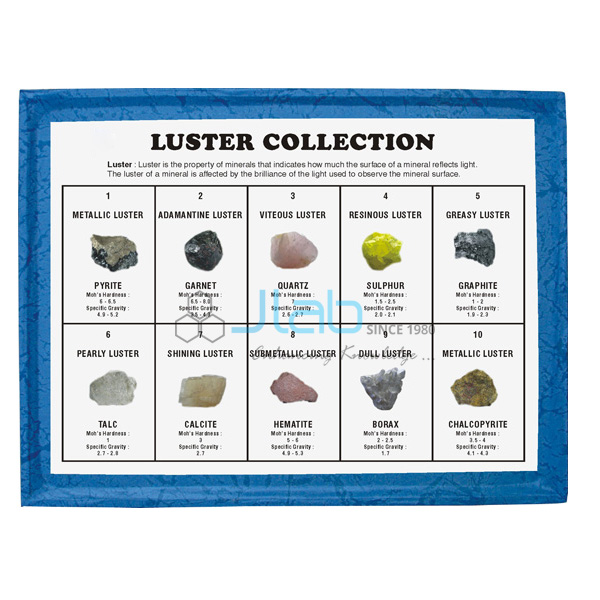
Minerals Luster Collection (Set of 10) (code EL-ERAM-4375) is a set of 10 mineral specimens that show the main kinds of lustre (luster) — how a mineral’s surface reflects light — from metallic and submetallic to adamantine, vitreous, resinous, greasy, pearly and dull. It is used for mineral identification lessons in school and college geology and earth science labs. Jain Laboratory Instruments Pvt Ltd (JLab) prepares the collection at its works in Ambala, India.
Get a quote: use the Add To Cart enquiry button below, or send your quantity and destination through the contact page.
Specifications
| Parameter | Detail |
|---|---|
| Contents | 10 mineral specimens |
| Property shown | Lustre — how much the surface of a mineral reflects light |
| Lustre types listed | Metallic, submetallic, adamantine, vitreous, resinous, greasy, pearly, dull and “shining” (the listing names metallic twice) |
| Specimen names | Not given in the listing — ask for the specimen list with your quotation |
| Quality check | Each collection is visually inspected before dispatch |
| Pack quantity | One set of 10 specimens |
| Minimum order quantity | 10 units |
| Dispatch time | Usually 7–10 working days |
| Product code | EL-ERAM-4375 |
| Manufacturer | Jain Laboratory Instruments Pvt Ltd (JLab) — OEM |
| Country of origin | India (made in Ambala, Haryana) |
What Each Lustre Looks Like
| Lustre | Group | What the surface looks like |
|---|---|---|
| Metallic | Metallic | Opaque and shining like polished metal |
| Submetallic | Metallic | Metal-like but duller than a true metallic shine |
| Adamantine | Non-metallic | Brilliant, diamond-like sparkle |
| Vitreous | Non-metallic | Glassy |
| Resinous | Non-metallic | Like a piece of resin |
| Greasy | Non-metallic | As if coated with a thin film of oil |
| Pearly | Non-metallic | A soft, pearl-like sheen, often on cleavage faces |
| Dull | Non-metallic | Little or no shine, as on earthy or clay minerals |
| “Shining” | As listed | Not a standard lustre term — ask JLab which specimen the listing means |
What Is the Minerals Luster Collection Used For?
Lustre is usually the first property students record after colour, and it divides minerals into two broad groups: metallic minerals, which are opaque and shine like polished metal, and non-metallic minerals, whose surfaces may be glassy, brilliant, resinous, greasy, pearly or dull. Familiar examples fix the terms — galena is metallic, quartz vitreous, talc pearly and kaolin clay dull. Because the brightness of the light changes how a surface appears, students should compare all ten specimens under the same lamp or daylight, turning each one until light falls on a clean face.
The collection supports rocks-and-minerals lessons in secondary-school geography and science, college geology and earth science practicals, and teacher training, and is often used with streak and colour sets so that students learn to record several properties for each mineral. Keep the specimens clean and dry; dust and fingerprints dull a surface and can make a vitreous mineral look greasy.
What to Specify When Ordering
- Quantity — at least 10 sets.
- Specimen list — ask for it with your quotation, including which mineral represents the “shining” lustre.
- Companion sets — streak, colour and cleavage collections for a full mineral-properties practical.
Frequently Asked Questions
What is lustre in minerals?
Lustre (luster) describes how much, and in what way, the surface of a mineral reflects light — for example metallic, glassy (vitreous) or pearly.
Which lustre types does this set show?
The listing names metallic, submetallic, adamantine, vitreous, resinous, greasy, pearly, dull and “shining” lustre across the 10 specimens, with metallic named twice.
What is the difference between metallic and non-metallic lustre?
Metallic minerals are opaque and reflect light like polished metal. Non-metallic minerals reflect light in other ways — glassy, brilliant, resinous, greasy, pearly or dull — and many let some light through.
Why should the specimens be viewed under the same light?
The brilliance of the light affects how a surface appears, so comparing every specimen under one lamp or in the same daylight gives fairer results.
What are the minimum order and dispatch time?
The minimum order is 10 sets, and orders are usually dispatched within 7–10 working days after each set is visually checked. Export quotations need the destination port or city, delivery terms such as FOB or CIF and any tender reference.
Who manufactures this collection?
JLab, the trading name of Jain Laboratory Instruments Pvt Ltd, prepares it at its works in Ambala, Haryana, India.
OEM Manufacturer
JLab is the trading name of Jain Laboratory Instruments Pvt Ltd, a school and college lab equipment manufacturer in India, incorporated in 2017 and based on Hargolal Road, Ambala, Haryana. The lustre collection is prepared at JLab’s own works rather than sourced from a trader, so schools, colleges, dealers and importers buy straight from the manufacturer; each set is inspected by eye before dispatch, and repeat orders are handled by the same team. JLab exports worldwide and ships to buyers in every region — for example Botswana in Southern Africa, the USA in North America, Jamaica in Central America and the Caribbean, Taiwan in East Asia and Norway in Northern Europe. Tender details are on the JLab lab tenders page.
Related Mineral Property Collections
- Minerals Streak Collection (Set of 10) — ten streak colours, from white and colourless to greenish black.
- Minerals Colour Collection (Set of 10) — minerals of different colours, from green and yellow to purple.
- Minerals Cleavage Collection (Set of 10) — minerals with basal, cubic, octahedral and other cleavage; pearly lustre often shows on cleavage faces.
- Collection of 9 Mohs Hardness Set — the Mohs scale minerals from talc to corundum.
See the full Educational Rock and Minerals range or the Rocks and Minerals section.
Request a Quote
Quotes come direct from the manufacturer. Use the Add To Cart enquiry button, or send the number of sets (minimum 10 units), any companion collections and your delivery location through the contact page.
Last updated: 9 October 2026