Overflow Vessel (G.I. Sheet) Manufacturer,Supplier and Exporter in India
Product Code : EL-SLE-2148
Jlab Export is a leading Overflow Vessel (G.I. Sheet) Manufacturer,and suppliers in India
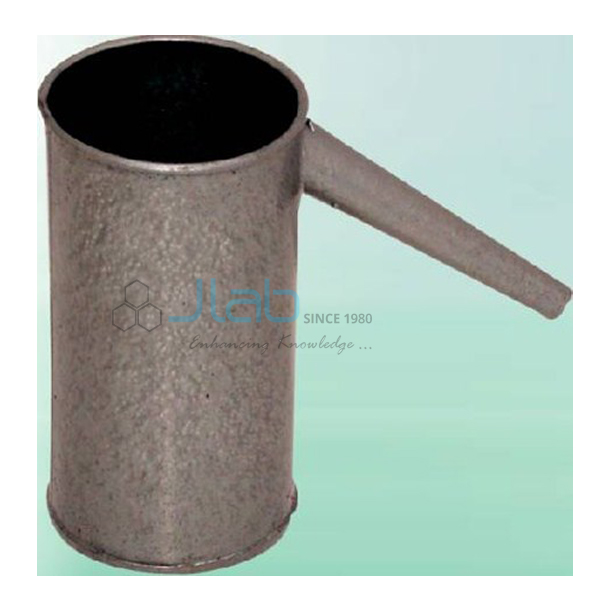
An overflow vessel is a can with a side spout. Filled to the spout and then given a solid, it spills a volume of water equal to the volume of the immersed part. This one is made of galvanised iron sheet with a hammer-tone finish, and its top edge is flared to stiffen the rim.
Specifications
| Material | G.I. (galvanised iron) sheet |
| Finish | Hammer-tone |
| Top edge | Flared for strength |
| Used for | Density, specific gravity and Archimedes principle experiments |
| Other version | Plastic (polypropylene), white |
| Minimum order quantity | 10 units |
| Dispatch time | Usually 4–6 working days |
| Manufacturer | JLab (Jain Laboratory Instruments Pvt Ltd), Ambala, India |
Archimedes and Density Practicals
For Archimedes’ principle, students weigh a solid in air on a Spring Balance. They lower it into the vessel filled to the spout and weigh it again while it is fully under water. They collect and weigh the overflow and find that the loss of weight equals the weight of water pushed out.
To find the density of a stone too wide for a cylinder, students catch the overflow in a Measuring Cylinder. Dividing the mass of the stone by this volume gives its density. Teachers often show the same principle first with the Bucket and Cylinder set.
G.I. Sheet or Plastic Version
This vessel is a metal can with a flared, stiffened rim and a hammer-tone finish. The plastic version has a white polypropylene body that is unbreakable and does not corrode, with a spout to drain the overflow.
Frequently Asked Questions
Do we need an overflow vessel if we already have measuring cylinders?
Yes, for larger solids. A small object that fits inside a measuring cylinder can be measured by the rise in water level. A stone, a metal block or anything wider than the cylinder needs the overflow vessel, and the spilled water is then read in the cylinder.
Can the same vessel be used for density and relative density work?
Yes. Weigh the solid on a balance, find its volume from the overflow and divide mass by volume for density. For relative density, compare the weight of the solid in air with the weight of the water it displaces.
Does a solid really lose weight when it is put in water?
No. Its mass and the pull of gravity on it stay the same. The water pushes up on it with a force called upthrust, so the spring balance shows a smaller apparent weight. The drop in the reading equals the upthrust.
Is the volume of water that overflows equal to the volume of the solid?
Only when the solid is completely under water. A floating or half-dipped object pushes out water equal to the volume of its submerged part. That is why the solid must be fully covered before the overflow is measured.
Why must the solid not touch the sides or bottom of the vessel?
If it rests on the can, the vessel takes part of its weight. The spring balance then reads too low, and the loss of weight looks larger than the upthrust. Lower the solid slowly and keep it centred, clear of the walls and base.
Other Displacement Cans and Archimedes Sets
- Overflow Vessel (Plastic)
- Eureka Can (Overflow Cans Plastic)
- Overflow Can
- Set for Archimedes Principle Experiment
For a quote, use Add To Cart or send us a message through the contact page.
Last updated: 16 November 2026