Physics of Fiber Optics Trainer Manufacturer,Supplier and Exporter in India
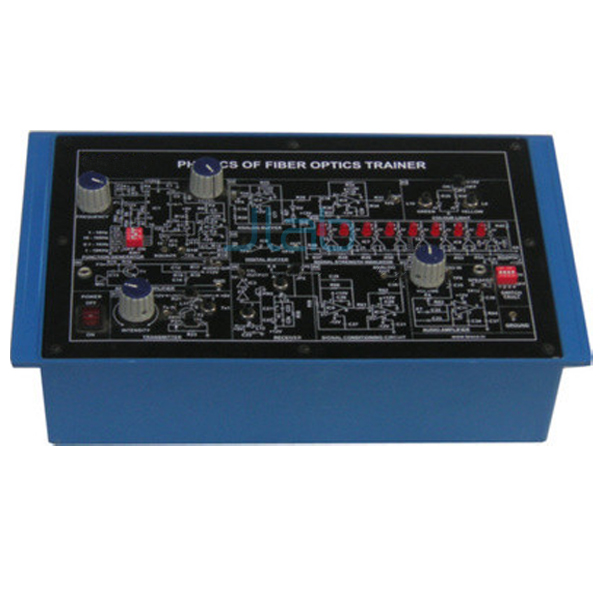
Product Code : EL-FOT-1543
Jlab Export is a leading Physics of Fiber Optics Trainer Manufacturer,and suppliers in India
Physics of Fiber Optics Trainer (code EL-FOT-1543) is a fibre optics trainer for college physics and electronics labs that takes students from the basic behaviour of light in an optical fibre to working analogue, digital and voice links, with an on-board function generator for the test signals. It is made by Jain Laboratory Instruments Pvt Ltd (JLab) at its works in Ambala, India.
Specifications
| Parameter | Detail |
|---|---|
| Light experiments | Light travelling around corners in an optical fibre; coloured light travelling down an optical fibre; photodetector detecting light; LED output as a function of current; transmission of light between two fibres; transmission through a gap between fibres; fibre optic transmission sensor; fibre optic reflection sensor; measurement of numerical aperture |
| Link experiments | Setting up a fibre optic analogue link, a digital link and a voice link |
| Loss measurements | Propagation loss in the fibre; connector loss; fibre bending loss |
| Switched faults | Fault 1 in the function generator section; fault 2 in the audio preamplifier section; fault 3 in the signal strength section; fault 4 in the audio amplifier section |
| Transmitter | 1 LED, peak emission wavelength 635 nm (visible red) |
| Driver circuit | Analogue and digital configuration for the 635 nm LED |
| Receivers | 2 silicon photodetectors |
| Modulation | Intensity modulation |
| Bandwidth | Analogue 35 kHz; digital 50 kHz |
| On-board function generator | Sine wave and TTL square wave; ranges 1–10 Hz, 10–100 Hz, 100 Hz–1 kHz and 1–10 kHz; amplitude 0–4 Vpp (except square wave) |
| Voice link | Fibre optic voice link using a dynamic microphone and speaker |
| Signal strength indicator | 8 LEDs to measure optical power |
| Optical fibre | 1000 micron step-index multimode plastic fibre |
| Power supply | GND, +5 V, +12 V and −12 V at 100 mA (internal) |
| Accessories | 10 red short links; 2 crocodile links; 1 m and 5 m plastic fibres with connectors; NA jig and NA scale; connection sleeve (splicing unit); microphone; speaker; experiment manual; mandrel |
| Other apparatus required | Cathode ray oscilloscope, 20 MHz |
| Quality check | Each trainer is visually inspected before dispatch |
| Pack quantity | Each (sold individually) |
| Minimum order quantity | 10 units |
| Dispatch time | Usually 7–10 working days |
| Product code | EL-FOT-1543 |
| Manufacturer | Jain Laboratory Instruments Pvt Ltd (JLab) — OEM |
| Country of origin | India (made in Ambala, Haryana) |
What Is the Physics of Fiber Optics Trainer Used For?
Light that enters an optical fibre is held inside it by total internal reflection, so it follows the fibre around a bend instead of travelling in a straight line. The opening experiments make this visible: light travelling around corners, coloured light running down a fibre and a photodetector responding to it. Students then see how much light passes from one fibre to another and across a gap, try the fibre optic transmission and reflection sensors, and measure numerical aperture, which describes the range of angles over which a fibre accepts light.
Further experiments turn the trainer into a communication link. The LED is intensity-modulated, meaning the strength of its light follows the signal, and the receiver turns the light back into an electrical signal. Measuring propagation, connector and bending losses shows why fibre length, joints and tight bends matter when an optical link is planned.
What to Specify When Ordering
- The number of trainers, for example one per bench or per student group.
- Any oscilloscope or other instruments you want quoted on the same enquiry.
- Other fibre optic trainers for the same lab, such as the numerical aperture or voice trainers linked below.
- The delivery address or port and your preferred delivery terms.
Frequently Asked Questions
Why is the transmitter a visible red LED?
At 635 nm the LED gives visible red light, so students can watch light leave the fibre, follow a bend and cross a gap between fibres. That makes the light-guiding experiments easier to follow than they would be with an invisible infrared source.
What bandwidth do the analogue and digital links offer?
35 kHz on the analogue link and 50 kHz on the digital link. The LED driver has analogue and digital configurations, and two silicon photodetectors act as receivers.
Which faults can be switched in?
Four. Fault 1 sits in the function generator section, fault 2 in the audio preamplifier, fault 3 in the signal strength section and fault 4 in the audio amplifier. Switching one in and tracing its effect gives practice in fault-finding on a working link.
What fibre does the trainer use?
1000 micron step-index multimode plastic fibre. Two lengths, 1 m and 5 m, come with connectors fitted, so loss can be compared between a short and a long fibre.
Is an oscilloscope needed?
Yes. A 20 MHz cathode ray oscilloscope is other apparatus required for the experiments and is ordered separately; JLab’s Cathode Ray Oscilloscope can be quoted on the same enquiry.
What should an export enquiry include?
The number of trainers, the destination country and port or city, preferred delivery terms such as FOB or CIF, any packing or labelling needs and a tender reference if one applies.
Who makes this trainer?
Jain Laboratory Instruments Pvt Ltd (JLab) builds it at its works in Ambala, Haryana, India.
OEM Manufacturer
JLab is the trading name of Jain Laboratory Instruments Pvt Ltd, an Indian manufacturer of physics, electronics and communication trainers, incorporated in 2017 and based on Hargolal Road, Ambala, Haryana. The trainer is made in JLab’s own works rather than sourced from a trader, so colleges, institutes, dealers and importers deal directly with the maker; every unit is visually inspected before dispatch, and repeat orders and replacement accessories are handled by the same manufacturer. JLab exports worldwide and ships to buyers in every region — Germany in Western Europe, Brazil in South America, Latvia in Northern Europe, the Czech Republic in Eastern Europe and Vanuatu in Oceania are a few examples. Institutional buyers can find tender details on the JLab lab tenders page.
More Fibre Optic Trainers and Test Equipment
- Elementary Fiber Optics Trainer — a simplex analogue and digital trainer with AM, FM and PWM modulation and demodulation.
- Advanced Fiber Optics Trainer — a full-duplex analogue and digital trainer with two LED transmitters and PC-to-PC communication through serial ports and software.
- Fibre Optic Trainer for Numerical Aperture — measures the numerical aperture of PMMA plastic fibre and the loss in PMMA patch cords.
- Fibre Optic Voice Transmitter and Receiver Trainer — sends audio signals and live speech over fibre to a phototransistor receiver.
- Cathode Ray Oscilloscope — a CRO for displaying and analysing voltage signals, offered in several bandwidth versions.
See the full Fiber Optic Trainers range within Electronics Lab Equipments.
Request a Quote
To ask for a quotation, use the Add To Cart enquiry button or write through the contact page with the number of trainers, any oscilloscope or companion trainers to be quoted with them, and the delivery address or port.
Last updated: 22 October 2026