Pin Fin Apparatus Manufacturer,Supplier and Exporter in India
Product Code : EL-HTL-10045
Jlab Export is a leading Pin Fin Apparatus Manufacturer,and suppliers in India
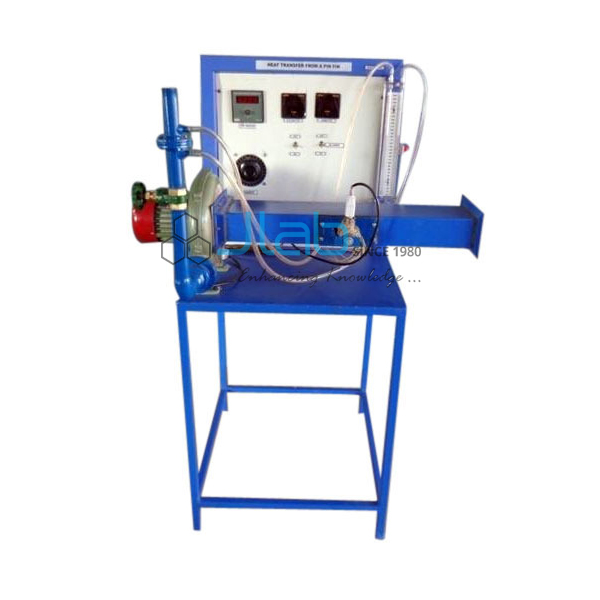
Pin Fin Apparatus (code EL-HTL-10045) is a convection rig in which a pin fin, heated by a band heater, is tested in a 150 x 100 x 1000 mm channel in both natural and forced convection, with fins of MS, brass and aluminium. Five thermocouple tappings along the fin give its temperature profile, and an orifice meter with a water manometer measures the air flow. JLab makes this three-fin convection channel in Ambala, India.
Specifications
| Parameter | Detail |
|---|---|
| Pin fins | 3: MS, brass and aluminium |
| Channel | 150 mm x 100 mm x 1000 mm, connected to the blower suction |
| Blower | Driven by an FHP motor |
| Air flow measurement | Orifice meter with water manometer |
| Heater | Band heater to heat the pin fin |
| Power | Voltmeter and ammeter; dimmerstat to control the input |
| Thermocouples | Cr-Al, 6 tappings, with temperature indicator; five along the fin |
| Supplied with | Technical manual |
| Electricity | 220 V stabilised single phase, with earthing |
| Floor area | 2 m x 1 m x 1 m height |
| Quality check | Each pin fin rig is visually inspected before dispatch |
| Pack quantity | Each (sold individually) |
| Minimum order quantity | 1 unit |
| Dispatch time | Usually 14–18 working days |
| Product code | EL-HTL-10045 |
| Manufacturer | Jain Laboratory Instruments Pvt Ltd (JLab) — OEM |
| Country of origin | India (made in Ambala, Haryana) |
Switching Between Natural and Forced Convection
The channel is connected to the suction side of the blower, so air is drawn past the fin and reaches it before passing through the blower. For a forced run the blower is started, and the orifice meter reading on the water manometer gives the air flow and from it the velocity in the channel. For a natural convection run the blower stays off and the window above the fin is opened to the atmosphere, letting warmed air rise away freely. Each mode yields its own heat transfer coefficient from the fin readings.
What Changing the Fin Material Shows
For a round pin the fin parameter m = √(hP/kA) reduces to √(4h/kd), so at a given diameter and air condition a higher conductivity gives a smaller m and a flatter temperature profile. The aluminium fin therefore stays warmer towards its tip than the brass one, and the mild steel fin cools off fastest along its length. Setting the measured profiles against the theoretical curve, and working out the heat loss and effectiveness of each fin, shows why fins are usually made from good conductors.
Other Fin and Convection Rigs
- Heat Transfer From Pin-Fin Apparatus — pin-type fin in a duct, with blower, orifice, manometer and 12-channel indicator.
- Natural Convection Apparatus — vertical brass pipe with seven thermocouples for local natural convection coefficients.
- Heat Transfer In Forced Convection — test pipe on the delivery side of a blower, inside a Nichrome heater.
It belongs to Heat Transfer Lab, part of Engineering Lab Equipment.
Request a Quote
Request a quotation for the rig with Add To Cart or on the contact page, giving the quantity and the delivery address.
Last updated: 30 October 2026