Composite Walls Apparatus Manufacturer,Supplier and Exporter in India
Product Code : EL-HTL-10041
Jlab Export is a leading Composite Walls Apparatus Manufacturer,and suppliers in India
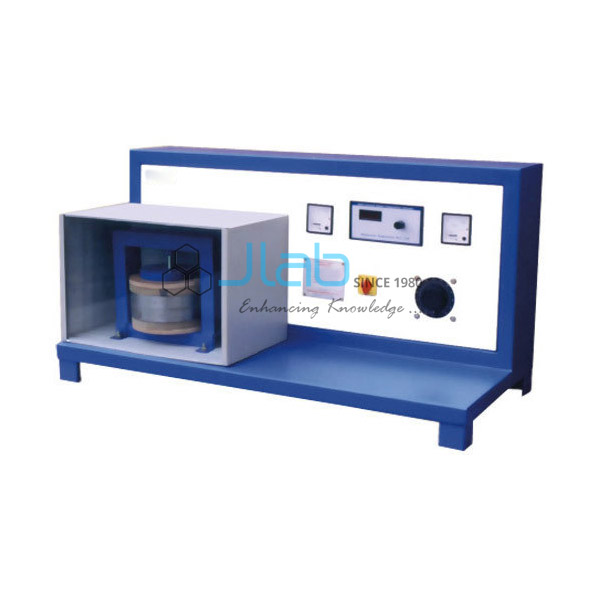
Composite Walls Apparatus (code EL-HTL-10041) is a conduction unit in which MS, Bakelite and brass or aluminium plates, all 250 mm in diameter, sit in series on both sides of a mica heater to form a composite wall. Thermocouple tappings through the stack give the temperatures from which the resistance and conductivity of the wall are found. JLab assembles the plate stack, clamping frame and meter panel in Ambala, India.
Specifications
| Parameter | Detail |
|---|---|
| Heater | Mica heater, 250 mm diameter |
| MS plates | 2, each 25 mm thick and 250 mm diameter |
| Bakelite plates | 2, each 10 mm thick and 250 mm diameter |
| Brass or aluminium plates | 2, each 15 mm thick and 250 mm diameter |
| Controls and meters | Dimmerstat of 2 A capacity; voltmeter and ammeter for input power |
| Temperature measurement | Thermocouple tappings with a multichannel digital temperature indicator |
| Mounting | Plates clamped in a frame, viewed through an acrylic sheet |
| Supplied with | Technical manual |
| Electricity | 230 V AC, stabilised, with earthing |
| Bench area | 1 m x 1 m x 0.5 m height |
| Quality check | Each composite wall unit is visually inspected before dispatch |
| Pack quantity | Each (sold individually) |
| Minimum order quantity | 1 unit |
| Dispatch time | Usually 14–18 working days |
| Product code | EL-HTL-10041 |
| Manufacturer | Jain Laboratory Instruments Pvt Ltd (JLab) — OEM |
| Country of origin | India (made in Ambala, Haryana) |
Why the Heater Sits Between Two Stacks
With an identical set of plates on each side, the heater output divides equally between the two stacks, so each carries half of the electrical input, Q = VI/2, read from the voltmeter and ammeter. Clamping the stack in its frame keeps the plates in close contact, which limits the extra resistance at each joint, and the acrylic sheet leaves the assembly in view during a run.
Resistance and Conductivity From the Readings
Each plate has a conduction resistance R = L/(kA), where L is its thickness and A = πd²/4 is the face area, the same for every layer because all the discs share one diameter. At steady state the temperature drops across the MS, Bakelite and metal layers add up to the drop across the whole wall, so R_total = ΔT_total/Q, and the stack behaves like one material of conductivity k = Q × (total thickness)/(A × ΔT_total). The steepest fall appears across the 10 mm Bakelite, which conducts far less heat than either metal. Repeating the run at other dimmerstat settings checks that the resistances stay constant.
Other Steady Conduction Set-ups
- Heat Transfer Through Composite Wall — MS, Bakelite and wood specimens between clamp plates, with a 12-channel indicator.
- Lagged Pipe Apparatus — radial conduction through two lagging materials between three concentric G.I. pipes.
- Thermal Conductivity of Insulating Powder — powder packed between two thin-walled concentric copper spheres, heated from inside.
The unit is part of the Heat Transfer Lab range of Engineering Lab Equipment.
Request a Quote
For a quotation, add the unit with Add To Cart or write through the contact page, stating brass or aluminium for the third pair of plates, the quantity and the delivery address.
Last updated: 30 October 2026