Culex Male, Female Model Manufacturer,Supplier and Exporter in India

Product Code : EL-BE-5197
Jlab Export is a leading Culex Male, Female Model Manufacturer,and suppliers in India
Culex is the common house mosquito of Indian towns, and the female of Culex quinquefasciatus carries the worm that causes filariasis. This pair gives students two separate models, an adult male and an adult female Culex, on one labelled base with a key. They learn how the two sexes of one species differ and which features set Culex apart from other mosquitoes.
Specifications
| Type | Zoology teaching model |
| Subject | Two separate models: an adult male and an adult female Culex mosquito |
| Teaching use | Medical entomology and vector biology lessons |
| Body length | About 240 mm each |
| Material | Rigid painted PVC or resin |
| Mounting | One labelled base, 450 x 300 mm, with a key |
| Minimum order quantity | 10 units |
| Dispatch time | Usually 4–6 working days |
| Manufacturer | JLab (Jain Laboratory Instruments Pvt Ltd), Ambala, India |
Practicals with the Culex Pair
Students begin by naming what separates the male from the female. The male has bushy, feathery antennae and long hairy palps, while the female has thin antennae and short palps beside her long proboscis. They then examine a dead mosquito collected from a window sill with a Hand Lens and decide which sex it is.
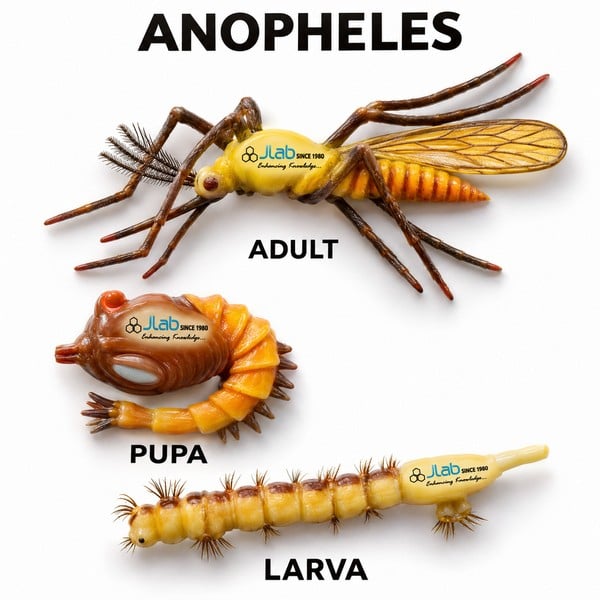
Next, the class compares the pair with the Anopheles Male Female Model. In Anopheles both sexes have long palps. A resting Anopheles also tilts its body at an angle to the wall, while Culex holds its body roughly parallel to the surface. The Culex Head Model helps when the lesson moves on to the mouthparts and the piercing proboscis of the female.
Frequently Asked Questions
Should we order this pair on its own or with the Anopheles pair?
For a lesson on one vector and on filariasis, the Culex pair is enough. For a lesson that compares mosquito vectors, order it with the Anopheles Male Female Model. The palps and resting posture of the two genera can then be compared in one class.
What should be checked when the pair arrives?
Check the thin parts first: legs, antennae, palps, wings and the proboscis are the pieces most likely to suffer in transit. Look for chipped paint, keep the packing until every piece has been checked, and never force a bent leg back into place.
Why does the male Culex have such bushy antennae?
The feathery hairs pick up the hum of a flying female. Males gather in swarms at dusk, and each one homes in on the wingbeat tone of a female that enters the swarm. The female finds her hosts by smell and body warmth, and her antennae carry only short, sparse hairs.
Which diseases does Culex spread in India?
Culex quinquefasciatus spreads the filarial worm Wuchereria bancrofti, which causes lymphatic filariasis and, in long-standing cases, elephantiasis. Other species, such as Culex tritaeniorhynchus, carry the Japanese encephalitis virus. Only the blood-feeding female passes these on.
When and where does Culex bite?
Culex is mainly a night biter. It enters houses after dark and spends the day resting on walls and in dark corners indoors. That habit is why bed nets, window screens and indoor spraying are the usual protection against it.
Other Mosquito and Filariasis Teaching Aids
For a quote, use Add To Cart or send us a message through the contact page.
Last updated: 20 November 2026