D.C. Ammeter Manufacturer,Supplier and Exporter in India
Product Code : EL-SLE-5803
Jlab Export is a leading D.C. Ammeter Manufacturer,and suppliers in India
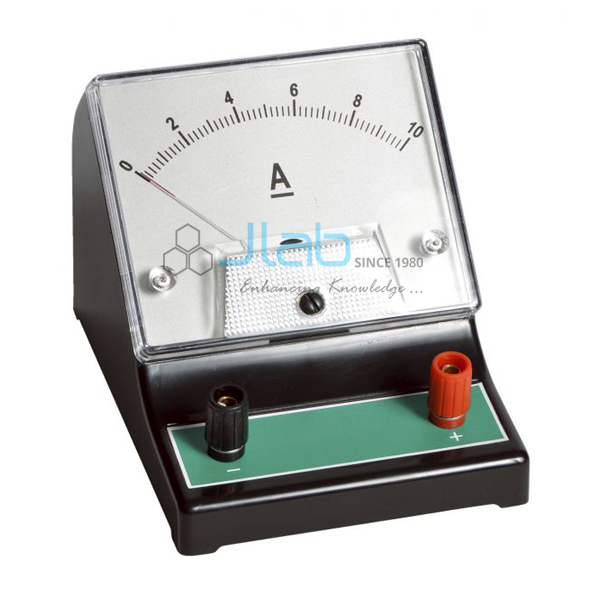
D.C. Ammeter (code EL-SLE-5803) is a dual-range ammeter for measuring direct current in amperes in school and college electricity practicals. One of its two ranges is 0–1 A; the second is listed as 0.5 A, so state the range you need when you enquire. It is connected in series with the part of the circuit being measured. It is made by Jain Laboratory Instruments Pvt Ltd (JLab) at its works in Ambala, India.
Specifications
| Parameter | Detail |
|---|---|
| Measures | Direct current (D.C.), in amperes |
| Ranges | Dual range: 0–1 A, and a second range listed as 0.5 A (confirm with your enquiry) |
| Quality check | Each ammeter is visually inspected before dispatch |
| Pack quantity | Each (sold individually) |
| Minimum order quantity | 10 units |
| Dispatch time | Usually 7–10 working days |
| Product code | EL-SLE-5803 |
| Manufacturer | Jain Laboratory Instruments Pvt Ltd (JLab) — OEM |
| Country of origin | India (made in Ambala, Haryana) |
How Does It Compare with Other JLab Current Meters?
| Meter | Measures | Other listed details |
|---|---|---|
| This D.C. Ammeter (EL-SLE-5803) | Direct current in amperes | Dual range, one range 0–1 A |
| Ammeter | Current in amperes | Desk stand moulded in black and white ABS plastic; single-range and dual-range versions |
| Digital Ammeter | Current in amperes | Digital display, which removes scale-reading and parallax errors |
| Milliammeters (Dual Range) | Small currents in milliamperes | Dual range; black and white ABS plastic desk stand |
Choose this meter when you want a dual-range d.c. ammeter that includes a 0–1 A range. For a numeric readout pick the digital ammeter, and for very small currents, such as in diode or photocell work, use a milliammeter.
What Is the D.C. Ammeter Used For?
An ammeter shows how much current flows through a circuit. Students use this D.C. ammeter in the class 10 Ohm’s law experiment, reading the current for each setting of a rheostat while a voltmeter reads the potential difference across a resistor, and in class 12 and college practicals that need the current in a d.c. circuit. Two ranges let the same meter cover a coarse and a finer reading, which helps when one set of physics lab instruments is shared between classes.
Connect it in series, with its positive terminal on the side of the supply’s positive terminal, and start on the higher range before switching to the lower one. Never connect an ammeter directly across a cell or power supply, as its low resistance lets a very large current flow. It is a d.c. meter, so use an a.c. ammeter for alternating current.
What to Specify When Ordering
- Ranges — confirm the two ranges you need; the listing gives 0–1 A and a second range listed as 0.5 A.
- Display and mounting — these are not stated here, so say whether you need a particular style for your benches or tender.
- Quantity — the minimum order is 10 units; many schools order one meter for each circuit set.
- Matching items — voltmeters, rheostats, plug keys and connecting wire can be added to the same enquiry.
Frequently Asked Questions
What is a D.C. ammeter used for?
It measures direct current, in amperes, flowing through a circuit — for example in Ohm’s law and other school and college electricity practicals.
What ranges does this ammeter have?
It is a dual-range meter. One range is 0–1 A; the second is listed as 0.5 A. Please confirm the exact second range with JLab before you order.
How should a D.C. ammeter be connected?
In series with the component whose current you want, positive terminal towards the positive side of the supply. Start on the higher range, and never connect it straight across a cell or supply.
Can it measure alternating current?
No. It is a d.c. ammeter; alternating current needs an a.c. ammeter.
How does it differ from the Digital Ammeter?
The Digital Ammeter, listed separately, has a digital display that avoids scale-reading and parallax errors. This listing does not state the display type of the D.C. Ammeter, so ask JLab if that matters for your order.
Who manufactures this ammeter?
Jain Laboratory Instruments Pvt Ltd (JLab) makes it at its works in Ambala, Haryana, India, and quotes for it as the manufacturer.
OEM Manufacturer
JLab is the trading name of Jain Laboratory Instruments Pvt Ltd, a manufacturer of school and college laboratory equipment in India, incorporated in 2017 and working from Hargolal Road, Ambala, Haryana. Its meters are produced at its own works, not bought in from a trading house, so schools, colleges, dealers and importers buy directly from the maker, each meter is looked over before packing, and repeat orders are supplied by the same manufacturer. JLab exports worldwide and ships to buyers in every region — for example Luxembourg in Western Europe, Eswatini in Southern Africa, Libya in North Africa, DR Congo in Central Africa and Benin in West Africa. Tender buyers can find details on the JLab lab tenders page.
Items Used with the Ammeter
- Voltmeters Dual Range — measure the potential difference that goes with each current reading.
- Rheostat — an 11 ohm, 3 A sliding rheostat for setting different currents.
- Plug Key — switches the circuit on only while readings are taken.
- Connecting Wires — double-cotton-covered copper wire for the connections.
See other school electricity apparatus in the School Lab Equipment range.
Request a Quote
Quotes come direct from the manufacturer. Use the Add To Cart enquiry button on this page, or send the quantity (minimum 10 units), the two ranges you need, any matching meters or accessories, and your delivery city or port through the contact page.
Last updated: 4 October 2026