DNA Repair Mechanism Model Manufacturer,Supplier and Exporter in India
Product Code : EL-BE-6100
Jlab Export is a leading DNA Repair Mechanism Model Manufacturer,and suppliers in India
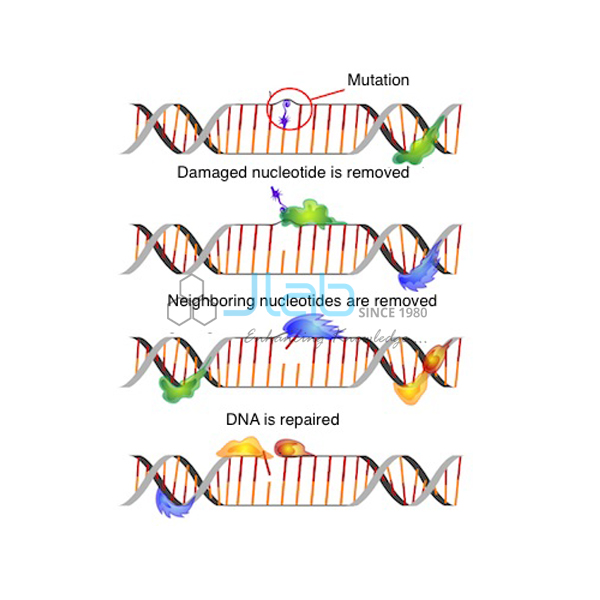
DNA Repair Mechanism Model (code EL-BE-6100) is a molecular biology teaching model on the ways cells detect and mend damage to their DNA before it becomes a permanent mutation. It is intended for college molecular biology, genetics and biotechnology courses, and as extension material when class 12 students study mutation. It is made by Jain Laboratory Instruments Pvt Ltd (JLab) at its works in Ambala, India.
Specifications
| Parameter | Detail |
|---|---|
| Subject | DNA repair mechanisms, as named in the listing |
| Quality check | Each model is visually inspected before dispatch |
| Pack quantity | Each (sold individually) |
| Minimum order quantity | 10 units |
| Dispatch time | Usually 7–10 working days |
| Product code | EL-BE-6100 |
| Manufacturer | Jain Laboratory Instruments Pvt Ltd (JLab) — OEM |
| Country of origin | India (made in Ambala, Haryana) |
What Is the DNA Repair Mechanism Model Used For?
DNA is damaged constantly. Ultraviolet light can join neighbouring pyrimidine bases into thymine dimers, chemicals and ionising radiation alter or break the strands, bases are lost or changed spontaneously, and DNA polymerase occasionally inserts the wrong nucleotide. Cells answer with several repair systems. The polymerase proofreads as it copies, and mismatch repair then fixes errors it missed, using the older parental strand as the guide. In base excision repair an enzyme called a glycosylase removes a single damaged base, the gap is refilled by DNA polymerase and sealed by DNA ligase. Nucleotide excision repair cuts out a short stretch of strand around bulky damage such as a thymine dimer and rebuilds it from the intact partner strand.
Breaks across both strands are mended either by homologous recombination, which copies the missing information from a matching DNA molecule, or by joining the broken ends directly. Some organisms can also reverse ultraviolet damage in one step with a light-activated enzyme, photolyase. A model gives students a clear sequence — recognise, remove, replace, seal — to compare the pathways.
Frequently Asked Questions
Which repair pathways does the model show?
That is not specified in the listing, and nor are the size or material. Ask JLab for a description and photograph so you can check it covers the pathways in your syllabus.
Why does a cell need more than one repair system?
Different damage needs different tools: a single altered base, a bulky distortion, a mismatched pair and a broken double strand are each recognised and fixed by a separate set of enzymes.
OEM Manufacturer
JLab is the trading name of Jain Laboratory Instruments Pvt Ltd, a laboratory and teaching-model manufacturer in India, incorporated in 2017 and based on Hargolal Road, Ambala, Haryana. The model is made at its own works, not sourced from a trader, so schools, colleges, dealers and importers buy direct from the maker. JLab holds MSME Udyam registration UDYAM-HR-01-0003849 as a manufacturing enterprise and Importer-Exporter Code 3317504552. JLab exports worldwide and ships to buyers in every region — for example the USA in North America, Georgia in Eastern Europe, Vietnam in Southeast Asia, Guatemala in Central America and the Caribbean, and Chad in Central Africa.
Related DNA Models
- DNA Replication Model — the copying process in which many errors arise.
- Telomerases Model — how chromosome ends are maintained.
- Inhibitors of DNA Replication Apoptosis Model — what follows when replication is blocked.
- DNA Structure Model — an easy-to-assemble double helix of coloured plastic pieces.
More teaching models are in Biology Equipment and across the Biology Lab Equipment range.
Request a Quote
For a quotation from the manufacturer, use Add To Cart or the contact page and include the quantity (minimum 10 units) and delivery destination.
Last updated: 4 October 2026