

Rammer Manufacturer,Supplier and Exporter in India
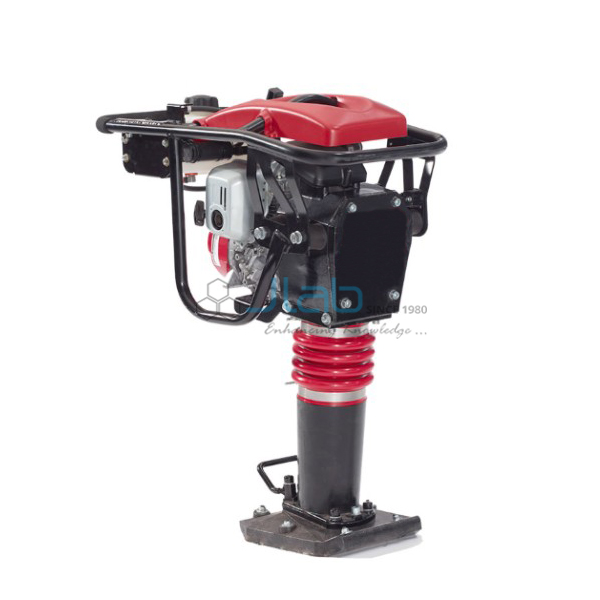
Product Code : EL-WT-8787
Jlab Export is a leading Rammer Manufacturer,and suppliers in India
A tamping rammer compacts soil by driving its shoe down onto the ground in rapid blows while the operator steers it forward. This one has a 10 x 13 in (25 x 33 cm) shoe of high impact poly with a steel reinforced base plate. It moves at up to 70 ft/min. Rubber shock mounts cushion the vibration that reaches the wrap-around handle.
Specifications
| Machine type | Engine-driven tamping rammer |
| Plate size | 10 x 13 in (25 x 33 cm) |
| Travel speed | Up to 70 ft/min |
| Shoe | High impact poly shoe with steel reinforced base plate |
| Handle | Wrap-around handle on heavy-duty rubber shock mounts |
| Engine guard | Side shields |
| Fuel tank | See-through polyethene |
| Minimum order quantity | 1 unit |
| Dispatch time | Usually 14–18 working days |
| Manufacturer | JLab (Jain Laboratory Instruments Pvt Ltd), Ambala, India |
Compaction Exercises for Civil Engineering Students
Students first find the maximum dry density and optimum moisture content of a soil in the lab with the Compaction Mould. In a test pit or trench they then place the same soil in thin layers and compact each layer with the rammer, counting the passes.
After each set of passes, they measure the field dry density with the Sand Replacement Equipment or drive the Core Cutter into a fine-grained layer. Field density divided by the lab maximum gives the relative compaction, and a plot against passes shows when more ramming stops adding density.
Frequently Asked Questions
When should I use a rammer instead of a plate compactor?
A rammer delivers heavy blows through a small shoe, which suits cohesive soils such as clay and silt and narrow trenches. A vibrating plate covers a wider area and works well on sand and gravel. Around pipes and footings, the narrow rammer shoe fits where a plate cannot.
How thick should each layer of fill be?
Keep layers thin, because a rammer compacts the upper part of the fill most and loses effect with depth. Spread the soil, ram it with overlapping passes, then add the next layer. A field density test on the first layers shows whether the thickness and number of passes are right.
How fast does the rammer move?
It travels at up to 70 ft/min as it hops forward under its own blows. The operator guides the handle and lets the machine set the pace instead of pushing it. Walking it more slowly over the same strip puts more blows into each part of the layer.
How do I check the fuel before starting?
The polyethene fuel tank is see-through, so the level can be read at a glance without opening the cap. Fill it on level ground before work, wipe off any spilt fuel and keep the side shields in place around the engine.
Other Earthwork and Soil Testing Equipment
- Sand Pouring Cylinder (field density of fine and medium soils)
- Drying Oven (drying soil samples for moisture content)
- Site Dumper (articulated dumper for moving fill)
For a quote, use Add To Cart or send us a message through the contact page.
Last updated: 6 November 2026
