Uniport, Symport and Antiport Model Manufacturer,Supplier and Exporter in India
Product Code : EL-BE-5888
Jlab Export is a leading Uniport, Symport and Antiport Model Manufacturer,and suppliers in India
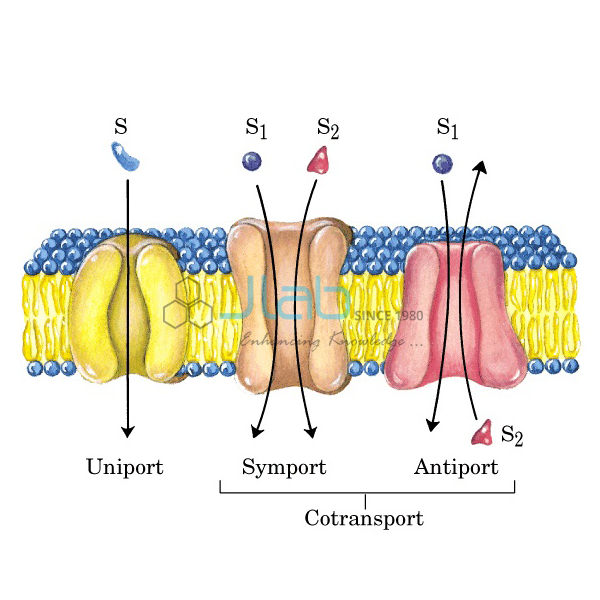
Uniport, symport and antiport are the three ways a carrier protein moves solutes across a cell membrane. A uniporter carries one solute, a symporter moves two in the same direction, and an antiporter moves two in opposite directions. This teaching model is used in biology lessons to show students how the three modes differ.
Specifications
| Type | Didactic (teaching) model |
| Topic | Carrier transport across a membrane: uniport, symport and antiport |
| Used in | Biology, physiology and biochemistry lessons |
| Minimum order quantity | 10 units |
| Dispatch time | Usually 4–6 working days |
| Manufacturer | JLab (Jain Laboratory Instruments Pvt Ltd), Ambala, India |
Membrane Transport Lessons and Experiments
Teachers often begin with the Cell Membrane Transport Model for the wider topic of how substances cross the membrane, then use this model to focus on carrier proteins. Students label which solute moves, in which direction, and whether a gradient or a pump supplies the energy.
A simple practical sets the model in context. Students tie off a length of Dialysis Membrane Tubing, fill it with a starch and glucose solution and stand it in water. After a while the water tests positive for glucose but not for starch. This shows diffusion through a partially permeable membrane with no carrier at all.
Frequently Asked Questions
Which courses and class levels is it suited to?
It suits senior school biology where membrane transport is taught, and college courses in cell biology, physiology, biochemistry, nursing and pharmacy. Younger classes usually need only a general cell membrane model.
How should the model be stored between terms?
Store it covered in a dry cupboard away from heat and direct sun. Lift it with both hands rather than by any raised part, and clean it with a slightly damp cloth only.
Do symporters and antiporters use ATP directly?
Usually not. Most are driven by a gradient of sodium or hydrogen ions that an ATP-powered pump has already built up. This is secondary active transport, in which one solute moves uphill while the other runs downhill.
Can a uniporter carry a solute against its concentration gradient?
No. A uniporter on its own only speeds up movement down the gradient, which is facilitated diffusion. To move a solute uphill, a carrier needs an energy source. A pump uses ATP, while a symporter or antiporter uses the gradient of a second solute.
What are common examples of each mode?
The glucose carrier of red blood cells is a uniporter. Cells lining the small intestine take in glucose together with sodium through a symporter. The sodium-calcium exchanger of heart muscle cells is an antiporter, moving calcium out as sodium comes in.
Other Cell Membrane Models
For a quote, use Add To Cart or send us a message through the contact page.
Last updated: 19 November 2026