Abbe Refractometer (Horizontal Loading) Manufacturer,Supplier and Exporter in India
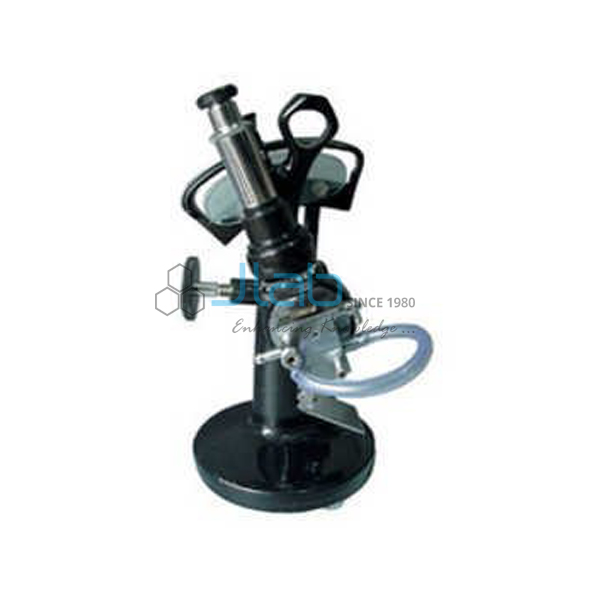
Product Code : EL-GLE-4006
Jlab Export is a leading Abbe Refractometer (Horizontal Loading) Manufacturer,and suppliers in India
An Abbe refractometer reads refractive index from the critical angle at a pair of prisms, with the sample spread as a thin film between them. This one covers 1.3 to 1.7, read to 0.001 on the scale and 0.0001 by estimation. It also reads sugar from 0 to 95 % and measures dispersion, and the prism loads horizontally.
Specifications
| Refractive index range | 1.3 to 1.7 |
| Refractive index reading | 0.001 direct on scale, 0.0001 by estimation |
| Sugar range | 0 to 95 % |
| Sugar reading | 1 % on scale, 0.1 by estimation |
| Features | Measures dispersion, horizontal loading of prism, convenient reading angles |
| Supplied with | Test piece, contact liquid and thermometer, in a wooden cabinet |
| Minimum order quantity | 1 unit |
| Dispatch time | Usually 7–10 working days |
| Manufacturer | JLab (Jain Laboratory Instruments Pvt Ltd), Ambala, India |
Physical Chemistry Practicals
A standard exercise finds the strength of an unknown sugar solution. Students first prepare sucrose standards of known strength, weighing each portion on an Analytical Balance and making it up to the mark in a Volumetric Flask (Polypropylene). The refractive index of every standard is then read at the same temperature. A graph of index against concentration then gives the unknown.
Other practicals find the specific and molar refraction of pure liquids from refractive index and density, or follow the make-up of a two-liquid mixture. Teachers can link the work to optical rotation by reading the same sugar solutions on the Research Polarimeter.
Frequently Asked Questions
How do I check the zero before measuring?
Use the test piece supplied. Put a drop of the contact liquid on the prism, press the test piece onto it and read the scale. If the reading differs from the value marked on the test piece, adjust the instrument or correct later readings. Distilled water is a second check.
Why is the light and dark boundary not sharp?
Too little sample, a dirty prism or coloured fringes are the usual causes. Spread enough liquid to fill the gap between the prisms, clean both faces, and turn the dispersion compensator until the coloured band disappears and the edge is crisp.
Why do my readings vary from one run to the next?
Refractive index changes with temperature, so note the thermometer reading every time and keep the prisms at a steady temperature. Air bubbles, evaporation of a volatile sample and setting the boundary off the crosshairs also scatter readings. Take three readings and average them.
Which scale should I read?
The instrument has two scales. Read the refractive index scale for liquids in general, and the sugar scale only when you want the sugar percentage of a solution. Reading the wrong scale is a common student mistake.
How is the dispersion measured?
Once the boundary is sharp and free of colour, read the number on the compensator drum. Together with the refractive index, that number gives the mean dispersion of the liquid from standard dispersion tables.
Other Refractometers and Optical Instruments
- Butyro Refractometer (Double Scale) (oil and fat scale)
- Student Polarimeter
- Hand Held Refractometer
For a quote, use Add To Cart or send us a message through the contact page.
Last updated: 12 November 2026