Die Stock Manufacturer,Supplier and Exporter in India
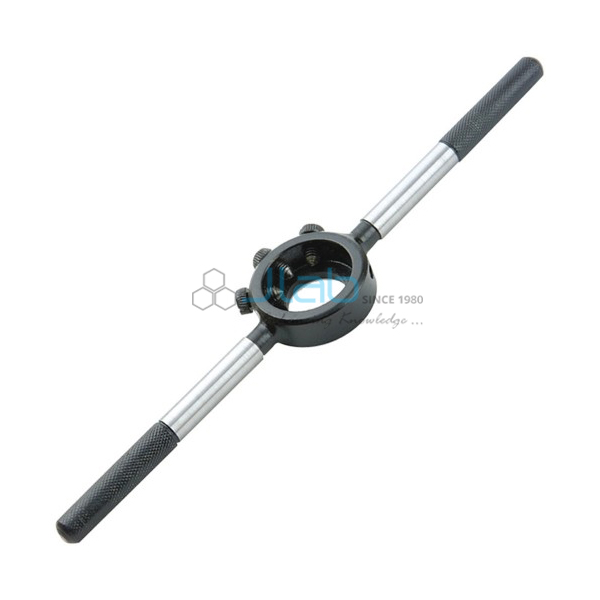
Product Code : EL-PWI-8818
Jlab Export is a leading Die Stock Manufacturer,and suppliers in India
A die stock holds a threading die and turns it round a rod, bolt blank or pipe end to cut an external thread. Its body keeps the die square to the work, so the thread comes out even along its length. It is turned by hand with its handles and is the basic threading tool of the fitting bench.
Specifications
| Use | Holding and turning a die to cut external threads |
| Work threaded | Screws, bolts and pipes |
| Function | Keeps the cutting die aligned for uniform threads |
| Minimum order quantity | 10 units |
| Dispatch time | Usually 4–6 working days |
| Manufacturer | JLab (Jain Laboratory Instruments Pvt Ltd), Ambala, India |
Threading Practicals for Fitter and Plumber Trainees
Fitter trainees grip a mild steel rod in a Bench Vice and chamfer its end with a Flat File. Then they cut a thread with a die held in the die stock and test it by running a matching nut along it. Plumber trainees do the same on a pipe end clamped in a Pipe Vice, using a pipe die.
Teachers use the exercise to show the rhythm of hand threading: half a turn forward, then a short turn back to break the chip. They also show why cutting oil is brushed on, and how a die started at an angle gives a drunken thread that will not take a fitting.
Frequently Asked Questions
How do the screws in a die stock adjust a split die?
Round split dies are usually held by three screws in the stock. Tightening the centre screw into the split opens the die a little for a light first cut. The two side screws then close it to the finished size for the last pass.
How do I start a thread square?
Chamfer the end of the rod or pipe so the die can bite. Put the die stock on with the tapered side of the die toward the work. Keep the handles level as you press and turn for the first few turns.
Why turn back after each half turn?
Turning back a little breaks the chip so it falls out of the die instead of packing the flutes. Packed chips tear the thread and can chip the cutting edges of the die.
What causes a rough or crooked thread?
A blunt die, a dry cut or a rod that is too thick leaves a rough, torn thread. A die started at an angle cuts a crooked thread that will not take a nut or fitting. Check the rod size first and brush on cutting oil as you go.
Other Threading Tools and Sets
For a quote, use Add To Cart or send us a message through the contact page.
Last updated: 6 November 2026