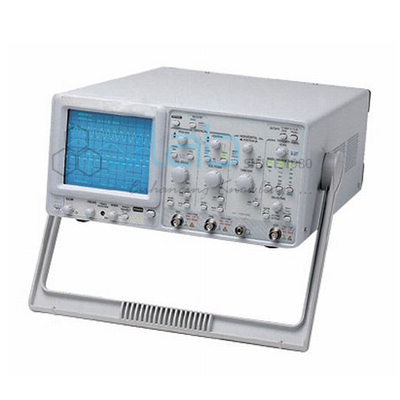
Half Wave, Full Wave and Bridge Rectifier Apparatus Manufacturer,Supplier and Exporter in India

Product Code : EL-DSO-10330
Jlab Export is a leading Half Wave, Full Wave and Bridge Rectifier Apparatus Manufacturer,and suppliers in India
Half Wave, Full Wave and Bridge Rectifier Apparatus (code EL-DSO-10330) is a rectifier circuit kit for building half-wave, full-wave and bridge rectifiers on one aluminium panel and studying how filter circuits change the DC output at different loads. It is made by Jain Laboratory Instruments Pvt Ltd (JLab) at its works in Ambala, India.
Specifications
| Parameter | Detail |
|---|---|
| Experiments | Half-wave, full-wave and bridge rectifiers, each with the effect of filter circuits at different loads |
| Power supply | Inbuilt AC supply, 8-0-8 V AC |
| Meters | On-board analog moving-coil meters (60 mm x 35 mm) — voltmeter 0–15 V DC; ammeter 0–250 mA DC |
| Diodes | 4 nos. |
| Filters | 2 nos. |
| Load resistances | 50 Ω to 500 Ω |
| Front panel | Aluminium, 270 mm x 170 mm, with printed circuit diagram; all important test points brought out on the front |
| Cabinet | Lightweight shock-proof plastic |
| Power requirement | 230 V AC ±10%, 50 Hz |
| Weight | 1.8 kg approx. |
| Dimensions | 300 mm (L) x 175 mm (B) x 75 mm (H) |
| Standard accessories | Power cord, patch cords, instruction manual |
| Quality check | Each apparatus is visually inspected before dispatch |
| Pack quantity | Each (sold individually) |
| Minimum order quantity | 10 units |
| Dispatch time | Usually 7–10 working days |
| Product code | EL-DSO-10330 |
| Manufacturer | Jain Laboratory Instruments Pvt Ltd (JLab) — OEM |
| Country of origin | India (made in Ambala, Haryana) |
How Does It Compare with Other JLab Rectifier Trainers?
| Model | Rectifier circuits | Filters and loads | Supply, meters and other details |
|---|---|---|---|
| This apparatus (EL-DSO-10330) | Half-wave, full-wave and bridge | Two filters; load resistances 50–500 Ω | 8-0-8 V AC supply; analog moving-coil voltmeter and ammeter |
| Half Wave, Full Wave and Rectifier Apparatus (toggle-switched loads) | Half-wave, full-wave and bridge; efficiency and ripple factor on load | Filter circuit kit; load resistances selected with toggle switches | Built-in AC supply; two meters for output voltage and current |
| Junction Diode Rectifier and Filter | Half-wave, full-wave centre-tap, bridge and voltage doubler | Capacitor, inductor, L-section and π-section filters with different resistive loads | Centre-tapped mains transformer; digital DC voltmeter and current meter |
| Experimentation With Rectifiers | Half-wave, full-wave centre-tapped and bridge | Transformer, rectifier and filter sections linked by patch cords | Test points in different power-supply sections |
Choose this apparatus when you want the three standard rectifier circuits, analog moving-coil meters and a 50–500 Ω load range in one cabinet. If you prefer digital meters, the Junction Diode Rectifier and Filter board has a digital DC voltmeter and current meter.
What Is the Rectifier Apparatus Used For?
A rectifier turns AC into pulsating DC. The half-wave circuit uses one diode and passes only one half-cycle; the full-wave circuit uses two diodes on a centre-tapped winding such as the 8-0-8 V supply; and the bridge uses four diodes across the whole winding, so both full-wave circuits deliver output on every half-cycle. A filter smooths the ripple, and the DC voltmeter and ammeter show how the output voltage changes as the load draws more current. The experiment is part of semiconductor electronics in class 12 physics and of basic electronics practicals in diploma and engineering courses.
What to Specify When Ordering
- Model — this apparatus or one of the rectifier trainers compared above.
- Quantity — the number of units for your benches.
- Bench instruments — oscilloscopes and other instruments are separate catalogue items and can be added to the same enquiry.
Frequently Asked Questions
What supply and meters are built in?
An 8-0-8 V AC supply, and analog moving-coil meters measuring 60 x 35 mm: a 0–15 V DC voltmeter and a 0–250 mA DC ammeter.
Which components are provided on the panel?
Four diodes, two filters and load resistances from 50 to 500 ohms; the circuit diagram is printed on the panel.
What comes with the apparatus?
A power cord, patch cords and an instruction manual. An oscilloscope is not among the standard accessories; JLab lists oscilloscopes as separate items.
What mains supply and bench space does it need?
It runs on 230 V AC ±10% at 50 Hz, measures 300 x 175 x 75 mm and weighs about 1.8 kg.
What should an export enquiry include?
The quantity, destination country and port or city, delivery terms such as FOB or CIF, any packing or labelling needs, and the tender reference where there is one.
Who manufactures this rectifier apparatus?
JLab (Jain Laboratory Instruments Pvt Ltd) builds it at its works in Ambala, Haryana, and supplies it direct.
OEM Manufacturer
JLab is the trading name of Jain Laboratory Instruments Pvt Ltd, an electronics and physics lab equipment manufacturer in India, incorporated in 2017 and based on Hargolal Road, Ambala, Haryana. JLab makes this apparatus in its own works instead of sourcing it from a trader, so schools, colleges, dealers and importers buy direct from the maker. JLab exports worldwide and ships to buyers in every region — for example Eswatini in Southern Africa, Congo in Central Africa, Tanzania in East Africa, Singapore in Southeast Asia and Mexico in North America. Tender buyers can refer to the JLab lab tenders page.
Related Diode Trainers
- Training Board for Diode and Zener Diode — forward and reverse characteristics of a germanium diode and a Zener diode.
- Experimentation with Diodes — a stand-alone unit with built-in DC supply, voltmeter and ammeter for diode characteristics.
- Silicon Controlled Rectifier — gate firing and anode current characteristics of an SCR, the controlled form of rectifier.
Browse the Analog Electronics Trainer range, the Digital Storage Oscilloscopes range or all Electronics Lab Equipments.
Request a Quote
Send your enquiry with the Add To Cart button or the contact page, naming the model you want, how many units, and the delivery destination.
Last updated: 22 October 2026