
Phases of the Moon Chart Manufacturer,Supplier and Exporter in India
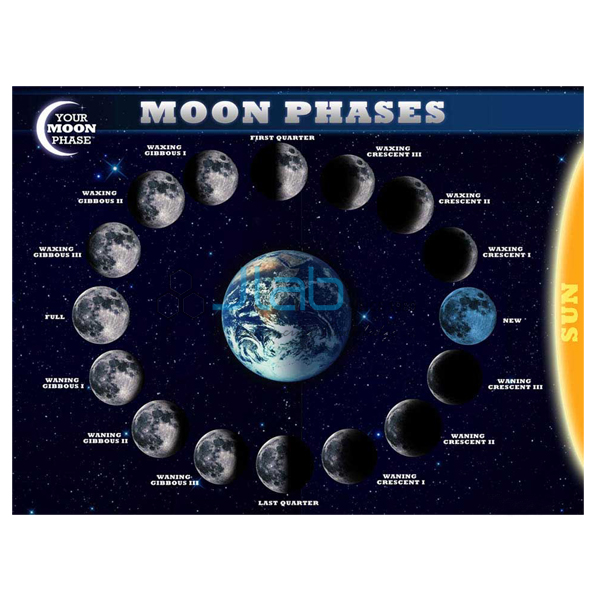
Product Code : EL-COG-3119
Jlab Export is a leading Phases of the Moon Chart Manufacturer,and suppliers in India
Phases of the Moon Chart (code EL-COG-3119) is a laminated 50 x 75 cm wall chart for teaching why the Moon seems to change shape over the month, from new moon to full moon and back, in school science and geography lessons. One chart carries both English and Hindi, so it serves English-medium and Hindi-medium classes alike. JLab (Jain Laboratory Instruments Pvt Ltd, Ambala, India) supplies it to schools, colleges and dealers.
Get a quote: use the Add To Cart enquiry button below, or send your quantity and destination through the contact page.
Specifications
| Parameter | Detail |
|---|---|
| Subject | Phases of the Moon |
| Size | 50 x 75 cm |
| Finish | Laminated |
| Language | English and Hindi combined on one chart |
| Panels | Not described in the listing; ask for a preview image |
| Quality check | Each chart is visually inspected before dispatch |
| Pack quantity | Each (sold individually) |
| Minimum order quantity | 10 units |
| Dispatch time | Usually 7–10 working days |
| Product code | EL-COG-3119 |
| Supplied by | Jain Laboratory Instruments Pvt Ltd (JLab), Ambala, India |
What Is the Phases of the Moon Chart Used For?
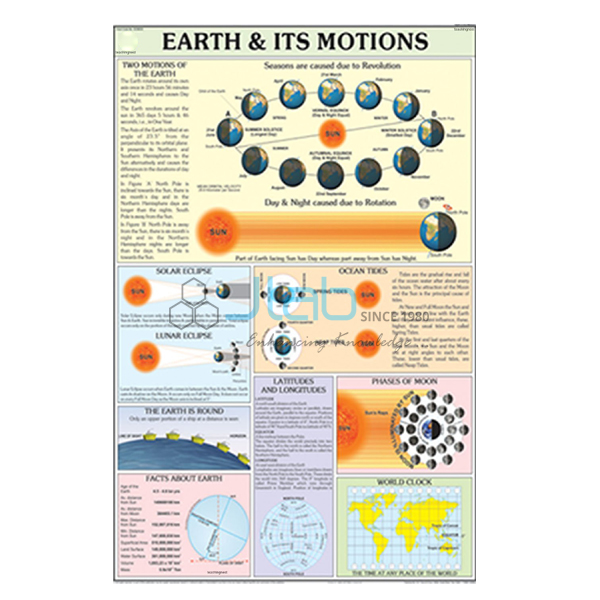
Children see the Moon change every night, and this chart helps explain why. The Moon gives no light of its own; it shines by reflecting sunlight, and one half of it is always lit. As it travels around the Earth we see different amounts of that lit half, which gives the sequence of phases: new moon, waxing crescent, first quarter, waxing gibbous, full moon, waning gibbous, last quarter and waning crescent, before the cycle starts again about a month later. A common misconception is that the Earth’s shadow causes the phases — it does not; the Earth’s shadow falling on the Moon is a lunar eclipse.
In Indian classrooms the chart links naturally to the calendar terms pupils already know: Amavasya is the new moon, Purnima the full moon, and Shukla Paksha and Krishna Paksha are the waxing and waning fortnights. The topic comes up in primary and middle-school science and geography and again with tides and eclipses. The laminated surface can be wiped with a damp cloth.
What to Specify When Ordering
- Quantity — minimum 10 units.
- Language — the chart is listed in English and Hindi combined; ask JLab before ordering if you need a different arrangement.
- Related titles — eclipse, tides and day and night charts, or a Sun–Earth–Moon model, for a complete unit.
Frequently Asked Questions
What size is the Phases of the Moon Chart?
50 x 75 cm, laminated.
Is it in English or Hindi?
Both: English and Hindi are combined on the same chart.
Does it show every phase?
The listing does not describe the panels. Ask JLab for a preview image to check which phases and labels appear.
What causes the phases of the Moon?
The changing angle between the Sun, the Earth and the Moon as the Moon orbits the Earth, which changes how much of the Moon’s sunlit half we can see. The Earth’s shadow is not involved.
What are the minimum order and dispatch time?
The minimum is 10 units, each chart sold individually. Orders are usually dispatched in 7–10 working days after a visual check; add transit time for export.
Who supplies this chart?
JLab, the trading name of Jain Laboratory Instruments Pvt Ltd, Ambala, Haryana, India, supplies it and quotes directly.
Supplier
JLab is the trading name of Jain Laboratory Instruments Pvt Ltd, incorporated in 2017 and based on Hargolal Road, Ambala, Haryana. Alongside the science and laboratory equipment in its own range, JLab supplies teaching charts such as this astronomy title, so schools can order charts and models together; each chart is visually inspected before it is packed. JLab exports worldwide and ships to buyers in every region — for example Moldova in Eastern Europe, Laos in Southeast Asia, Tajikistan in Central Asia, DR Congo in Central Africa and Australia in Oceania. Tender information is available on the JLab lab tenders page.
Sun, Earth and Moon Teaching Aids
- Solar and Lunar Eclipse Chart — how eclipses of the Sun and of the Moon happen.
- Tides Chart — the Moon’s effect on the rise and fall of the sea.
- Day and Night Chart — how the turning of the Earth gives day and night.
- Sun-Earth-Moon Model — a geared model for seasons, day and night, moon cycles and eclipses.
- Tellurium Earth Moon Sun Model — demonstrates the relative movements of the Sun, Earth and Moon.
See every title in Charts on Geography or browse all Charts.
Request a Quote
JLab quotes for this chart directly. Use the Add To Cart enquiry button or the contact page, and give the quantity (minimum 10 units) and the delivery destination.
Last updated: 4 October 2026