AC Servo Speed Torque Characteristic Trainer Manufacturer,Supplier and Exporter in India
Product Code : EL-DSO-10342
Jlab Export is a leading AC Servo Speed Torque Characteristic Trainer Manufacturer,and suppliers in India
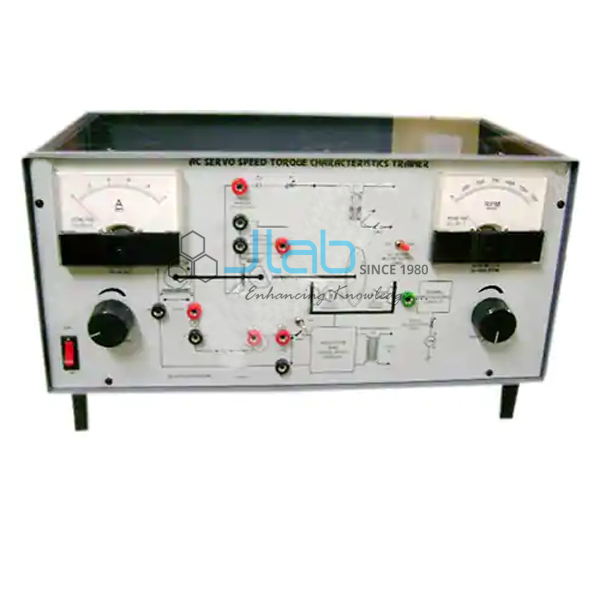
AC Servo Speed Torque Characteristic Trainer (code EL-DSO-10342) is a bench trainer for studying how the speed of a two-phase AC servo motor changes with the load on its shaft, used in control systems and electrical machines practicals. A control unit with an in-built AC supply drives a separate motor unit, whose shaft is coupled to a loading arrangement. It is made by Jain Laboratory Instruments Pvt Ltd (JLab) at its works in Ambala, India.
Specifications
| Parameter | Detail |
|---|---|
| Experiments | Speed–torque characteristics of the AC servo motor; speed variation and speed measurement; plotting speed against torque |
| Motor | AC servo motor with 2-phase windings and a shaft extended on both sides |
| Loading | Loading arrangement coupled to one end of the motor shaft |
| Speed sensing | 20-hole disc on the other shaft end, with a photoelectric pickup and phototransistor acting as an optocoupler across the disc |
| Motor supply | In-built fixed AC supply: approx. 100 V AC for the reference winding; 0–60 V AC for the control winding |
| Speed measurement | RPM meter on board |
| Load current measurement | Ammeter on board |
| Front panel | 400 mm x 225 mm, mounted on a lightweight shock-proof plastic cabinet; circuit diagram printed on the panel and all important test points brought out on the front |
| Control unit dimensions | 430 (L) x 230 (B) x 90 (H) mm |
| Power requirement | 220 V AC +10%, 50 Hz |
| Standard accessories | Motor unit, power cord, patch cords and instruction manual |
| Quality check | Each trainer is visually inspected before dispatch |
| Pack quantity | Each (sold individually) |
| Minimum order quantity | 10 units |
| Dispatch time | Usually 7–10 working days |
| Product code | EL-DSO-10342 |
| Manufacturer | Jain Laboratory Instruments Pvt Ltd (JLab) — OEM |
| Country of origin | India (made in Ambala, Haryana) |
What Is the AC Servo Speed Torque Trainer Used For?
An AC servo motor is a two-phase induction motor: one winding, the reference winding, is fed at a fixed voltage, while the voltage on the control winding sets how fast the rotor turns. Its speed–torque curve slopes downward — torque falls as speed rises — and that steady droop is what makes the motor stable in low-power control loops such as instrument drives and positioning systems.
The trainer turns that curve into a measured result. Its stated objectives are to study the speed–torque characteristics of the motor, to study speed variation and speed measurement, and to plot a graph of speed against torque, an experiment taught in the control systems labs of electrical, electronics and instrumentation engineering courses.
What to Specify When Ordering
- Number of trainers needed for the lab.
- Mains supply at your site — the control unit is built for 220 V AC, 50 Hz.
- Companion trainers — the position-control, DC servo and stepper motor trainers linked below are separate items.
Frequently Asked Questions
How is the motor speed measured on this trainer?
Speed is sensed optically. A 20-hole disc on one end of the shaft turns between a photoelectric pickup and a phototransistor that act as an optocoupler, and the control unit carries an RPM meter for reading the speed.
What is supplied with the trainer?
The standard accessories are the motor unit, a power cord, patch cords and an instruction manual, together with the control unit itself.
Can students follow the circuit while they work?
Yes. The circuit diagram is printed on the 400 x 225 mm front panel and all the important test points are brought out on the front, so readings can be taken without opening the cabinet.
How does it differ from the AC Position Control System Trainer?
This trainer is for speed and torque tests on the servo motor. The AC Position Control System Trainer is for position control: its AC servo motor drives a gear train with a servo potentiometer for position sensing, and a null meter measures the angle.
What information is needed for an export quotation?
Send the number of trainers, the destination country and port or city, the delivery terms you prefer (for example FOB or CIF), any packing or labelling instructions and, for a tender, its reference number.
Who manufactures this trainer?
JLab — Jain Laboratory Instruments Pvt Ltd — builds it at its own works in Ambala, Haryana, and quotes for it as the manufacturer.
OEM Manufacturer
JLab is the trading name of Jain Laboratory Instruments Pvt Ltd, a maker of electronic lab instruments and training equipment in India, incorporated in 2017 and based on Hargolal Road, Ambala, Haryana. This servo trainer is built at JLab’s own works rather than bought from a trader, so engineering colleges, polytechnics, dealers and importers order it factory-direct, every unit is visually inspected before it is packed, and repeat orders are handled by the maker. JLab exports worldwide and ships to buyers in every region — for example Chad in Central Africa, Finland in Northern Europe, Afghanistan in South Asia, Japan in East Asia and Saudi Arabia in the Middle East. For institutional purchases, see the JLab lab tenders page.
Related Control and Motor Trainers
- AC Position Control System Trainer — a 2-phase AC servo motor with gear train and servo potentiometer for position sensing.
- DC Position Servo Mechanism Trainer — a DC servo motor with a tacho generator on one shaft end and a loading arrangement with potentiometer on the other.
- Stepper Motor Controller Trainer — stepper motor speed control by digital logic circuits or an 8-bit microprocessor.
- Universal Motor Speed Control — SCR and TRIAC speed control of a universal motor.
Motor speed-control boards are also listed in the Power Electronics Trainers range, and the full Electronics Lab Equipments section covers the rest of the electronics lab.
Request a Quote
Press Add To Cart to start an enquiry, or write through the contact page with the number of trainers, the delivery city and country, and any companion trainers you want quoted on the same enquiry.
Last updated: 22 October 2026