Leptospira Species Summary Model Manufacturer,Supplier and Exporter in India
Product Code : EL-BE-6203
Jlab Export is a leading Leptospira Species Summary Model Manufacturer,and suppliers in India
Leptospira Species Summary Model (code EL-BE-6203) is a microbiology teaching model that summarises the genus Leptospira — thin, tightly coiled spirochaetes — and leptospirosis, the disease its pathogenic species cause in people and animals. It suits college, medical, nursing, veterinary and public-health courses. Jain Laboratory Instruments Pvt Ltd (JLab) makes it at its works in Ambala, India.
Specifications
| Parameter | Detail |
|---|---|
| Topic | Leptospira species and a summary of leptospirosis |
| Intended courses | Undergraduate microbiology, medical, nursing, veterinary and public-health teaching |
| Parts, labels, size and material | Not described in this listing — ask for a description and photo with your quote |
| Quality check | Each model is visually inspected before dispatch |
| Pack quantity | Each (sold individually) |
| Minimum order quantity | 10 units |
| Dispatch time | Usually 7–10 working days |
| Product code | EL-BE-6203 |
| Manufacturer | Jain Laboratory Instruments Pvt Ltd (JLab) — OEM |
| Country of origin | India (made in Ambala, Haryana) |
What Is the Leptospira Model Used For?
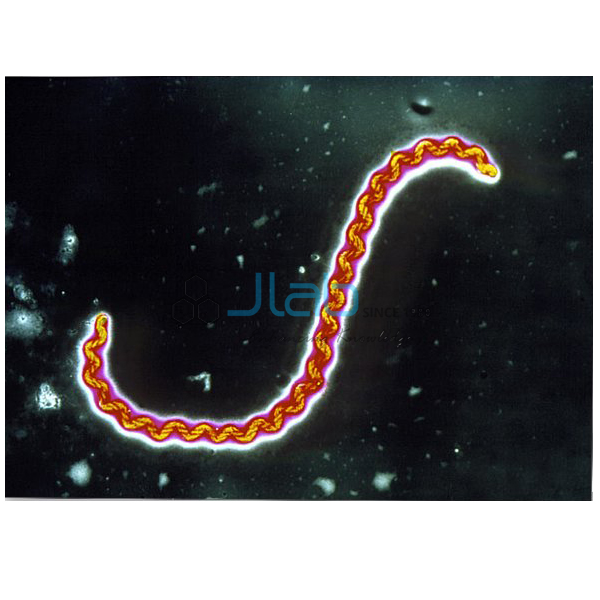
Leptospires are so thin that they are usually viewed by dark-ground microscopy rather than in ordinary stained smears. They have hooked ends, like a question mark, and move by internal flagella that run along the cell beneath its outer layer. The genus includes pathogenic species such as Leptospira interrogans and harmless free-living species such as Leptospira biflexa, found in fresh water.
Rats, dogs, cattle, pigs and other animals carry pathogenic leptospires in their kidneys and pass them in urine. People are infected when contaminated water or soil touches cuts or the lining of the eyes, nose or mouth, so the disease is common after floods and among farm workers, sewer workers and anyone wading through water. Leptospirosis often starts suddenly with fever, headache, muscle pain (especially in the calves) and red eyes; most cases are mild, but the severe form, Weil’s disease, brings jaundice, kidney failure and bleeding. Laboratory diagnosis relies mainly on blood tests such as the microscopic agglutination test, with culture in special media such as EMJH.
Frequently Asked Questions
What does the model summarise?
The Leptospira species and the disease they cause, as the title states. Its parts and labels are not listed, so ask JLab for a description and photo before ordering.
How is leptospirosis prevented?
By avoiding contact with water or soil that may carry animal urine, wearing boots and gloves in high-risk work, controlling rats, and vaccinating animals such as dogs and cattle.
Who manufactures the Leptospira model?
JLab — Jain Laboratory Instruments Pvt Ltd — at its own works in Ambala, Haryana.
OEM Manufacturer
JLab is the trading name of Jain Laboratory Instruments Pvt Ltd, a biology lab equipment and teaching-model manufacturer in India, incorporated in 2017 and based on Hargolal Road, Ambala, Haryana. Because the model is made at JLab’s own works rather than bought from a trader, colleges, dealers and importers deal directly with the manufacturer. JLab exports worldwide and ships to buyers in every region — for example Bhutan in South Asia, Taiwan in East Asia, Benin in West Africa, the UK in Western Europe and Portugal in Southern Europe.
Related Microbiology Models
- Clinical Stages of Untreated Syphilis Model — syphilis, caused by another spirochaete.
- Francisella Species and Summary Model — tularaemia, another infection caught from animals and water.
- Epidemiology and Pathogenesis of Plague Model — plague, a disease that also starts in rodents.
- Bacterial Families Model — the wider classification of bacteria.
See more models in Biology Equipment within JLab’s Biology Lab Equipment range.
Request a Quote
For a manufacturer’s quote, send the quantity (minimum 10 units) and the destination through Add To Cart or the contact page.
Last updated: 4 October 2026